


Stage set for famous love story









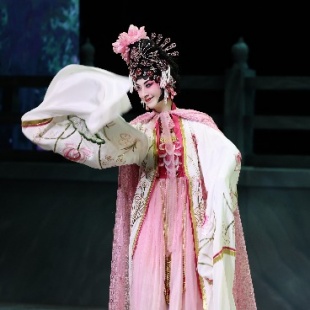
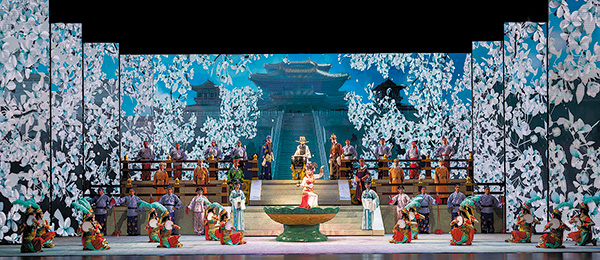
Peking Opera actress Shi Yihong brought the legendary royal concubine Yang Yuhuan of the Tang Dynasty (618-907) to life in the capital, with Peking Opera production, The Royal Consort of Tang, running at the National Centre for the Performing Arts from Wednesday to Sunday.
Yang is known as one of the four beauties of ancient China. Her tragic love story with Emperor Li Longji has been portrayed in various art forms, and still intrigues audiences today.
In 1925, Peking Opera master Mei Lanfang (1894-1961) premiered his original work, Taizhen Waizhuan, or The Anecdotes of Taizhen, which was inspired by The Song of Everlasting Sorrow, a narrative poem in which the Tang Dynasty poet Bai Juyi portrayed the love affair between Yang and Li.
Yang is also named Taizhen. Mei told the romantic and tragic story of Yang and the emperor through Peking Opera, also known as jingju, a 200-year-old art form that combines singing, dancing and acrobatics.
Mei was a famous nandan (a man playing a female role) — a Peking Opera practice forged at a time when women were forbidden to take to the stage — who played the leading role of Yang in the show. With original songs and choreography, the show, the performance of which lasted for four nights, was a great success.
In 2001, Mei's son, Mei Baojiu (1934-2016), revived and restaged his father's classic work, Taizhen Waizhuan, by narrowing the four-night-long show into a one-night performance. Mei Baojiu, who was also a renowned nandan artist, along with two young Peking Opera actresses — Li Shengsu, who was trained by Mei Baojiu, and Shi, then a rising Peking Opera star in Shanghai — performed the leading role, Yang, in the new version, which was titled The Royal Consort of Tang.
By keeping the most popular songs and emphasizing the love story between Yang and the emperor, Mei Baojiu also invited Peking Opera songwriters to add new music pieces to the production, including a song called Li Hua Song, or Ode to Pear Flowers, which became the show's theme song. The song is widely credited with attracting a new audience to Peking Opera thanks to its catchy melody and poetic lyrics.
"Taizhen Waizhuan was one of Mei Lanfang's most celebrated works and was one of Mei Baojiu's favorite works of his father. When he decided to restage it in 2001, Mei Baojiu wanted it to be loyal to his father's original version, while adding contemporary elements to appeal to the audience," says Shi.
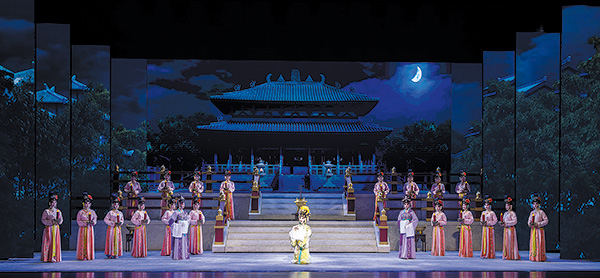
In 2008, Shi played Yang in The Royal Consort of Tang along with Mei Baojiu at the National Centre for the Performing Arts, one year after the venue opened to the public.
"When I met Mei Baojiu in March 2016, he told me that he wanted to stage the production again. Unfortunately, he passed away in April that year," says Shi.
In 2019, Shanghai Peking Opera Company restaged the show with Shi playing the leading role of Yang and Peking Opera actor Li Jun playing the emperor. It was staged for five shows, which all sold out.
"We planned to bring the production to Beijing, but the plan was postponed over and over again due to the coronavirus pandemic," adds Shi.
In the latest rendition, the creative team has added more elements, such as symphonic music, multimedia technology and a new stage design. Like Mei Baojiu, Shi says that the team tries to stay loyal to Mei Lanfang's version.
One of the highlights of the production is that Shi brought the "jade-plate dancing" — a scene Mei Lanfang performed in Taizhen Waizhuan — to the stage again. According to Shi, there are no videos of the "jade-plate dancing", but only an old photo, which shows Mei Lanfang posing with the skill of woyu — crossing his legs and sitting down gracefully — on a jade plate.
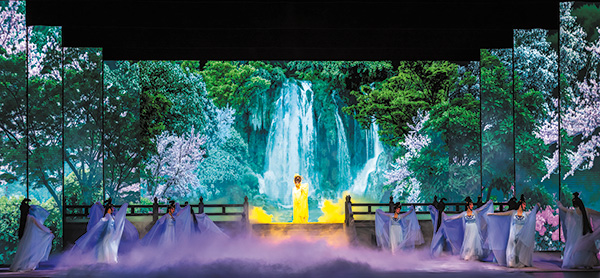
"There was an audience surrounding him in that photo, which is just like today's immersive theater. He had always been a pioneer in his own art. When we revived the dance scene, we had a much bigger plate and choreographed new movements," says Shi.
She adds that renowned choreographer Huang Doudou is among the creative team, making the show contemporary and appealing to the audiences, especially the younger generation.
"I've been practicing very hard. I really admire Mei Lanfang because his productions all featured beautiful and creative dance moves. He was a great artist at showcasing the beauty of women," Shi says.
Martial arts have also been added during a scene with the character, when a general, named An Lushan, becomes a rebel occupying the imperial city of Chang'an, today's Xi'an in Shaanxi province. The emperor, Li, is forced to flee to southern China. The troops who accompany Li and Yang mutiny, blaming the concubine for the troubles and asking the emperor to put Yang to death. Li refuses, but the troops will not back down and he has no choice but to comply. He admits that he has allowed himself to be seduced away from his duties and consents to Yang being strangled.
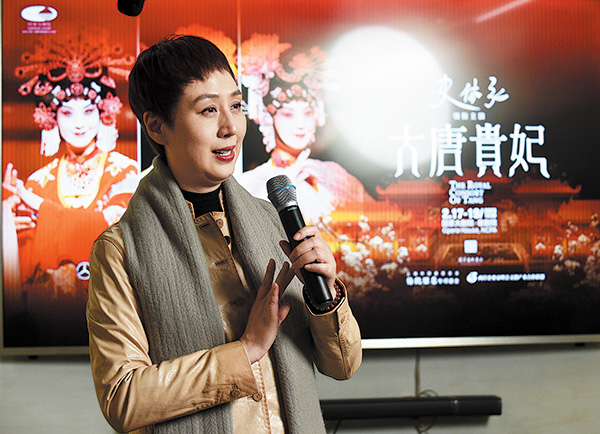
Shi, born in 1972, began her Peking Opera training as a wudan, or a female martial arts performer, at the age of 9. When she turned 15, Shi took up qingyi roles, which are young or middle-aged women characters that exude refinement and grace, and became a disciple of Mei Lanfang's Peking Opera style.
In 1990, Shi joined the Shanghai Jingju Theater Company. She is keen on reviving the old art form and trying to combine it with a diverse range of other art forms. In 1999, she collaborated with Oscar-winning composer Tan Dun, and presented a Peking Opera adaptation of Victor Hugo's classic novel Notre Dame. In 2017, she combined a Peking Opera classic, Farewell My Concubine, with chamber music in Shanghai. The production was staged at Princeton University and The Metropolitan Museum of Art in New York City that year.