


Ecomuseum guards ancient culture of Miao ethnic group









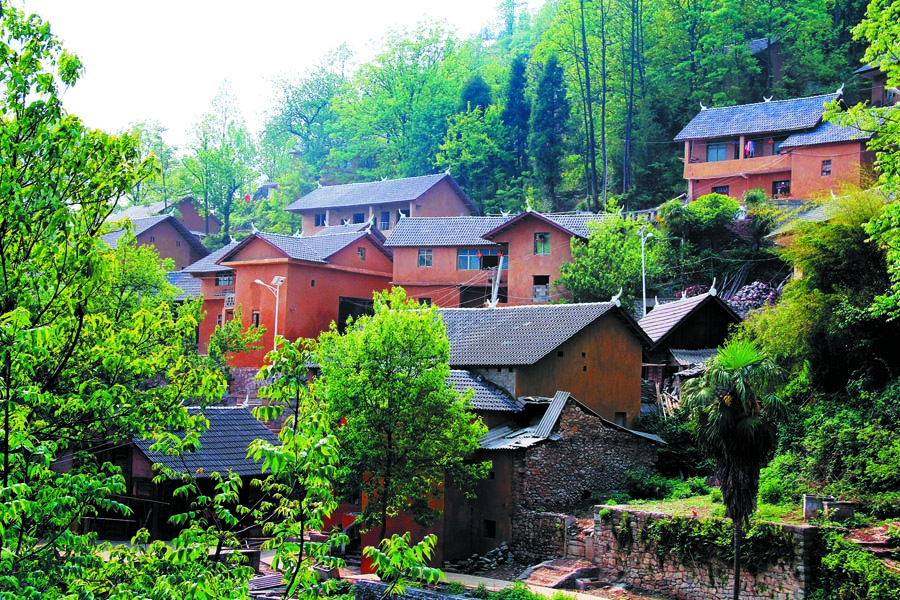
Every day early in the morning, Luo Gang, the curator of China's first ecomuseum in Southwestern Guizhou province, cleans up the courtyard to welcome visitors.
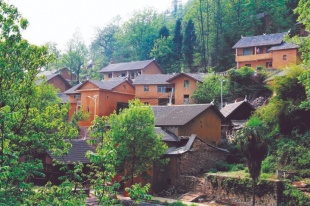
The ecomuseum nestles in the Liuzhi Special District mountains. It was built to protect the Qing Miao culture, an ancient and mysterious branch of the Miao ethnic group.
There were less than 5,000 Qing Miao people in remote high mountains from 1,400 to 2,200 meters above sea level in the Liuzhi Special District and Zhijin county when a research team organized by the Chinese Museums Association traveled to the area in early 1995.
The symbolized buffalo horn-shaped head ornament, traditionally used by women, also has the Qing Miao people known as "the longhorn Miao people."
The eye-catching head ornament is tied with horn-shaped wooden boards in hair, twined by linen and wool thread, or hair as long as three meters and weighing around two kilograms. The Qing Miao people wore this head ornament to scare off beasts while escaping wars and moved to forests in the early Qing Dynasty (1644-1911).
"Roads towards the villages were muddy, and dwellings were thatched-roof. Villagers there were afraid of strangers, and children ran away," recalled An Laishun, who was among the research team members, and now is the chairman of the regional alliance of Asia-Pacific countries of the International Council of Museums.
"Back then, the Qing Miao people still lived in a closed environment and had a self-sufficient natural economy, which was rare to see," An added.
The research team was invited by the provincial cultural department to build a new type of museum in the province. Finally, team members, including Chinese and Norwegian museum professionals, decided to set up the country's first ecomuseum in Suojia Miao, Yi, and Hui Township.
Sponsored by the Chinese and Norwegian governments, construction of the ecomuseum was launched in 1997. It opened to the public in October 1998.
The Suojia ecomuseum consists of a Qing Miao community and an information center. The community covers 12 villages distributed over more than 120 square kilometers. The information center is in Longjia Village. It holds all data and documentation of the culture, such as tape recordings of oral history, photographs, written sources, and specific, valuable objects.
The concept of the ecomuseum originated in France in the 1970s. Unlike traditional museums, which transfer cultural heritage to museum buildings, the ecomuseum protects and preserves cultural heritage in its original state in its community and environment. The community area is equivalent to the scope of the museum.
"Countries have been exploring new methods to protect traditional culture since the 1970s. And China adopted a brand new mode of ecomuseum at that time. The Suojia ecomuseum was the first of its kind across the country," An said.
Over the past two decades, experts and local people have helped protect the local ethnic culture by developing the ecomuseum.
The museum put the remote area on the map, closing the distance between villagers and the outside world.
Over 70,000 domestic and foreign tourists visit the ecomuseum annually, said Luo.
However, the outside world also brought challenges.
"Since the area has been isolated so long, its culture has been well preserved in its original state. However, as links between the area and the outside world have strengthened, the balance between modern life and traditional culture and living standards has been challenged," An said.
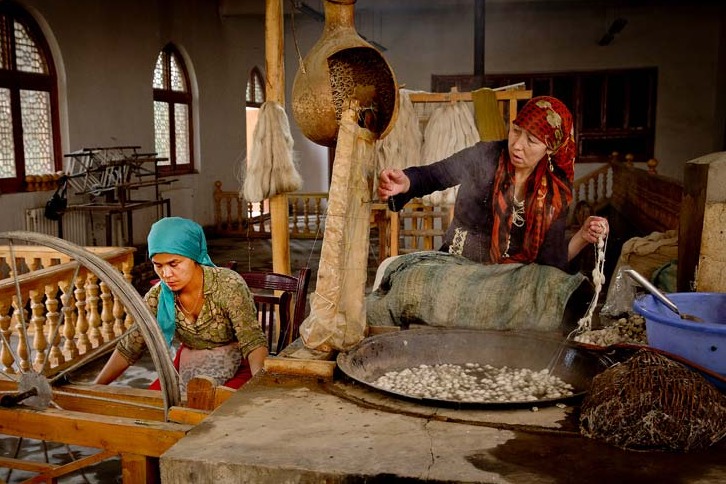
Around a decade ago, Luo found that fewer people could make traditional Qing Miao costumes as more young people left their hometowns to find jobs, and spinning and weaving machines at home were abandoned.
"We applied for funding from the local government to tailor 50 spinning and weaving machines and distributed them to villagers who know how to make traditional clothing for free. And we encourage them to pass on their weaving skills to young women," Luo said.
At present, about 200 villagers have a grasp of the skills. A Qing Miao clothing processing factory was even opened in Gaoxing Village, providing jobs, increasing income for villagers, and passing on the ethnic tradition.
The traditional thatched-roof wooden and mud dwellings were once in danger of disappearing as they could not meet the young people's pursuit of modern life. All new residential buildings are concrete brick structures.
Luo also applied for governmental funding to protect ten traditional dwellings in the community.
In the eyes of residents, the ecomuseum helps protect their traditional culture and also brings a better life for them. Villagers are looking forward to better roads and more tourists in the future.
"Mainstream museums in the cities reflect the elite culture, while museums in the countryside preserve the cultural heritage and lifestyle of ordinary people there. Combining cultural heritage protection with tourism and cultural and creative industries will be one of the focuses of the ecomuseum's future development," said Pan Shouyong, a professor of the Department of Archaeology and Museology at the School of Cultural Heritage and Information Management, Shanghai University.