A career that touches history, puts back the missing parts









When Zhou Yuqi, 24, a restorer of porcelain ware and pottery items, was working on a figurine last year, she was astounded to find a fingerprint after removing accumulated soil inside it. Judging from where the fingerprint was discovered, she guessed it belonged to the craftsman who made the figurine nearly 2,000 years ago.
"The fingerprint was in the internal part of the figurine, and could only be seen with a restorer's equipment. As a restorer, I regard myself as a craftswoman. The discovery made me feel like I was transcending time and space and communicating with my counterpart in the ancient time," says Zhou, who works at Chongqing China Three Gorges Museum.
That was just one of many shining moments for the young woman in her work. Although she has just started her career, she has made impressive progress.
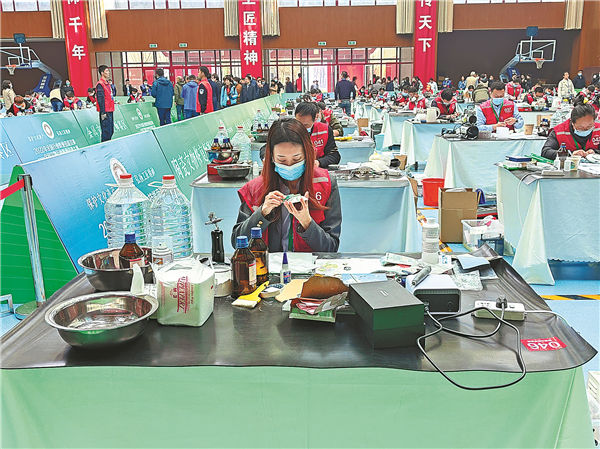
Zhou took part in the National Vocational Skills Competition on Cultural Relics, held in Taiyuan, Shanxi province, in March, which offered competitors real cultural relics to restore, and won third prize in the porcelain-restoring section, competing with many seniors who have been engaged with the cause for more than a decade.
Zhou drew an overglaze rose porcelain produced during the early 20th century, which is "relatively easy to restore" in her eyes. "I think I restored it well, and finished the work about one or two hours before the end of the competition. The final artifact looked good, and it was not easy to find traces of my repair," says Zhou.
Zhou became interested in pottery and porcelain at a young age, and that urged her to learn how to repair them at college. "The old artifacts at my grandparents' home always attracted me a lot. My parents fancy drinking tea, and they have collected some tea sets, which were appealing to me as well when I was a child," says Zhou.
"I also love visiting museums since childhood, and feel at ease there just like being at home. Every time I arrive in a city, I visit local museums first," she adds.
She chose to study the restoration of porcelain and pottery at the Shanghai Institute of Visual Arts, and has worked at Chongqing China Three Gorges Museum for three years, first as an intern and then an official restorer, becoming one of a few students of this major who chose to work as professional restorers after graduation from her university.
Restoring pottery and porcelain items involves complicated procedures. They first analyze the components of the item, form a plan, and then begin to work on it.
"Most of the artifacts were improperly restored before. We dismantle them first, cleaning up the glue. Then we join the pieces with our glue, which is much better than that used before. Later, we supplement the defective parts, polish the item to make it smooth, and finally complement patterns on it," says Zhou.
She enjoys the final procedure very much. "When other steps are finished, I add the patterns, then the whole item seems to regain its vitality in my hands. That's always impressive," says Zhou.
Restorers repair the items to different degrees based on their functions. For archaeological use, they just piece them together, add the missing parts to show the complete form; for displaying, they add colors so that exhibition visitors can glimpse the original look of the artifacts.
Since 2014, the craft of restoring ancient porcelain and pottery items has become a national-level intangible cultural heritage. According to Jiang Daoyin, an inheritor of this craft and a well-known expert in this area, mastering the craft is very difficult.
"The old porcelain and pottery items are always broken, and can split into a large number of pieces. It's very tiring for a restorer to accomplish all the procedures when restoring one artifact," says Jiang.
"Many people who learn the craft give up halfway since it's demanding. They must understand archaeology, chemistry and fine arts, and have the patience to work on the cultural relics for a long time," he adds.