


Cherishing the gifts of ancestors
Ancient tea trees are central to livelihoods and traditions of ethnic groups living in Yunnan province's Jingmai Mountain, Deng Zhangyu reports.










At a garden located halfway up Jingmai Mountain in Lancang Lahu autonomous county, Pu'er city, Yunnan province — an area that boasts the biggest ancient tea tree plantations in China — Su Guowen grabs a handful of drying tea from the ground, smells it and knows immediately that it is not ready.
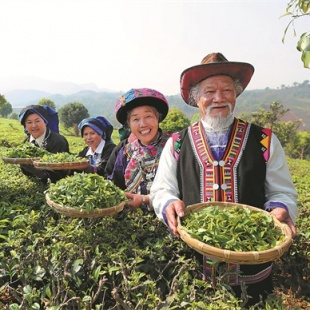
This is a skill that most members of the Blang ethnic group living in the Jingmai Mountain area have mastered — from teenagers to the elderly. Su is a 40th-generation tribal leader of the Blang people, an ethnic group that has cultivated and utilized tea trees for more than 1,800 years.
The 80-year-old sips a cup of tea sent by an 86-year-old villager who, just a day previously, climbed onto a venerable old tree to pick the freshest leaves.
"It's easy for us to cultivate tea trees, pick tea leaves by climbing onto the trees and make tea. These activities have been part of our daily lives since we were kids," the tribal leader explains. After his morning tea, Su starts preparing for a coming annual ritual in April. This grand ceremony is meant to pay respect to the tea trees and to honor the tribe's ancestors before harvesting the gifts of nature.
Besides the Blang, other ethnic groups living in the area — including the Dai, Hani and Va — also hold rituals to worship their own "tea tree spirits" and ancestors.
These ethnic groups all have a long history of tea cultivation and unique tea cultures. Although they have developed distinctively, they still share the same mission: protecting the ancient plantations passed down by their forefathers.
"Our ancestors left behind the message that we must take care of our tea trees like they are our own eyes. With such a long history of tea tree cultivation, the practice has become an indispensable part of our lives," says Su.
The Blang people regard the symbol of tea, in the form of a bud and two leaves, as their totem. The pattern is found on the roofs of their two-storied dwellings, differentiating them from the nearby Dai villages, where roofs are decorated with ox horns.