Global carmakers accelerate R&D in China









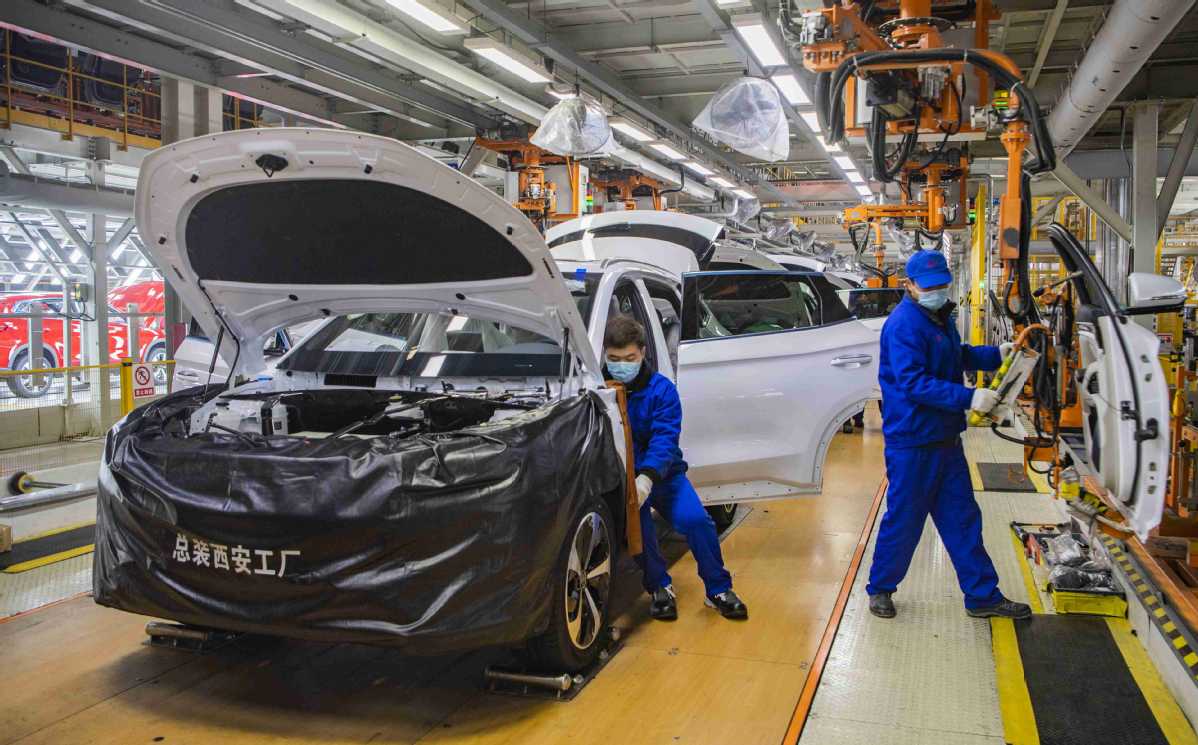
Increasing the weighting of China's research and development has become the common choice for multinational carmakers such as Volkswagen, Mercedes-Benz, Toyota and Honda, Chinese financial media outlet Yicai reported.
And China has maybe become one of the core drivers for the transitions of these automakers, Yicai said quoting Dong Jun, an executive of VW's subsidiary company in China.
During this year's Shanghai auto show, Volkswagen announced it plans to spend around 1 billion euros on a new state-of-the-art development, innovation and procurement center for smart electric vehicles. Located in Hefei, Anhui province, it is expected to slash the time spent on the R&D of new products and technologies by around 30 percent.
BMW has more than 3,200 research and development personnel and information technology engineers in China, constituting the company's largest R&D network outside of Germany. Its four innovation bases are located in Beijing, Shanghai, Shenyang and Nanjing.
The German premium carmaker Mercedes-Benz said in March 2022 that it will open a R&D center in Shanghai that will focus on mobility technology. The center is its second R&D facility in China.
Many Chinese new entrants are well prepared for the layout in pure electric vehicles, said Lutz Meschke, deputy chairman of the executive board at Porsche AG. In terms of battery technology and in-car entertainment, they also launched some good products, with broader development prospects in mass production and the luxury vehicle market.
In recent years, the boom of smart electric vehicles has overturned the pattern of Chinese auto market that had been built over the past decades. In the era of fuel vehicles, among the top 10 automakers that sold more than one million cars per year, seven were joint ventures.
However, their past glories have faded away over the past three years. In 2022, only three joint ventures saw their sales surpass one million units. VW, whose annual sales once topped 4 million vehicles, posted a nearly 30 percent decline in sales in China last year.
Data from Marklines, a global auto information platform, showed during the first quarter of this year, the share of local carmakers in China's market reached 53 percent, with shipments up 5.5 percent. In comparison, the share of German and Japanese carmaker stood at 19.1 percent and 15.9 percent, with shipments down 8.9 percent and 31.9 percent, respectively.
China's new energy vehicle market began to take off in 2021, when majority of joint venture brands dealt with internal combustion engine-based NEV. In 2022 and 2023, JV brands launched their pure electric vehicles. However, these products still were not recognized by Chinese users. Data from the China Passenger Car Association showed during the first quarter the share of mainstream JV brands in China's NEV market was just 5.2 percent.
The core problem is the definition of product, said Dong.
When Chinese local carmakers broke in and changed the way things have been done for so long, they also redefined products, the standard of pricing, and control the products dominance in the field of smart electric vehicles.
And it's difficult for foreign car companies whose decision makers are far in Europe, North America and Japan to feel this change, leading to a big difference between products defined by headquarters and the real demand by the Chinese market.
Advanced technology and software have become the biggest weakness for traditional multinational automakers. In comparison, China has sufficient software talent, as well as companies focused on related industrial chains, such as Horizon robotics and Hesai Technology.
"The Chinese market is a trend-setter. We can learn a lot from the Chinese innovations and technology and the requirements of the Chinese customers who are using their cars as a software device," said Volkswagen CEO Oliver Blume.
"Chinese customers are young. They are very addicted to technology, to innovations. That drives the whole market."