


Heritage experts discuss space technology use










Several years ago, using satellite technology, Chinese researchers, alongside scientists from Tunisia, Italy, and Pakistan, discovered 10 archaeological sites, including walls, military fortifications and agricultural irrigation systems from ancient Rome in Tunisia, at the western end of the ancient Silk Road.
The discovery encouraged a strong response from the international community, and was a good example of the application of technology in protecting heritage sites, says Guo Huadong, director of the International Centre on Space Technologies for Natural and Cultural Heritage (HIST) under the auspices of UNESCO.
Guo, who is also an academician of the Chinese Academy of Sciences, cited the example during the 4th Huangshan Dialogue on UNESCO-designated Sites and Sustainable Development, which was held in Huangshan, Anhui province, from June 29-30.
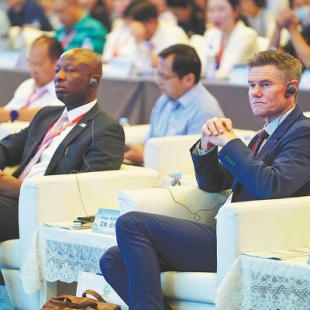
With the theme "Digital Technologies Enabling Sustainable Development of UNESCO-designated Sites", the dialogue brought together more than 200 delegates from China and abroad to explore the application of technology in the protection and management of World Heritage Sites, Biosphere Reserves and Global Geoparks recognized by UNESCO.
Organized by HIST, the International Research Center of Big Data for Sustainable Development Goals, Aerospace Information Research Institute of Chinese Academy of Sciences, and Huangshan Municipal People's Government, among others, the meeting featured eight sessions, with nearly 70 experts making speeches on topics such as the digital protection, harmonized management and sustainable development of UNESCO-designated sites, and their role in cultural tourism.
As of now, there are 1,157 World Heritage sites in 167 countries, 738 World Biosphere Reserves in 134 countries, and 195 Global Geoparks in 48 countries.
The precious heritage sites are more or less influenced by natural and human-induced risks, Guo said at the opening ceremony.
"To respond to such risks, international conventions and agendas such as the Convention Concerning the Protection of the World Cultural and Natural Heritage, the Convention on Biological Diversity and the 2030 Agenda for Sustainable Development have been issued, and are proactively being implemented.
"With the rapid development of technological innovations, the international community is increasingly realizing the important role of space and other digital technologies in identifying, nominating, monitoring, evaluating, presenting and managing heritage sites," says Guo.
For example, he says to China Daily, due to chaos caused by past wars, the Angkor Wat Buddhist temple complex in Cambodia, a UNESCO World Heritage Site, has been damaged. For many years, people have worked to restore the architecture, but such work was only partial, and there was a need to extend the scope of protection efforts by employing space technology.
Guo explained that HIST carried out a project in 2014 to monitor the surrounding environment of the site with remote sensing of an area of 5,000 square kilometers, trying to figure out the influence that the environment exerts on the site to enable better conservation.
"For example, we found some of the architecture had collapsed, but didn't know why. Later, through our research, we knew it was related to the flow of underground rivers. Therefore, we continued to monitor the place using new methods and technology, collected data and provided suggestions to the local government," says Guo.
He also notes that virtual reality can be applied in predicting what influence climate change and natural disasters would have on such sites.
"Technologies like these are opening new doors. Now we need the world to walk through them," Qu Xing, deputy director-general of UNESCO, told the opening ceremony via video.
The Huangshan Vision, which advocates for international organizations and countries to give full play to digital technology, take concrete action, enhance the protection and management of UNESCO-designated sites and contribute to such sites to meet the UN's Sustainable Development Goals, was released at the closing ceremony of the dialogue.
Initiated in 2014, the dialogue is a platform for policymakers, site managers and heritage professionals to cooperate and discuss issues related to the conservation of UNESCO-designated sites.
wangru1@chinadaily.com.cn