


A guardian of history










Ningxia man dedicates himself to finding, cataloging and, more importantly, protecting priceless local cultural relics, report Yang Feiyue and Hu Dongmei.
Time seems to go in reverse after one steps foot in the old alley of Hongya village.
The earthen walls, opera stage, millstone and stone carvings recount history at every turn in the village that sits in Longde county, Guyuan city, Ningxia Hui autonomous region.
It has become a tourist hot spot, where visitors can enjoy watching elder villagers singing popular traditional opera in the local style on the street, and local women making distinctive snacks and rice vinegar.
It all showcases the originality of the village, thanks to Liu Shiyou's insistence on keeping things as they were when, back in 2012, the village was slated for renovation after being named a traditional Chinese village by the Ministry of Housing and Urban-Rural Development and other government organs.
"The biggest attraction of traditional villages lies in the authentic old buildings and customs," says Liu, who was born and raised in Longde.
The man, in his 50s, has committed himself to the protection of local cultural relics and their activation for more than three decades and is now head of the Longde Cultural Heritage Institute and curator of the Longde Museum.
"Tourists come to the old alley to seek moments of the past and find the physical manifestation of the nostalgia in their hearts. If the original residents and old houses are gone, the traditional village loses its meaning and reason to exist," Liu explains.
His suggestions were eventually taken on board by local authorities and the old alley has become a hit among travelers.
In addition to the alley, Longde is home to more than 100 cultural relics from the Neolithic period, and multiple traces of Qijia Culture (2200 BC-1600 BC) have turned up in the county.
Liu says he considers every relic found in Longde to be a precious family heirloom, as they are "historical evidence left by our ancestors".
Ningxia has invested more than 800 million yuan ($110.5 million) between 2016 and 2020 in the restoration and preservation of its cultural relics, says Zhang Yu, an official from the cultural relic protection and archaeology division of the region's culture and tourism department.
More than 100 major cultural relic protection projects were undertaken, realizing the digitalization, categorization and archiving of 2,000 historical artifacts.

Ningxia now has more than 3,800 registered immovable cultural relics and 75 museums, as well as multiple relic sites that record the development of civilization along the Yellow River, Zhang says.
Driven by his interest in local history, in 1993, after working as a teacher at a local primary school for seven years, Liu quit his job and started work at the Longde Cultural Heritage Institute.
After transitioning to the new career, Liu wasted no time adapting himself to his new role with great determination.
"I started from the very basics, reading books on cultural heritage," Liu says.
"I learned about laws and regulations related to cultural heritage protection, attended training courses organized by the National Cultural Heritage Administration, and engaged in extensive exchanges with colleagues to comprehensively improve myself," Liu says.
Although initially the work conditions were rough, with poor housing and a shortage of staff, Liu's interest in cultural relics grew as he visited rural areas and ventured into the countryside to collect materials and delve into local records and history books.
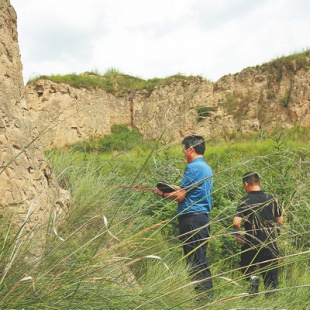
During the third national general survey of cultural relics, from 2007-11, Liu led a team from the Longde Cultural Heritage Institute and did field work across 13 villages and towns in the county.
Altogether, they discovered 229 new cultural relic sites and completed the filing of more than 800 relics.