



Sichuan temple honors legendary Chinese patriot









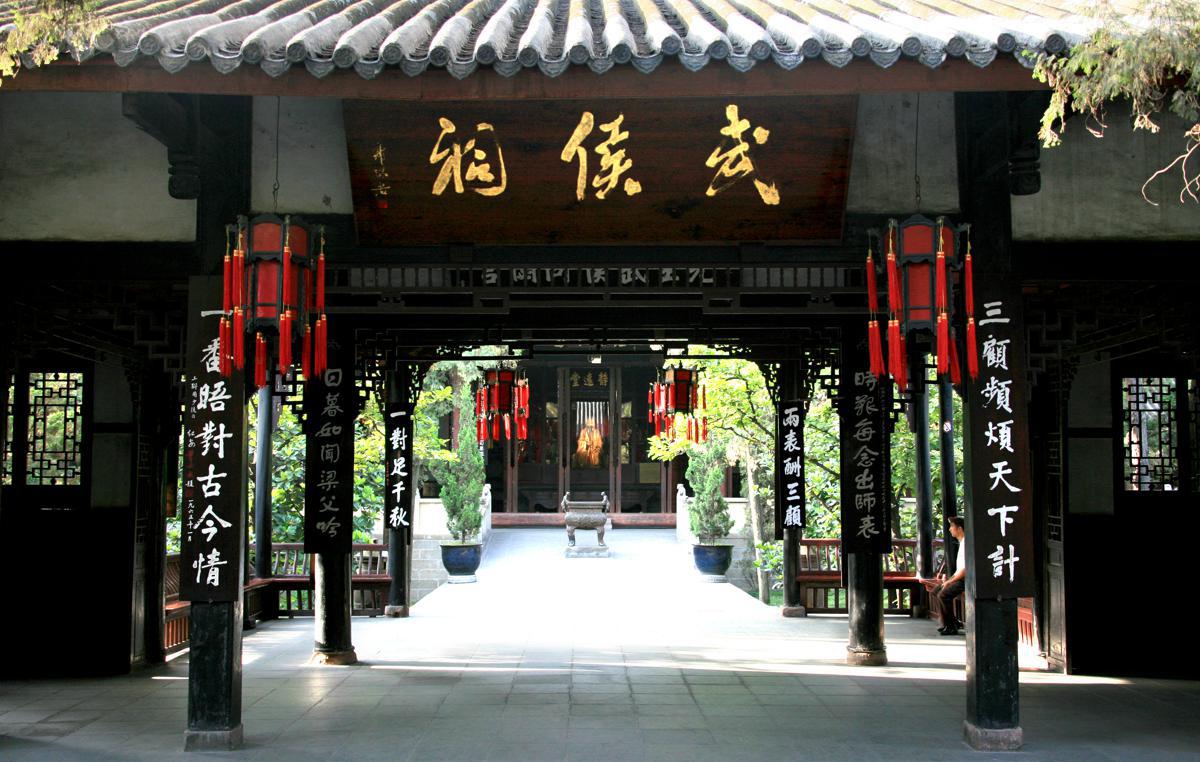
Fans of the Three Kingdoms period (220-280) can visit the Temple of Marquis Wu in Chengdu, Sichuan province, where a three-month-old opera art exhibition on the period will start July 26, two days before the start of the 31st Summer World University Games in the city.
The exhibition will bring together more than 100 pieces and sets of opera relics from museums and memorial halls across the country, such as the Palace Museum in Beijing. They include costumes of famous actors who played characters from the Three Kingdoms.
The exhibition is to celebrate the holding of the Games, according to Xie Jiaqian, an information officer with the temple.
The mention of the temple may remind people of Zhuge Liang, the personification of loyalty and wisdom in China, and the poem "Shu Premier" written by the great poet Du Fu (712-770) to lament the death of Zhuge before accomplishing his mission.
Hoping somebody as capable as Zhuge could end a nearly eight-year war waged by two rebelling generals that led to the decline of the Tang Dynasty (618-907) and the suffering of the people, Du made a special visit to the temple in 760, writing the poem "Shu Premier" whose last two lines read:
Sad that he had
To die before he gained victory,
Leaving great men of
Succeeding generations
Wetting sleeves with tears.
Zhuge Liang (181-234), whose posthumous name is Marquis Wu, was a legendary premier and strategist of the Shu Kingdom (221-263) during the Three Kingdoms period.
In Zhuge's youth, warlords were entangled in fighting which led to the division of the country into three kingdoms, Wei, Shu and Wu.
Liu Bei, an ambitious warlord, was defeated repeatedly by other warlords and his spouses were held captive many times due to the lack of a capable strategic adviser.
Admiring Zhuge's abilities, Liu paid him three visits on a remote mountain in 208, asking for strategies to unify the country and inviting him to be his top adviser.
Moved by Liu's sincerity, Zhuge left the mountain and helped Liu found the Shu Kingdom. Liu became the first emperor of the Shu Kingdom and Zhuge served as premier for 13 years until his death.
Before Liu's death, he said if his son proved to be a weak-minded person, Zhuge could become emperor. Liu's son did prove to be a poor emperor, but Zhuge offered help instead of dethroning him.
Zhuge excelled at managing state affairs and commanding the army. During his tenure, Shu, the weakest of the three kingdoms, enjoyed political stability and economic prosperity. He died of overwork at the age of 53.
To realize Liu's unfulfilled dream of reunifying China, Zhuge led expeditions aimed at conquering the more powerful Wei Kingdom.
In the Hall of Zhuge Liang, the seated statues of Zhuge, his son and his grandson are enshrined. The son died along with Zhuge's grandson in 263 during the battle against the invading Wei troops that eventually toppled the Shu Kingdom.
Before Zhuge's first expedition, he sent a report to Liu's son, the new emperor, outlining his reasons for undertaking the expedition and expressing his devotion to the task of reunifying China.
His devotion to his country, as expressed in the report, influenced patriots of later generations, the most well-known being Yue Fei (1103-42), a national hero of the Southern Song Dynasty (1127-1279).
Yue's famous poem The Whole River is Red can be seen on a wall as visitors enter the temple. It shows the general's determination to wipe out the invading enemies from northern China and reclaim vast tracts of land.
Zhuge's devotion to his country also influenced Liu Xiang. The temple houses the tombs of Liu Bei (161-223), first emperor of the Shu Kingdom, and Liu Xiang (1888-1938), a patriotic general who led the Sichuan army out of the province to fight the invading Japanese army during the War of Resistance Against Japanese Aggression.
Even though Sichuan soldiers were poorly equipped, often wearing straw sandals, they were nonetheless involved in almost all of the big battles against the Japanese.
According to the statistics of the then Kuomintang government, the number of Sichuan troops killed and wounded during the war was about one-fifth of the total casualties of the national anti-Japanese army.
Wang Xiaochun, an official with the Sichuan Provincial Archives Bureau, said 3.4 million Sichuan soldiers left their province to fight, 646,000 of whom were killed, injured or classified as missing.
It was Liu Xiang, then-governor of Sichuan, who led the first 300,000 Sichuan soldiers out of the province in October 1937 to fight against the invaders.
In January 1938, Liu Xiang died of illness in Wuhan, Hubei province. Sorting out his belongings, people found a hand-written note with verses from the time-honored poem by Du Fu.
Liu Xiang's last words, "The war of resistance against Japan will be fought to the end, and the Sichuan army will swear not to return home until the enemy withdraws from Chinese territory," were recited by Sichuan soldiers on the front line during their morning flag-raising ceremony to encourage them in the fight.
In February 1938, the Kuomintang government ordered a state funeral for Liu Xiang, and the tomb was laid to the west of the temple's cultural relics area. Construction of the tomb was finished in early 1940.
Moved by his patriotism, visitors to the tomb place chrysanthemums there regularly.






Most Popular
- Pogacar in GOAT territory after stellar 2025 season
- The beautiful game's growth knows no bounds
- A day of healing and relaxation
- Rivers: Bucks don't need to make wholesale changes
- World Cup winner to get $50m from richer prize pool
- World's tallest teen Rioux, delivers emphatic dunk