


Weaving its magic









Craft center
The origin of yunjin can be traced to the late Eastern Jin Dynasty (317-420), when general Liu Yu defeated the Later Qin kingdom and brought the kingdom's craftsmen from Chang'an (the present day Xi'an in Shaanxi province) to the then capital Nanjing. The majority of these craftsmen were brocade artisans.
In 417, a governmental institution specially administering brocade production was set up in Nanjing, marking the advent of Nanjing yunjin brocade.
Nanjing is believed to be especially conducive for silk manufacturing, as it is commonly said that the water of the city's Qinhuai River is rich in tannic acid, a substance that facilitates the process of dyeing.
In the Yuan, Ming and Qing dynasties (1271-1911), the brocade weaving techniques reached their pinnacle.
The influence of the craft on Nanjing is evident. Many places in the city are named after silk manufacturing processes, and in China's literary classic Dream of the Red Chamber, written by Nanjing-born novelist Cao Xueqin, yunjin garments are frequently mentioned.
After the founding of the People's Republic of China in 1949, the country continued to place special emphasis on preserving and passing down the brocade weaving technique, establishing the Nanjing Yunjin Research Institute in 1957.
Earlier this century, the institute set up the Nanjing Yunjin Museum, as the only professional museum in China dedicated to the display of the brocade, including its history, weaving technique, culture and contemporary artworks.
And now, with the support of technology and research conducted by the institute, yunjin craftsmanship and teaching are increasingly efficient and effective. In 2009, the craftsmanship of Nanjing yunjin brocade was inscribed on UNESCO's Representative List of the Intangible Cultural Heritage of Humanity.
Chen Cheng, a young artisan at the institute, introduces the three primary applications of the fabric in ancient times — royal attire, particularly the dragon robes worn by emperors; decoration, adorning walls and chairs at palaces; as well as at religious and ceremonial settings.
Its esteemed status and unique historical role are key factors that set this silk production technique apart from others, according to Chen.
"China's silk craftsmanship has continuously evolved and progressed with the times, and within its vast history, yunjin represents a milestone where the technique reached a level of maturity," he says.
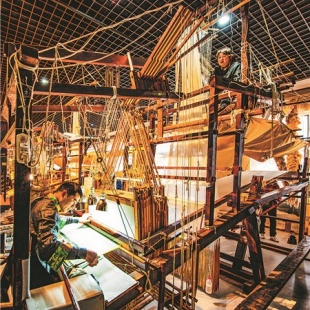
He draws an analogy between the yunjin manufacturing process and binary coding. After transcribing and amplifying the patterns onto a piece of grid paper, the artisans then arrange the warps and wefts, so as to create a draft of the textile to be woven.
As for the following weaving process, operating the gigantic wooden loom requires the collaboration of two artisans, one sitting at the top pulling the strings and informing the weavers of the patterns, and the weaver passing a shuttle over and under the alternating warps.
While the pattern designs usually symbolize goodwill and blessings, such as dragons, clouds and peonies, the weavers can freely change the colors of the patterns according to their tastes and judgment.