


Bringing words to life









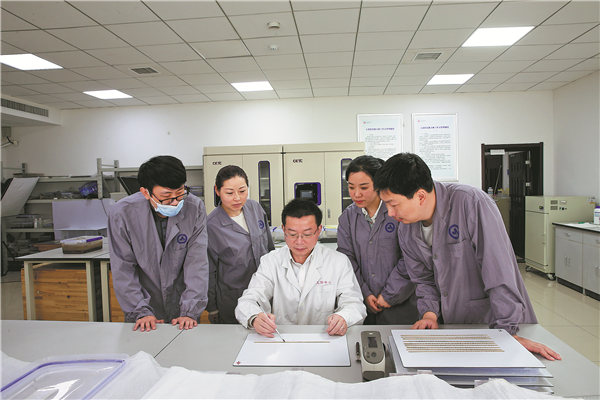
Relic restorer Fang Beisong has spent his career developing special techniques to revive ancient texts inscribed on bamboo and wooden strips, Wang Ru and Liu Kun report in Wuhan.
Fang Beisong's experience of successfully restoring bamboo strips, inscribed with words written by the ancient Chinese, in 2015 was a profound one. When he cleaned one strip, unearthed from a tomb of the Chu state of the Warring States Period (475-221 BC), he saw characters spelling out the phrase "hold your hand and grow old with you", a famous verse from a poem in Shijing, or The Book of Songs, the oldest existing collection of Chinese poetry from the 11th to the 6th century BC.
"I felt the light and warmth of civilization," says Fang, recalling his reaction to holding the millennium-old artifact.
For more than three decades, Fang, who now works as director of the Jingzhou Cultural Relics Protection Center in Jingzhou, Hubei province, has been devoted to restoring cultural relics, especially wooden and bamboo strips, or jiandu, the main media for written documents before paper was widely introduced in China. He has explored the best ways of restoring the strips and, after numerous experiments, has become a famous expert in this area.
Graduating as an analytical chemistry major from Wuhan University in the provincial capital of Hubei in 1988, Fang was soon recruited by Jingzhou Museum to work on protecting cultural relics. "The museum needed someone to do the work, and I have an interest in history and cultural relics. That's how I started my career," Fang tells China Daily.
The museum is home to a large number of lacquerware, wooden artifacts, bronzeware, wooden and bamboo strips and textiles.
In 2002, a large collection of bamboo strips from the Qin Dynasty (221-206 BC) was unearthed from Liye ancient city in Longshan county, Hunan province. Fang joined the protection work, and started to focus on restoring them.
In order to restore them, and another batch of bamboo strips found in Zoumalou, the urban central area of Changsha, Hunan, Fang was stationed in Changsha for nine years, working for about 12 hours every day without any vacation. In the end, he and his colleagues organized more than 92,000 bamboo strips, according to Jingzhou Daily.
Fang feels proud that they "restored so many without destroying or losing any of them. The restored strips are still well-preserved today".
During the process, he gave a lot of consideration to how the artifacts could be better restored. "Bamboo and wooden strips are organic, and, as such, decay more easily compared to inorganic artifacts like bronze and ceramic. The strips, which date back to between the Spring and Autumn Period (770-476 BC) and the Han Dynasty (206 BC-AD 220), have a history of more than 2,000 years, and the reason why they survived underground to this day is that they were in a water-saturated and hypoxic environment," says Fang.
"Once they were unearthed and came into contact with the air, there was a high likelihood of oxidization. Their surface turned black, making the words on them unrecognizable," he adds.
According to Xiao Congli, an expert on jiandu at the Gansu Jiandu Museum, such strips are not easy to preserve for such a long time, unless they are in a very stable environment that is either very dry or very moist.
When they are sent to Fang's studio, many have become black or even rotten, and are often very brittle, but after his restoration work, they return to their original color, and the words can clearly be read.
The restoration process requires more than 20 different procedures. Among them the most important are decoloring and dewatering, according to Fang. The decoloring process means immersing the strips in chemical reagents to restore the original color, while not fading the words inscribed on them. The dewatering process transforms the water molecules in the bamboo or wood into other molecules with chemical reagents, so that the strips can be separated from a watery environment and become more stable for preservation.
He has carried out countless experiments to find the best chemical reagents to achieve this in two steps, before finally settling on the right combination. His techniques were awarded as an outstanding technological advancement in Hubei in 2019.