



Guardians of the Great Wall
Dedicated couple and teams of experts devote themselves to protecting and better understanding our heritage, report Fang Aiqing in Dunhuang and Ma Jingna in Lanzhou, Gansu.









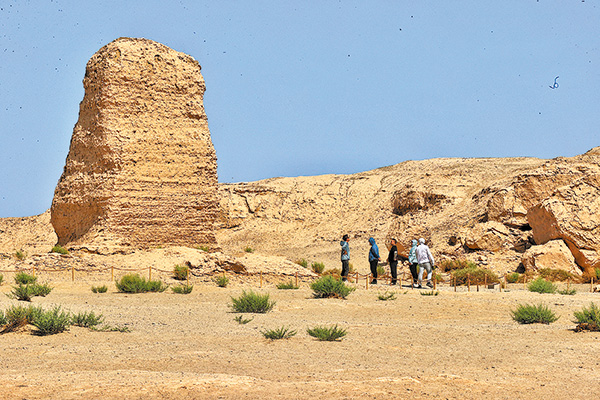
Deep in the Gobi Desert in Northwest China's Gansu province, remnants of the Han Dynasty (206 BC-AD 220) Great Wall stand firm. One layer of fine sand, plus a layer of reeds or rose willow, tier upon tier, has made it through two millennia, from a military installation to a representative living heritage.
Two thousand years of sandstorms has not been long enough to weather it down or diminish the evidence of trade and cultural exchanges between the East and the West, nor has the heavy wind howled enough to prevent people from evoking the glory of the ancient Silk Road.
Rather, the endeavor to keep this part of history alive, in every possible way with manpower and the assistance of technology, will prolong the magnificence that marked ancient people's wisdom, their marching into a more stable, civilized and prosperous society, as well as their adaptation to nature's cruelty in such a barren land.
A family's perseverance
The city of Dunhuang — sitting at the west end of the Hexi Corridor, the main artery of the ancient Silk Road — has a relatively well-preserved section of the Han Dynasty Great Wall.
The Great Wall and the beacon towers in Dunhuang run the length of nearly 200 kilometers through, mainly, no man's land northwest of the city, says Zhang Chunsheng, deputy director of the local cultural relics preservation department.
At the Yumen Pass, or Jade Gate Pass, swallows, with their sharp, forked tails, hover above the roofless ruins of a rectangular fortress. Visitors trudge in the wind, curling themselves up in the inadequate shelter of their clothes.
Looking north, fragmentary wetlands are positioned between a vast land dotted with shrub. In the distance are ruins of the Han Dynasty Great Wall, running east to west, and the natural barrier of the Shule River and Mazong Mountain.
Such a structure was first built in the reign of Emperor Wudi (156-87 BC) of the Western Han Dynasty (206 BC-AD 24) to resist the threat from the nomadic Xiongnu tribe, later serving as what today would be a customs office.