For green network
China and Japan should enhance their third-party market cooperation with the focus on carbon neutrality









China and Japan should enhance their third-party market cooperation with the focus on carbon neutrality

The Belt and Road Initiative, which marks its 10th anniversary this year, has become well recognized and acclaimed by the world as an international cooperative platform and global public good. Meanwhile, third-party market cooperation, an innovation of China, contributes to the construction of the Belt and Road Initiative as a new impetus with the emphasis on extensive consultation, joint contribution and shared benefits.
Since its initiation, Sino-Japanese third-party market cooperation has made preliminary achievements in different areas, revealing both the strong economic complementarity between China and Japan and the breadth and depth of their third-party market cooperation. Nevertheless, under the impact of the COVID-19 pandemic and the international situation, the cooperation also faces challenges. First, the pandemic has triggered drastic changes in the global economy and geopolitical relations, further heightening the already existing stresses and conflicts in global governance. Second, in pursuing the US security strategies, Japan has hampered the Sino-Japanese economic cooperation. Third, Chinese and Japanese enterprises need to further strengthen coordination in third-party market cooperation due to their different business models.
Addressing climate change, a universal challenge confronting all mankind, remains a top priority in global governance. By focusing on green development with collaborative, practical efforts and fostering a mutual understanding of climate change issues, the two countries can forge a dynamic Sino-Japanese relationship that resonates with the new era and contributes to the improvement of global governance.
At the 75th session of the United Nations General Assembly in 2020, President Xi Jinping announced that China will strive to peak carbon emissions before 2030 and achieve carbon neutrality before 2060. In November 2020, the Japanese government also declared its goal of realizing a carbon-neutral, decarbonized society in its Green Growth Strategy through Achieving Carbon Neutrality in 2050. The respective targets and implementation paths toward carbon neutrality of the two countries show their joint willingness to participate in global climate governance.
Enhancing the Sino-Japanese third-party market cooperation in green development offers more than mere economic and environmental benefits for both nations. It will also empower the third-party countries or regions with more cost-effective and competitive products, technologies and services.
In recent years, the Sino-Japanese third-party market cooperation in green development has made initial progress. Here are a few examples.
In January 2019, the Nepal Tana Lake Hydropower Project officially began construction. As the first major pumped-storage hydropower plant in Nepal, it represents a significant achievement of the Sino-Japanese third-party market cooperation in the field of green hydropower.
In the same year, construction commenced on Indonesia's first plant to produce battery-grade nickel chemicals, a project that combines the advantages of China, Japan and Indonesia in respect of technology, market and resources, which achieves comprehensive joint benefits. It manifests the amplifying effect of third-party market cooperation for mutual gain.
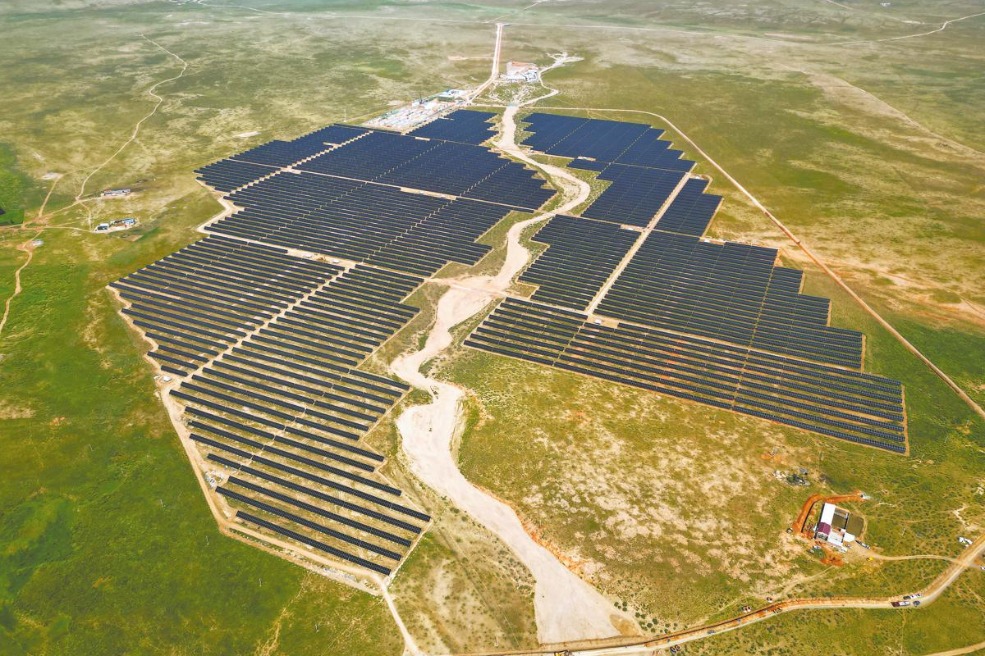
Meanwhile, in April 2019, Noor Abu Dhabi, the stand-alone operational solar photovoltaic plant built by the United Arab Emirates and a consortium of Chinese and Japanese companies, was officially put into commercial operation. It will reduce the UAE's carbon dioxide emissions by 1 million metric tons per year. The project has great significance for the stable power supply of the Middle East.
In pursuit of carbon neutrality, green development is a motif of Sino-Japanese third-party market cooperation. They will further exploit the emerging market fields, gain mutual benefits, and promote the innovation of the global industry, supply and value chains.
Green Sino-Japanese third-party market cooperation can be outlined at the level of industrial layout, with the primary focus on decarbonization and carbon sequestration under the core framework of promoting green infrastructure, renewable energy, smart construction and green finance. Strategic priority should be given to the development of the hydrogen energy industry and new energy battery industry.
To strengthen Sino-Japanese third-party market cooperation in the context of carbon neutrality, carbon neutrality should be set as a general goal for the third-party country's green development plan and carrying out the Sino-Japanese third-party market cooperation. Both countries should actively align with the carbon-neutral path planning of third-party countries and regions and engage in high-quality cooperative projects with a focus on green development.
A long-term mechanism for the Sino-Japanese third-party market cooperation centered on green development should be established with an emphasis on scientific research innovation and operation effectiveness.
It is also important to fully leverage the comparative advantages of China, Japan and the third-party countries and regions in building a mutually beneficial Sino-Japanese third-party market cooperation framework under the context of carbon neutrality.
The leading role of policy-based financial institutions should be highlighted and a green finance third-party cooperation model should be established. The supporting and leading role of policy-based financial institutions should be fully utilized.
It is important to deepen green Sino-Japanese third-party market cooperation within the RCEP framework. China and Japan should continue to cultivate third-party market cooperation in Southeast Asia to facilitate the formation of a regional green cooperation network.
Although the Sino-Japanese third-party market cooperation started relatively late, it has shown good momentum. China and Japan should treat each other with sincerity and honesty, strengthen communication, manage differences, be vigilant against interference and obstacles to Sino-Japanese economic and trade cooperation, remain committed to the path of green development, and actively promote the green Sino-Japanese third-party market cooperation.
The author is an associate professor of the Academy of Regional and Global Governance and executive director of the Institute of Silk Road Studies at Beijing Foreign Studies University. The author contributed this article to China Watch, a think tank powered by China Daily.
Contact the editor at editor@chinawatch.cn.