



Giving the lion dance more bite










Only he and a few other trainees managed to complete the 6-year course.
The plus side, however, was that he had the lion dance down to a fine art after all those years of practice.
In 2008, when he returned home, more than 200 of his fellow villagers, including his whole family, rolled out the red carpet in welcoming him back.
He says it gave him an added sense of responsibility to upgrade the local lion dance.
That same year, Yang founded his own lion dance troupe.
He further integrated the northern lion dance elements, which highlight martial arts, with the more diverse costumes and cerebrating vibes of the southern style.
Yang has reinforced the characteristics of the Xitao lion dance.
"The movements in the routine are based on a martial arts horse-riding stance, making the performance appear even more vigorous and powerful," Yang says.
Its representative moves include the seemingly dangerous leaping on narrow piles, as well as pole climbing and drumming, Yang says.
After three months of trial and error, in 2010, he was satisfied that the village's dance moves on the piles were up to the national standard.
The preparation enabled Yang's troupe to bring the house down at Wuzhi county's Spring Festival gala and was officially proclaimed an excellent show by the county in 2012.
It opened a new chapter for Yang's lion dance performance.
He has received many invitations to perform nationwide.
To date, his troupe gives about 500 performances a year for business openings, special celebrations or wedding ceremonies.
Under Yang's guidance, local lion dance societies were established to draw in young people.
To popularize the art form, Yang has led his team to take part in various competitions and won multiple awards, including first prize at the Henan folk sports competition from 2016 to 2019.
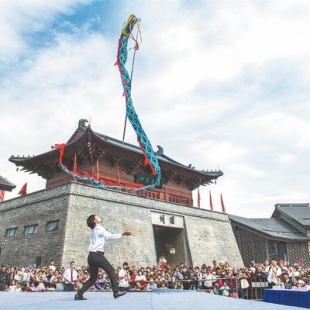
In the interim, he also worked with folk artists and jointly delivered an innovative flying dragon show that won first prize at the 13th National Dragon and Lion Dance Championships in 2021.
Built on the traditional dragon dance, it uses a redesigned main body, which has a cylindrical shape, creating a three-dimensional and lifelike appearance.
The performers wield a long pole to make the dragon airborne and move gracefully, as the dragon's body from head to tail is inflated with air.
"We have established a system as to how long a pole should be for different lengths of a dragon, while ensuring the pole is strong enough to hold the dragon and keep its appearance true to life," Yang says.
It features martial arts movements and integrates Chinese dragon culture.
Due to its relatively easy operation, Yang has also been actively promoting it as a physical fitness activity for the public. He has founded more than 100 dragon flying training facilities across the country, including in Shanxi, Shaanxi and Shandong provinces, as well as the Inner Mongolia autonomous region.
So far, those facilities have registered about 10,000 members annually, many of whom are middle school students, Yang says.
The flying dragon has, in turn, added to the charm of the Xitao lion dance.
Wang Rong, a local resident, still vividly remembers the stunt Yang pulled for a provincial Spring Festival gala in Xitao in January.
"The sheer scale alone was stunning," Wang says, adding that the number of dancing lions and flying dragons were too many for her to keep track.
"Explosive applause broke out at very close intervals, which added to the festivity," she adds.
Now, the simultaneous display of frolicking lions on the ground and flying dragons along the banks of the Yellow River has become a distinct feature of Yang's troupe's performance.
"They have been a carrier of spiritual culture and the embodiment of wisdom belonging to the working people living in the Yellow River Basin, and thus a part of the Yellow River culture," Yang says.
He considers it of extraordinary significance to perform on the banks of the Yellow River.
"I'd like to ensure the traditional dragon and lion culture gets carried forward, so that it can be embraced and recognized by more people," Yang says.
Contact the writer at yangfeiyue@chinadaily.com.cn




















