


Reading between the lines










A natural conclusion
In September 2017, the scale of Liangzhu jadeware production was partly revealed with the excavation of the Zhongchuming site, located about 25 kilometers northeast of Liangzhu city. Within the 1-million-square-meter area, archaeologists discovered living quarters, burial grounds, jade workshops and dumping pits. In the workshops and pits, many raw jade materials, as well as finished, semifinished and defective products have been found.
"It's clear that the several villages in that area had collectively taken up jadeware production as a profession and a means of living, thanks to a huge demand," says Wang. "The area's crisscrossing waterways may have provided transportation for the raw materials to be delivered, and finished products to be exported."
In the meantime, people who spent countless hours rubbing down a piece of raw jade, or carving intricate lines across its surface, must also be fed. Those working in the paddy fields must have produced enough extra crops to make sure the artisans and craftsmen could concentrate on their work. Behind the jadeware production was a division of labor reflective of Liangzhu society at large.
During excavations conducted between 2015 and 2017, along an ancient river course running right along the eastern fringe of the palatial complex, archaeologists unearthed not only discarded jade materials and products, but also giant logs and human skulls. For those in the know, they tell a story of Liangzhu, one about the forming of a belief system and the making of a city, before all that glory was lost to the repeated invasion of floodwater coming from the east where the land met the sea.
That record of marine transgression, fatal to rice crops that couldn't stand the saline water, was kept in the multiple thin layers of silt, which today covers large areas of the Liangzhu site and the regions to its east. On top of that was the relentless rain brought on by the monsoon season and the typhoons, slashing the land and crippling Liangzhu's flood-control system. These are considered by some researchers as the leading cause for Liangzhu's demise around 2300 BC. Such destructive natural occurrences were coupled, perhaps not surprisingly, with eruptions of violence, even close to the heart of the city.
Yet, there's another narrative thread, one that is spun around a jade story.
"Liangzhu people chose to build their city in a basin surrounded on three sides (north, west and south) by the mountains, with only one side open to the alluvial plains and the funnel-shaped Hangzhou Bay to its east," says Zhou. "The mountains are believed to have contained deposits of jade, whose depletion toward the end of the Liangzhu civilization may have been seen as an omen."
According to Fang, although cong pieces are still found in late phase of Liangzhu tombs, sometimes even in larger numbers within a single pit, they were often made either with low-quality jade or a replacement, such as serpentine.
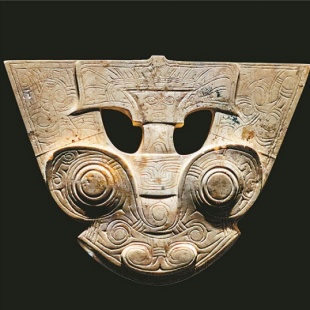
Having tried very hard to read between the carved lines, Fang believes that he has made inroads into the minds of those who created the man-and-beast image with unmistakable intention, clarity and uniformity.
"Look at the way it replicates itself within one single item," he says, pointing to an ivory scepter showcased at the Shanghai exhibition, across the surface of which 10 of the motif are arranged as if engaged in a heavenward spiral.
"It could be a sun god, which many cultures from East to West have depicted as simultaneously having multiple incarnations, thanks to the deity's daily ride across the sky," Fang continues.
"But they are more likely to be ancestral deities — the fathers, grandfathers and great-grandfathers from whom the men and women of Liangzhu descended, and with whom they would eventually join."