


In pursuit of Utopia










A reborn album
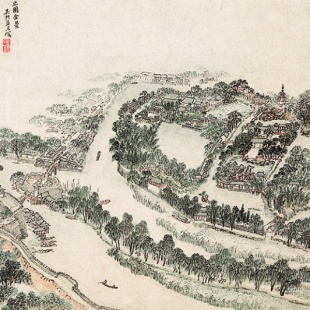
The fruit of the pair's research, Zhiyuan Mengxun, contains not only finely reproduced prints of the 20 paintings from the Zhiyuan album, but also five chapters respectively devoted to the story of the artist Zhang, Cahill and the album, the garden's philosophy and layout, its designer Zhou Tingce — who was a master garden designer of the time — and Wu Liang's family, whose history spans a period between the Ming Dynasty and today.
According to a pioneering researcher of Chinese gardens, Tong Jun, who was quoted by Huang and Liu in an article about the Zhiyuan Garden published in the Art Trade Journal in 2018, Chinese gardens are regarded as a fairyland and an idealistic world where one can liberate oneself from mundane worries and fatigue, and live a leisurely, elegant life.
"People often connect Chinese gardens with concepts of Taoism like tranquility and inaction that were advocated by Laozi, and with the sincerity and selflessness advocated by Zhuangzi. Meanwhile, we can also see in the gardens the order and hierarchy of Confucianism. For example, in the dominant buildings and the Chinese belief in the symbolism behind flowers and trees," the article reads.
"Like the yin and yang of tai chi, Taoism and Confucianism both exert an influence on Chinese gardens, shaping them into a perfect vehicle to represent the thoughts and lives of ancient people."
In 1610, 48-year-old Wu Liang, fed up with the factionalism of officialdom and feeling homesick, resigned from his position in North China, and returned to his hometown in Changzhou, in the hope of planting a garden where he could live in seclusion.
He invited Zhou to design it and named it Zhiyuan (a "garden for stopping", zhi meaning stop) after the Eastern Jin Dynasty (317-420) poet Tao Yuanming's composition Zhijiu (Stop Drinking Wine).
Zhijiu represents the idea of knowing when it is better to stop, advocated by both Taoism and Confucianism, Huang says.
Deeply influenced by this idea, Wu Liang ended his career to protect himself from political rivals. He became a lay Buddhist, taking on the name Zhiyuan and giving his 11 sons similar names that each included the character zhi.
Before Wu was reinstated in 1622, he spent 12 years in his garden. It was replete with symbols from the stories and poems of great writers of previous eras, and as he strolled through it, Wu would have been able to see these hidden allusions.
In his garden, Wu's spiritual world met with those of great ancients like Laozi from the Spring and Autumn Period (770-476 BC), Zhuangzi and Qu Yuan from the Warring States Period (475-221 BC), Wang Wei, Li Bai and Du Fu from the Tang Dynasty (618-907), and Su Shi from the Song Dynasty (960-1279), vividly illustrating the essence of Chinese gardens as the residence of the human spirit, Huang and Liu write in their book.

Among the great literati, the most important for Wu was Tao, whose fable Peach Blossom Spring is one of the earliest utopias described in Chinese literature, a place where people live harmoniously with nature, unaware of the outside world for centuries. Zhiyuan is Wuliang's Peach Blossom Spring, Huang and Liu write.
Wu was as wise to know when to stop his career, as he was to know when to stop his seclusion. In 1622, the 61-year-old left Zhiyuan, embarking on his next journey, losing his Peach Blossom Spring forever. He died in 1624.
In 1627, Wu's son Wu Rousi invited Zhang to paint the 20-leaf Zhiyuan album. In the centuries that followed, the garden disappeared, lost to the mists of time. Only in these paintings can people get a glimpse of the Chinese garden at its peak.