Tianjin facility powers new approach to electricity generation









In addition to the rooftop photovoltaic network in Chongqing, another Chinese PV project is attracting great attention.
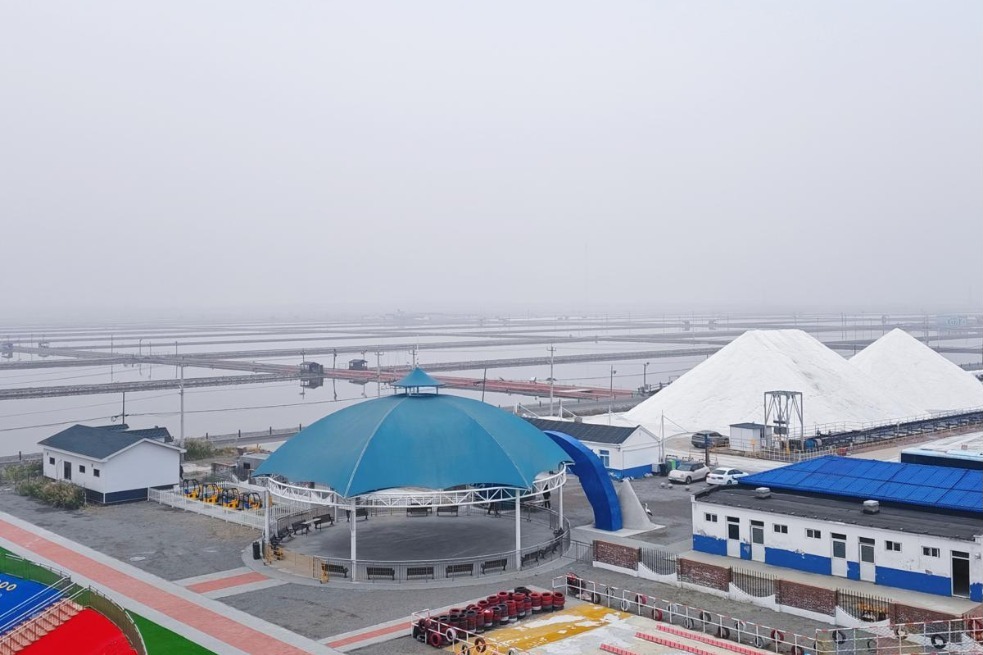
A vast array of solar panels shining in the fields of the Changlu Salt Farm in Tianjin feeds the Huadian Tianjin Haijing 1 million-kilowatt power plant. As the world's largest combined solar power station and salt farm project, the facility was connected to the national power grid and officially put into operation on July 8, according to reports on China Central Television.
It combines salt production with photovoltaic power generation as PV panels have been installed at a specific height above the salt field.
The project aims to improve North China's power supply capability, while exploring a comprehensive industrial model that combines photovoltaic power generation and salt production with aquaculture.
Located at the farm in Binhai New Area in Tianjin, the plant covers 1,333.3 hectares, equivalent to 1,868 standard soccer fields. It can generate 1.5 billion kilowatt-hours of electricity a year, which is enough to meet the annual electricity consumption of 650,000 households.
Moreover, it is estimated that the project will reduce carbon dioxide emissions by approximately 1.25 million metric tons a year, according to Tianjin Daily.
Unlike traditional photovoltaic power plants, the space between the rows of solar panels can be as much as 14 meters, and instead of the usual angle of 30 to 40 degrees, the panels are tilted at a fixed angle of 17 degrees.
That angle maximizes the amount of sunlight reaching the surface of the water by minimizing shadows throughout the year in accordance with the trajectory of the sun's movement.
It also lessens the sun's influence on the salt farm and aquaculture, such as the shrimps being raised in the water of the salt fields below the panels.
Both sides of the PV panels can generate electricity. In addition to absorbing sunlight directly on the tops, the backs of the panels can capture sunlight reflected off the water, resulting in a 5 to 7 percent rise in power generation efficiency.
Statistics provided by the National Energy Administration show that by the end of May, China's installed capacity of photovoltaic power generation had reached 450 million kilowatts, maintaining the country's eight-year-long ranking as the global number one in that field.
With the continuous improvement of PV technology and the tightening of land policy regulations, as at the Tianjin project, such "photovoltaic plus" programs have gained in popularity in recent years.
Driven by China's dual carbon goals — the pledge to peak the country's carbon dioxide emissions before 2030 and to achieve carbon neutrality before 2060 — the country's installed capacity of wind and solar power has risen rapidly in recent years, reported Changjiang Daily in Wuhan, Hubei province, on July 6.
Zhang Jingjie, deputy director of the Department of Planning and Development at the China Electricity Council, told the newspaper that by the end of March, the nation's total grid-connected installed capacity of wind, solar and hydroelectric power had reached 376 million kW, 430 million kW and 420 million kW, respectively.
Moreover, the total installed capacity of nonfossil energy power generation had reached 1.33 billion kW, accounting for 50.5 percent of the country's total installed capacity and surpassing 50 percent for the first time. The milestone indicates that the role of coal-fired power generation in China's energy supply is diminishing, while green energy, represented by wind and solar power, is playing a bigger part in the energy supply nationwide.
China not only leads the world in installed capacity of hydro, wind, solar and biomass power, but has been the global leader in the generation of new energy for several years, Changjiang Daily reported.
The country has already developed a relatively comprehensive power technology industry system.
With photovoltaic power technology rapidly developing and continuously setting records in conversion efficiency, the independently developed silicon heterojunction solar cell has reached a power-conversion efficiency rate of approximately 27 percent.



- First cross-border event debuts at the National Games
- China Focus: National Games enhances coordination under 'one country, two systems'
- China's Fujian aircraft carrier to make regular appearances on high seas: spokesperson
- A decade of dialogues
- HK: a stage for art and cultural dialogue
- Tapping truly unknown wonders