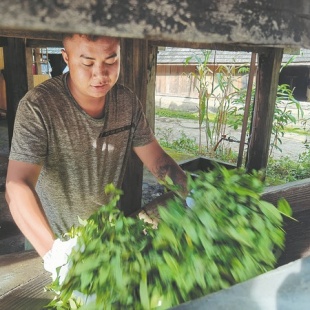



A drink heritage to cherish










Traditional tea-growing area honors its history as it embraces the future, Wang Kaihao reports in Pu'er, Yunnan.
Near the China-Myanmar border, the mountain is embraced by a sea of clouds on average about half the year. Driving through the zigzag road into the clouds feels like a journey into a wonderland normally associated with fairy tales.
Traditional tea-leaf-shaped totems of the Blang ethnic group stand sentinel on the roofs along the road. This is the core area of old tea forests of the Jingmai Mountain in Lancang Lahu autonomous county, Pu'er, Yunnan province.
Pu'er is home of the world-renowned tea of the same name. While some other tea-growing hubs in the region may have a larger output, more famous brands, and heritage surrounding the history of the famous trade route known as the Tea-horse Ancient Road, Jingmai may not be the obvious candidate as people's first choice to look for the best Pu'er Tea.
Nevertheless, being cut off from the outside by rivers, this mountainous area has become a haven for an ancient planting technique, cultivating tea trees under forest canopies, known as the "under-story" method, which filter sunshine while ensuring moisture. A tasteful location in more ways than one.
Nan Kang was former head of the Mangjing village committee. He now prefers crediting himself as "storyteller of the Jingmai Mountain".
Running a credit union for more than 40 tea-producing families from various ethnic groups, he now wants to turn Jingmai into an influential name in the kingdom of tea.
"Compared to modern plantations, we'll surely produce less tea in the ancient forest," the 61-year-old Blang man says. "But we have to respect our tradition and belief.
"Birds eat insects to protect the tea and the fallen leaves from canopies provide fertilizer," he explains. "Everything reinforces the other, but also restrains each other. It is the way of nature."
Everyone in his union vows to only sell locally produced tea of high quality. Modern checkpoints at the gateways to the Jingmai Mountain try to prevent tea from elsewhere from entering. Apart from that, they have a sublime supervisor.
A 50-meter banyan known as "the tree of the bee spirit" in Mangjing village is sacred to local hearts as a patron of tea plants. Hundreds of honeycombs hang from its branches, but no one will touch them to fetch honey as they are in awe of nature. Instead, villagers set up their own hives nearby.
"We have an old belief: If somebody's hive is empty, it's a sign of the banyan's punishment," Nan says. "The owner must have done something to break our rules, and everybody will know."
Nan is an old-time Blang chieftain's grandson. Following a trail leader named Pa Aileng, his ancestors came to settle near the Jingmai Mountain centuries ago. Legend says that Pa Aileng found that tea leaves cured his people of the diseases they succumbed to during their migration, and so the hero is also worshipped as a "tea ancestor".Blang people chose a peak as their sacred mountain to remember him. They call it Peak Aileng.
Every spring, locals hold a sacrificial ceremony before the sacred mountain in hopes of a good tea harvest. Nan leads the ceremony and yells into the valley, calling for the tea ancestor to safeguard the forests.
"We Blang people believe tea has its own spirit," he says. "The first planted tea tree in every field is identified as the Tea Spirit Tree. That means the field has an owner. And the symbol also urges everyone to observe moral codes and protect the plants."
Now, this mountain of tea, also a reservoir of the time-tested traditions of indigenous ethnic groups, attracts global attention.
On Sunday, the Cultural Landscape of Old Tea Forests of the Jingmai Mountain in Pu'er was inscribed as a World Heritage Site at the 45th Session of the World Heritage Committee of UNESCO in Riyadh, Saudi Arabia, becoming China's 57th entry on the list.
As the committee notes, the cultural landscape represents an exceptional testimony of the under-story tea cultivation traditions. It enabled the development of a complementary spatial distribution of different land uses providing ecosystems and microclimates that support both the cultivation of forests and the wellbeing of local communities. The integrity of the property is based on preservation of the social relationships and ecological interdependencies between the climate, the topographic features, and the cultural practices of the peoples on the mountain.