A sound approach










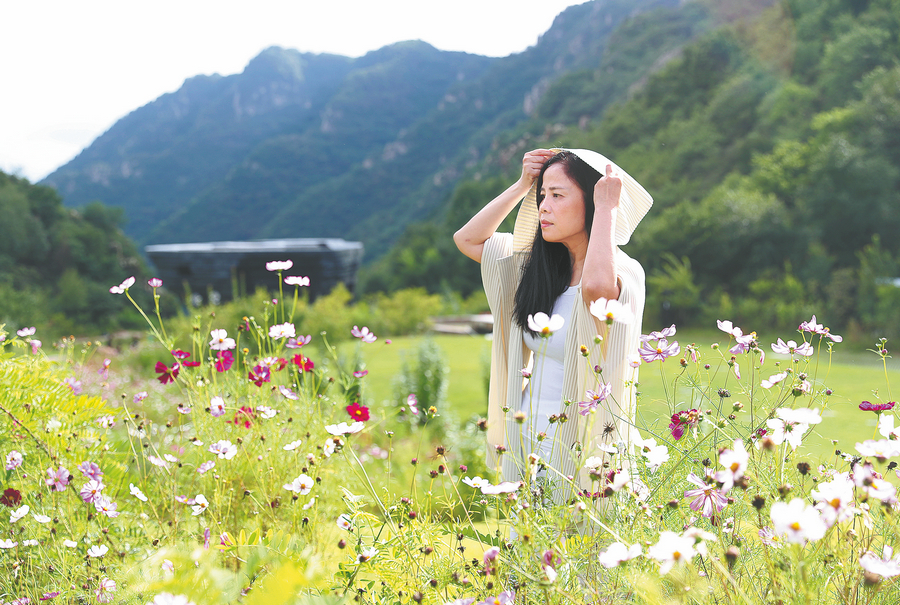
Singer's latest project centers around the music of nature, from the dawn chorus of birdsong, to a symphony of frogs on the river in the evening, Chen Nan reports.
The Chapel of Sound, a concert hall, which overlooks the distant mountains of Jinshanling, in Luanping county in Chengde, Hebei province, to the north of Beijing, is nestled into the valley and resembles a rocky landform.
Built entirely of concrete mixed with locally sourced rocks, the concert hall is a uniquely designed space, which optimizes its acoustics. Even with no scheduled performance or musical event, the concert hall remains a destination for visitors.
It's a weekend afternoon, and Zhu Zheqin, who is better known by her stage name Dadawa, walks into the concert hall and tries to test the sound quality by humming and singing.
She sits and quietly listens to an ever-changing natural symphony of birdsong, wind and the hustle and bustle of tourists coming and going through the concert hall.
"I'd recommend people experience it in person of course, leaving all the annoyances and complexities of life behind, just be there with yourself, and nature, and see what you can hear," says the singer.
On Sept 30, she is going to give a concert in the hall, titled Asking Mountain, along with some friends, including Mongolian ethnic musician Munkhjul and wind instrumentalists Wang Hua and Zhang Di. They will be performing music Dadawa wrote for Jinshanling, with her as vocalist.
Since May, the singer has been living in Jinshanling and collecting the sounds of nature, which inspired her to write original music, blending vocals with electronic and natural sounds.
"We got up at 4 am to record the sounds of the birds, who wake up with the sunrise. We also went to the mountains and recorded the sounds of the river. When the sun goes down, the frogs croak, which sounds like a chorus," says Dadawa. "The color of the mountains changes every day — even every hour or every minute. Nature is the ultimate source of inspiration for me.
"I didn't want to just visit and leave. I want to stay and see what I can do for the area," she adds.
"She enjoys her days here and every time she hears a new sound, she gets excited. The project is an experiment and a journey of discovery," says Ma Haiping, one of Dadawa's team members, who helped her record the sounds in Jinshanling.
The project, for which Dadawa and her team spent months in Jinshanling, is part of a sound art program, which she initiated about 10 years ago.
Dadawa, who was born in Guangzhou, Guangdong province, became a singer in 1990 after taking part in a TV talent show. Instead of focusing on her pop career, she traveled around the country seeking inspiration for her music and took a special interest in the music of China's ethnic groups.
Her debut album, titled Yellow Children, was released in 1992. Working with He Xuntian, a famous composer and producer, she gained international recognition through her album Sister Drum. Released in 1995 and inspired by the folk music of the Tibetan ethnic group, the album enabled Dadawa to become one of the first Chinese singers to release an album worldwide. Available in 56 countries, Sister Drum sold over 3 million copies. In 1997, she released her third album, Voice From the Sky, which was also well-received, both in China and abroad.
After that album, she took a long break from recording and traveled from Kashmir to Delhi and Varanasi in India, to Nepal, then across the Himalayas and back to China.
In 2006, Dadawa was nominated for a BBC World Music Award for her album, Seven Days. In 2009, she was named as a National Goodwill Ambassador by the United Nations Development Program for a two-year project titled Show the World, which aimed to preserve and develop ethnic music and local handicrafts.
It took Dadawa to regions with large populations of minority ethnic groups, such as Yunnan and Guizhou provinces, the Inner Mongolia, Xinjiang Uygur and Tibet autonomous regions. She and her team collected more than 1,000 songs. Her self-produced album Moonrise, which was released in 2013, was inspired by the trip and featured the music and instruments of the ethnic groups.