Doctor's blood oath to cure illness









Hematologist develops innovative treatment to improve outcomes for leukemia patients, reports Zhou Wenting in Shanghai.
At the beginning of his medical career three decades ago, Hu Jiong chose the roller coaster of bone marrow transplantation over the more routine merry-go-round disciplines of the medical profession.
In the early 1990s, hematology was an emerging field where a lot of improvements were needed. However, Hu says he preferred the challenge of hematology to other medical disciplines that already had set treatment plans and predictable outcomes.
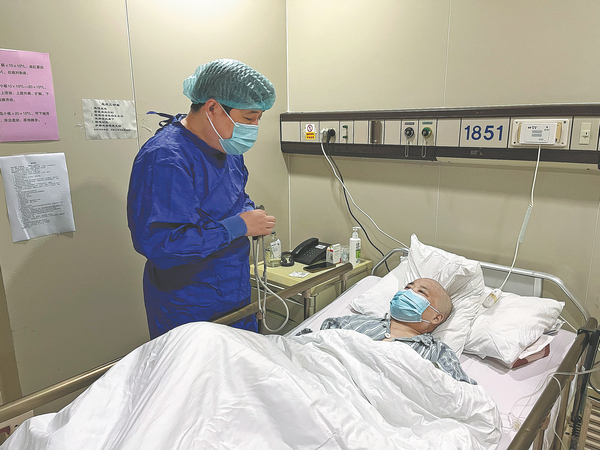
Hu, 53, is now the director of the Bone Marrow Transplantation Center of the Hematology Department, Shanghai Ruijin Hospital, and his treatment innovations have improved the outcomes for many leukemia patients.
Hematopoietic stem cell transplantation involves clearing away damaged or diseased bone marrow in a patient's body through chemotherapy and radiation therapy.
This is followed by infusing normal donor hematopoietic stem cells, and rebuilding the hematopoietic and immune system in a patient's body.
The procedure is recognized as one of the most challenging clinical treatment techniques, and requires highly skilled physicians, according to medical experts.
Hu says a patient is usually hospitalized for five to six weeks during the transplantation procedure. Doctors have to ride a roller coaster with the patient as there are many obstacles to overcome, including complications and rejection of the donor material.
"We'll be haunted by fear all the time. But I enjoy such challenges from work," says Hu, whose hospital is affiliated with Shanghai Jiao Tong University's School of Medicine.
For his patients, Hu's aim is to lessen the impact of the roller-coaster ride of treatment, by improving their outcomes, achieving a full cure, and reducing donor material rejections and recurrence of the disease.
Through constant innovations in his treatment method — intensive chemotherapy with sequential transplantation — Hu and his team have improved the long-term survival rate of patients suffering from refractory acute myeloid leukemia, or AML.Since the method was initiated in 2015, the long-term survival rate has increased from 20 percent of patients to between 50 and 60 percent.
The recurrence rate of the disease among refractory AML patients — those who do not achieve full remission after treatment — has been lowered from around 60 percent to less than 20 percent.
"That gives hope to patients and their families who originally had already lost hope. As a doctor, saving lives is always my goal. Nothing else compares with this," says Hu.
Refractory AML accounts for half of all AML cases. But these patients are often turned down by medical institutions due to the high relapse rate and risks of complications.
The increased transplantation success rate was achieved by combining established international practices with innovations introduced by Hu's team. The lower recurrence rate was a result of using new targeted medicines, which proved to have good efficacy and fewer side effects, he says.
Since the late 1990s, the international status of Hu's team has gone from follower to front-runner.
Spreading benefits
Multicenter prospective clinical research to confirm the treatment used at Shanghai Ruijin Hospital, is in the works.
Two centers in France have already introduced the Ruijin treatment for refractory AML patients. The centers include the Institut Paoli-Calmettes in Marseille, which began using it in 2019.
A published paper about the treatment method showed that 42 percent of patients could realize long-term survival, with the percentage expected to rise over the following years.
The centers in Shanghai and in Marseille have regular exchanges, with the two teams often visiting each other. Hu got to know Didier Blaise, leader of the blood and marrow transplantation and immune cellular therapy program at Institut Paoli-Calmettes, at an international conference in 2004.
During the COVID-19 pandemic, they held monthly online meetings to discuss difficult and complicated cases. Regular meetings have been maintained after that, with new ideas and research programs discussed.
In June, Hu was invited by the center in Marseille to join a hematology experts conference to help the center review its clinical treatment plans. A month later, Blaise was invited to Shanghai by Hu to review the Ruijin team's methods.
Sharing and reviewing knowledge and techniques helps research teams avoid getting stuck in a rut, Hu says. "Sometimes we need an onlooker from the outside to assess our programs from a different perspective, especially an international one, which may make our treatment approaches better recognized in international academic circles," he says.