


Exhibition unveils strange creatures of Triassic period










A fascinating glimpse into how marine reptiles ruled the seas during the Triassic period is the focus of an exhibition making a splash at the National Natural History Museum of China in Beijing.
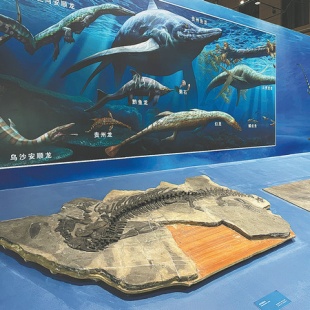
The exhibition, Loong Diving in the Ocean — The Ancient Ocean in Triassic Guizhou, opened on Sept 19. Loong, or long in pinyin, meaning dragon in Chinese, is a significant cultural icon of China. Running through to March 17, it displays 50 fossils of the marine reptiles from the Geological Museum of Guizhou.
Among the exhibits is the 8-meter-long complete skull of a Guizhouichthyosaurus, also known as a "fish lizard", and the fossil of a pregnant dinosaur, both found in Guizhou province.
"These well-preserved fossils of various sizes provide important information on how these deep sea creatures evolved from shallow water animals," Liu Shuang, a researcher at the National Natural History Museum of China, says.
Ichthyosauromorpha appeared 252 million years ago after what's known as the largest recorded mass extinction in history, which killed about 81 percent of all marine species. It was caused by the oceans becoming inhospitable to life. What has been described as the "Great Dying" was caused by global warming, and deprived ocean animals of oxygen.
Starting as land dwellers, marine reptiles quickly adapted to life in the water and dominated the sea for more than 100 million years.
The creature was discovered by Mary Anning, a 12-year-old fossil hunter, who found an ichthyosaur skeleton in the cliffs of Lyme Regis in Dorset, England, a region known as the Jurassic Coast, which was declared a UNESCO World Heritage Site in 2001.
Research into the marine reptiles in China dates back to the 1950s. In 1957, the first fossils of small marine reptiles were found by Hu Chengzhi (1917-2018) of the Geological Museum of China in Luyin village in Guizhou. The area, which lies inland today, was once under water.
The following year, the find was named Keichousaurus hui by paleontologist Yang Zhongjian (1897-1979), the first curator of the National Natural History Museum of China. The term Keichousaurus was derived from Kweichow (Guizhou) and the Greek word for "lizard".

"The discovery marked the beginning of the study of the Triassic marine tetrapod clade in China," Liu says, adding that the species has a short snout and a long neck, and is one of the most often found reptiles in the Xingyi Fauna of Guizhou.
"At the exhibition, visitors can see fossils of the mature male and female, and a baby Keichousaurus hui. Through further investigation, researchers found that certain features of the humerus were an indicator of gender," Liu says.
While Keichousaurus hui lived in shallow water, ichthyosauromorpha became more streamlined and fishlike over time in the deep sea. The 8-meter-long fossil, named Guanlingsaurus liangae, offers clues as to how the giant marine reptile evolved into a top predator.
They resembled fish and dolphins, with an elongated, toothed snout, like a crocodile.
"Ichthyosauromorpha eventually gave rise to a dolphin-like body plan witnessing, fin-like limbs, dorsal and caudal fins, indicating a high level of adaptation to the marine life. Moreover, their long snout and large eyes are conducive to adapting to marine life," Liu says.
The fossilized remains of a Qianichthyosaurus zhoui, which died while pregnant, are another highlight on display. They were discovered in Guizhou's Guanling Fauna, a place of great diversity that has offered up well-preserved and even completely articulated skeletons.
"If you take a close look at the skeleton with its embryos still inside, you can see its belly is much bigger than others. It offers a glimpse of the multiple stages in the life cycle of the species, such as how they were born, like tail or head first," Liu says.
The conclusion of the exhibition writes: "The rise and fall of ichthyosaurs were merely the blink of eye in the long history of evolution. Only by respecting and protecting nature can we improve systems of ecological conservation and achieve sustainable development."
The admission fee for the exhibition is 20 yuan ($2.74) per person.
wangqian@chinadaily.com.cn