


Words for the song
A grand project to record a millennium of cultural achievements, initiated in the 10th century, still makes an impression today, Zhao Xu reports.









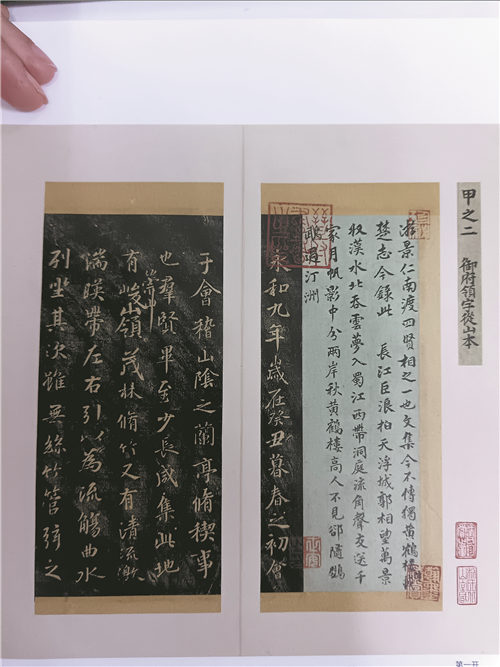
High art
The exact timelines for printing and rubbing — the latter is sometimes viewed as a type of printing in the most general sense of the word — may never be fully established. Yet it is believed that rubbing had once served as a primary way of making Confucian, Buddhist and Taoist texts available to a wider public following the invention of paper by the Chinese, which happened sometime between the first and second centuries.
However, the fast development of printing during China's Tang and Song dynasties, between the 7th and 13th centuries, meant that it eventually overtook rubbing to become the most widely used and reliable means for the provision and dissemination of textual information. Instead of becoming irrelevant, rubbing reinvented itself as a form of high art, accessible only to men of learning, who constantly added to it with their own scholarship.
"These men approached rubbings not merely as recordings of history, but rather as an inspiration. And in their tireless quest, they had reached much further back than their immediate Tang Dynasty past, to the Han Dynasty (206 BC-AD 220) and beyond," says Ho, pointing to the exhibition's featuring of Song rubbings made of inscribed steles initially erected during the Han period.
"What they were trying to do was to reconnect their society with the ancient Chinese societies, whose core values celebrating humanity allowed them to rise above what they saw as the overbearing influence of Buddhism and Taoism, both embraced by the Tang rulers at different times," she says. "At a time when the Western world was under the domination of religion, the educated elite of the Song society managed to initiate a cultural revival.
"Whatever they were able to achieve culturally and artistically was rooted in a profound understanding of history, and a keen awareness of their own role in it."
Around seven centuries after the making of Model Calligraphy From the Chunhua Era, Emperor Kangxi (1654-1722), the fourth emperor of the Qing Dynasty (1644-1911), after a careful viewing of an early copy believed to have been made from the original stones inscribed under the auspices of Zhao Jiong (Zhao Guangyi), committed his thoughts to paper. (Those stones are believed to have been destroyed in a palace fire during the reign of Zhao Jiong's grandson, Zhao Zhen, in the mid-11th century.)