


Forum examines writing's role









To study ancient Chinese civilization, researchers have to look into documents from previous eras, both handed down or discovered, integrate them and verify their accuracy, writes Qiu Xigui, paleographer at Fudan University in Shanghai.
"Otherwise it would be difficult to draw valuable conclusions," he says.
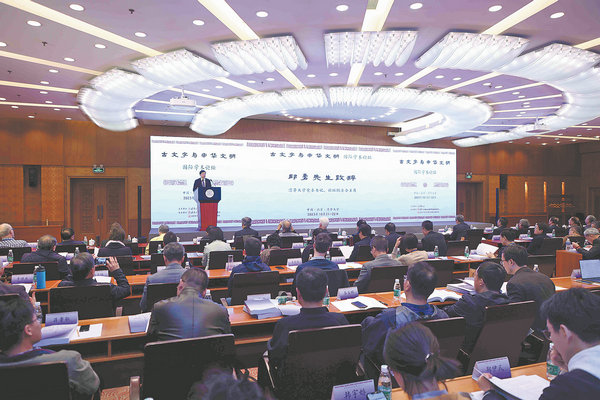
Although suffering from severe visual impairment, the 88-year-old master persists in his research. With his colleagues reading research materials for him and taking his words down for him, Qiu completed this essay delivered to a forum themed "Paleography and Chinese Civilization" held at Tsinghua University in Beijing on Oct 21.
The organizer read out the main body of the essay during the forum.
Qiu writes that paleographers should also pay attention to associated materials in cultural anthropology. There are many ideas in other populations that were similar to those of ancient Chinese people, which are of great help to better understand ancient Chinese thought, he says.
His essay made an example of this point by arguing that a character, referring to an idea similar to the anthropological concept of mana (the primitive belief of the power of elemental forces embodied in an object or person), emerged on oracle bone inscriptions from the 3,300-year-old Yinxu Ruins in Anyang, Central China's Henan province, and inscriptions on bronze ware of the early Western Zhou Dynasty (c.11th century-771 BC).
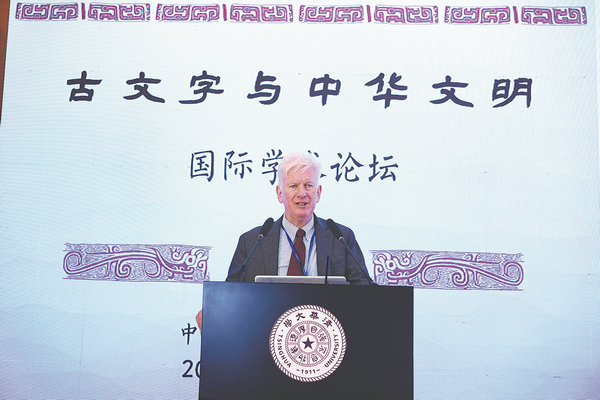
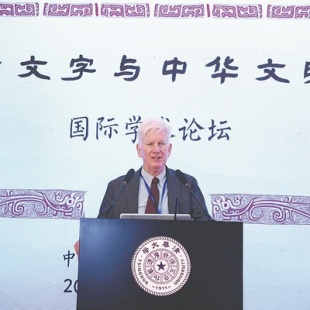
Edward L. Shaughnessy, director of the Creel Center for Chinese Paleography at the University of Chicago, clarified the meaning of a character found on oracle bone inscriptions and in ancient bamboo manuscripts.
It's an academic question the 71-year-old veteran first discussed in his doctoral dissertation four decades ago, and which he has pursued ever since.
Based on more than a decade's research into the ancient bamboo manuscripts collected by Tsinghua, Shaughnessy again expounded his explanation, which is different to that of many of his counterparts.
Huang Dekuan, director of Tsinghua's Research and Conservation Center for Unearthed Texts, concluded the two-day forum on Oct 22, saying that the study of ancient writing systems and Chinese civilization is fascinating because of its many unsolved mysteries, and that the controversies and debates around these mysteries further arouse scholarly interest and desire for knowledge.
More than 120 Chinese and foreign scholars from countries including the United States, Russia, the United Kingdom, France, Japan and Germany attended the forum, which featured topics related to the states and societies of early China, early written languages, as well as specific research into Tsinghua's collection of ancient bamboo manuscripts, which date back to the Warring States Period (475-221 BC).
Huang says that there's no need for reticence, and that Chinese and foreign scholars have obvious differences in understanding the formation of Chinese civilization and some important issues regarding the study of early Chinese history, due to differences in academic backgrounds, perspectives, methodologies and theoretical bases.
"It is precisely because of such differences that we can deepen our discussion, research and exploration of Chinese history and civilization, so as to seek the historical origins and truth of the development of Chinese civilization," he says, adding that these differences can also be seen among Chinese scholars.
Paleographical studies and new discoveries from unearthed documents offer the hope of knowing more about ancient China, Huang says.
Qiu Yong, secretary of the Communist Party of China Tsinghua University Committee, says that he hopes the forum will deepen and extend international academic cooperation on paleography, and promote exchange and mutual learning between civilizations.
Tsinghua's paleography studies will combine the Chinese and Western academic traditions, ancient and modern knowledge, liberal arts and science and technology, so as to make greater contributions, he says.
Hong Dayong, director of the National Office for Philosophy and Social Sciences, says that the National Social Science Fund of China has sponsored over 1,000 research projects into Chinese characters over the past 10 years and paleography is one of the key areas.
Since 2018, special subsidies have been disbursed to support a group of scholars working on specialized studies, including those of ancient Chinese characters and ethnic written languages.
Hong says that his office will increase financial support for paleographical studies and strengthen publicity of the research findings in the future.