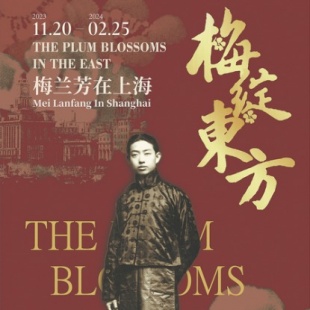



Exploring an opera legend's connections with the city










Renowned performer Mei Lanfang (1894-1961) has already been the focus of many exhibitions, but the latest to deal with the Peking Opera legend focuses solely on his connection to Shanghai, the city where he lived in later years, and where he came up with his famous innovations to the traditional art form.
An ongoing exhibition at the Shanghai History Museum, The Plum Blossoms in the East: Mei Lanfang in Shanghai, contains 191 objects, 82 of which are on public display for the first time. They include one 8-meter fan painting, as well as footage of Mei's visit to the former Soviet Union in 1935, alongside exquisite costumes, props, letters, music and other historical objects.
The exhibition is hosted by the Beijing-based Mei Lanfang Memorial Museum, Shanghai University, the Shanghai Theatre Academy, and the China Peking Opera Art Foundation, and runs till February 2024.
Born in Beijing, Mei was greatly influenced by his family of opera performers, particularly his grandfather Mei Qiaoling, who can be seen in a large ink-color painting Thirteen Stars of Tongzhi and Guangxu Reigns of the Qing Dynasty, on display at the exhibition. It was painted in the late 19th century and features 13 famous singers who contributed to the founding of Peking Opera.
Mei Lanfang began learning opera as a child and quickly earned a reputation as an accomplished nandan (a man playing a female role). He made his debut in Shanghai in 1913, when he was just 19 and one of the reasons for the exhibition is to celebrate the 110th anniversary of his first Shanghai show.
"This visit surprised him a lot, as he found that the theater in Shanghai was not the same as the traditional stages of Beijing. Here, the stage was much brighter because electric lamps were used as lighting," says Ding Jiarong, director of the Shanghai History Museum's storage department, and curator of the exhibition.
This difference proved to be a turning point in Mei's career. Unlike in Beijing, where nandan actors were usually more focused on their singing because the dim lighting meant that their movements and facial expressions were not a priority, he had to adapt to the new conditions in Shanghai, and put in more effort into other aspects of his craft.
He devised new ways of moving on stage and designed new garments, makeup and stage settings suited to a better-lit stage, giving traditional opera a modern touch, says Ding.