


The embodiment of beauty









As a melting-pot of ideas, beliefs and stunning landscapes, Jiangnan became the window through which the world viewed China, Zhao Xu reports.
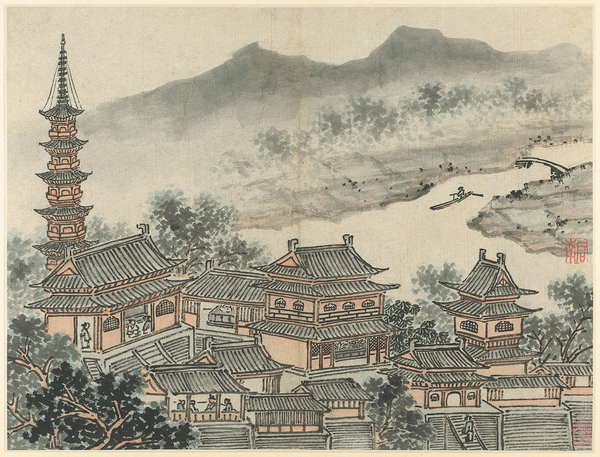
Of all the 240 items at the current exhibition China's Southern Paradise: Treasures From the Lower Yangzi Delta, at the Cleveland Museum of Art, Clarissa von Spee, the curator, has singled out one particular painting as the cover of its accompanying catalog.
"Why this one? Because it represents China and Cleveland," says Spee, noting that the piece, a leaf from a painted album by the much-celebrated 15th-century painter-calligrapher Shen Zhou, is often requested for viewing by visiting scholars drawn to the museum's enviable Chinese art collection.
"It shows water, it shows a misty landscape, it shows Buddhist temples and a pagoda, which together constitute the ultimate image of China for a Westerner living before our modern age," says the curator, who believes that her visitors will "not only see Chinese art, but will see China through art".
It's an ambitious goal Spee sought to accomplish by focusing the entire show on one specific area of China — Jiangnan, meaning "land south of the Yangtze River". Originally a terrain of wilderness to which dismissed officials were exiled, Jiangnan, throughout Chinese history, managed to reinvent itself again and again, until it became what Chinese dubbed "the land of fish and rice", marked by equally rich agricultural and artistic productions, and by extensive trade that linked it to the world beyond.
Spee's storytelling started with the ancient cultures of Hemudu (5000 BC-3300 BC) and Liangzhu (3300 BC-2300 BC), the influence of both were concentrated on the Yangtze River Delta in southeastern China, the region that would eventually become known as "Jiangnan". Although the earliest remains of silk were found in central China, silkworms depicted on Neolithic ivory and pottery from Hemudu suggest their early domestication in the south. That narrative thread would be later spun into resplendent silk to be exported to foreign markets, with Jiangnan being its indisputable center of production between the 14th and early 20th centuries.
Appreciating contrast
First to recognize the potential of Jiangnan, the people of Liangzhu, in around 3000 BC, built a grand city of 100 million square meters on its swampy marshland, before spreading their splendid jade culture inland through the area's crisscrossing waterways. Drawing everything from giant wood to raw jade from the mountains that surrounded the ancient city on three sides, these people seemed to have little use of the sea to its east.
Yet three millennia after the demise of Liangzhu, believed to have been partly caused by repeated inundation of its paddy fields by marine floodwater, that same sea would carry ships loaded with the Tang (618-907) empire's prized green stoneware to many parts of the world. Known in the West as celadon, these wares were produced by the famed kilns in Jiangnan, and contained a soft jade-green hue "taken from the verdant mountains (of Jiangnan)", to quote a contemporary author.
In the meantime, novice monks from Japan and Korea were treading the waters to Jiangnan, where, taught in monasteries by Buddhist masters, they were getting an education that was not only religious, but also literary and aesthetic.
"They were pilgrims to sites steeped in history and imbued with the mood of Chan (Zen in Japanese) Buddhism," says Spee, whose point is amply illustrated by the many long painted scrolls laid out at the exhibition, each capturing a horizontal slice of the mist-shrouded, water-saturated Jiangnan riverscape.
One of them, awash with monochrome ink, depicts mountains, lush in vegetation, emerging from a lacework of streams. On loan from the Tokyo National Museum, it was created by the 11th-century painter Li Gonglin and was meant for a Chan master who had traveled widely before arriving at a temple in Jiangnan.
"The hazy atmosphere can be read as Chan Buddhism's belief in the illusory nature of reality: Nothing is real but the Buddhist truth," she says.
Inside the monasteries, enlightenment could also be gained by gazing intently at a spartan-looking Jianyao tea bowl and "learning to appreciate the contrast between the black glaze and the white froth produced as the tea powder was whisked vigorously", to use Spee's words. (The fact that Jianyao sites — yao means kilns — were located outside the Jiangnan area, in the Chinese province of Fujian further south, has allowed the curator to highlight Jiangnan's role in serving up an abundance of beauty that China has to offer.)
"All these ideas of beauty and nature, they took with them to Japan and Korea and made them their own," says Spee. She is pointing to the influence of the Jiangnan landscape on Japanese painters of the Edo period (1603-1868), and to the continued treasuring of the Jianyao bowls in Japan, where they became known as tenmoku (tianmu in Chinese) bowls, after Tianmu Mountain in Hangzhou.
One of the best-known Jiangnan cities, Hangzhou was the capital of China's Southern Song Dynasty (1127-1279), whose territory was mainly composed of the Jiangnan region and whose emperors were, almost without exception, master calligraphers and devoted Buddhists who ruled, not unlike their ancestors, in accordance with the teachings of Confucianism.
"What these visitors to Jiangnan learned was that one can be a Taoist, Buddhist and Confucian at the same time, that the Chinese were able to tolerate several ideological currents and philosophies, and live them," says Spee.
And they kept coming well into the 14th century, as attested by a piece of calligraphy from the Chinese Chan master Chushi Fanqi (1296-1370), on display at the exhibition. In it, Fanqi, venerated in Japan as Soseki Bonki, dedicated a poem to one of his departing Japanese friends who "has long served as an attendant to great (Buddhist) masters here", and whose thoughts "are now with the ship Japan-bound".
With all that being said, not many had journeyed to China in the pre-modern era. For those who didn't make the trip, glimpses of that faraway place could be gained from what was available in the local markets.
"By the 10th century, celadon wares produced exclusively by the kilns in Jiangnan had become China's biggest export," says Chen Jie from the Shanghai Museum, which contributed 14 exhibits to the exhibition, including porcelain wares produced between the 7th and 18th centuries.
"A late 9th-to-10th century shipwreck discovered in 2003 in the Java Sea offshore of Cirebon, Indonesia, contained more than 200,000 celadon items," she says, adding that the discovery is only one of the three made since mid-1990s in the area of the Java Sea frequented by 9th-to-10th century merchant vessels loaded with large amounts of Chinese porcelain.
While scholars are still arguing over whether Southeast Asia had served as a crucial waypoint for China's maritime porcelain trade, it is widely agreed that the celadon wares were exported as far as central Africa and southern Europe.