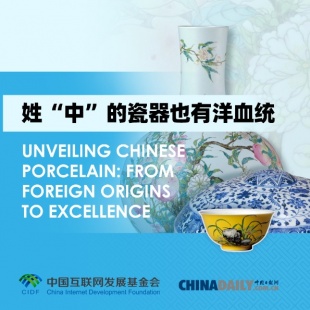



Unveiling Chinese porcelain: From foreign origins to excellence









Blue-and-white porcelain and famille rose are two iconic varieties from China, renowned for their exquisite underglaze and intricate overglaze patterns. Interestingly, their origins and evolution owe much to foreign influences in materials and techniques.
The blue-and-white style flourished during the 13th to 14th century. In its early stages, it relied on imported cobalt pigment known as "Samarra Blue" or "Sumatra Blue", which contained a higher percentage of iron dioxide, resulting in the distinct blue hue. Over time, Chinese artisans sought local mines and successfully formulated indigenous pigments. During the late Ming Dynasty (1368-1644), they experimented by blending local and imported raw materials to create pigments that not only aligned with but also shaped prevailing aesthetic preferences.
With advancements in craftsmanship and techniques, blue-and-white porcelain produced during the Kangxi era (1662-1722) of the Qing Dynasty exhibited remarkable variations in tone, reminiscent of the five hues in traditional Chinese paintings.
The emergence and evolution of blue-and-white porcelain symbolized the vibrant cross-cultural exchanges between China and the world during that period.
Likewise, famille rose porcelain emerged when a new type of ceramic, enamel-glazed porcelain, was developed in the Qing imperial palace during the early 18th century. This style was influenced by European techniques involving copper-mounted painted enamel, and was exclusively enjoyed by the imperial family. Although it won substantial popularity with the imperial family for its lustrous finish and sumptuous coloration, having also reached a high standard in artistic value, it had a brief existence of less than a century, fading away in the late 18th century.
However, the legacy of enamel-glazed porcelain was carried on by famille rose porcelain. Craftsmen at the imperial kilns in Jingdezhen drew inspiration from the cherished imperial style, creating a new variety of porcelain known for its softer and more delicate color palette. This type of porcelain excelled in nuances of tone and presented motifs and patterns in subtle color transitions.
Famille rose porcelain has continued to be produced to the present day, alongside blue-and-white, and together they represent the distinguished types of Chinese ceramics.
For more insight, watch the video and join Han Qian, a researcher of the Palace Museum, on an enlightening journey of discovery.