


Grain plants the seed of possible early East-West exchanges










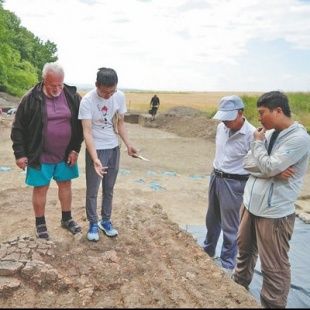
From June to September this year, after a three-year suspension due to the COVID-19 pandemic, Chinese archaeologists eventually returned to Romania to conduct a second excavation at the Dobrovat ruins site in the northeast of the European country.
It was thanks to this program in Romania, that, in 2019, Chinese archaeologists had the privilege of setting foot on European soil to conduct systematic research for the first time.
The Cucuteni culture, an important archaeological era that emerged in the late Neolithic period in southeastern Europe, had a vast distribution area ranging from the Carpathian Mountains in the west to the left bank of the Dnieper River in Ukraine, covering more than 350,000 square kilometers. The part within Ukraine is known as the Trypillia culture. Over 3,000 sites belonging to the Cucuteni-Trypillia culture have been discovered so far.
During this year's field work, the China-Romania joint archaeological team focused on the excavation and cleaning of the collapsed red-burned clay deposits of houses No 3,5 and 6 on the settlement ruins.
This revealed well-preserved architectural remains and numerous artifacts, including painted pottery shards featuring typical Cucuteni early period (c. 4300-4200 BC) motifs, such as white-painted musical note-shaped and spiral patterns.
Throughout the three-month excavation, more insights were gained into the formation processes and technological characteristics of the so-called "red-burned earthen house," one of the most noticeable cultural attributes with the Cucuteni culture, besides abundant exquisitely painted pottery.
Currently, the team has not discovered any sections of the roofs of the red-burned clay houses. Therefore, archaeologists tentatively assume that the tops of these houses were built using organic materials without a coating of mud and straw. These tops were likely to be quickly burned during the fires, leaving no trace.
According to the current excavation results, the houses in the Dobrovat settlement are arranged in rows, with 8 to 10 meters of open space between adjacent houses. These areas often contain a small number of ash pits, scattered broken pottery shards, and fragments of animal bones. Some pottery shards compressed by red-burned clay blocks show distinct honeycomb-shaped melted features, while some stone tools or rocks exhibit clear thermal fracture marks, indicating the intensity of the fires inside the houses.
However, a perplexing phenomenon is the absence of any large charcoal pieces in the red-burned clay house deposits, and the reasons for this remain to be explored.
In 1921, Swedish geologist Johan Gunnar Andersson made groundbreaking archaeological discoveries in Yangshao village in Henan province, marking the birth of modern scientific archaeology in China. However, due to the almost blank state of prehistoric archaeological discoveries in China at the time, Andersson created a controversial hypothesis of the "westward spread of painted pottery" due to Yangshao culture displaying strikingly similar painted pottery patterns to those found in southeastern Europe.
The hypothesis has been abandoned following development of archaeology.
Nevertheless, the similarities in painted pottery patterns between the Yangshao culture and the Cucuteni-Trypillia culture are still evident, raising intriguing questions about whether these similarities are coincidental or indicative of some cultural connection.
So far, in Romania no direct evidence of the East-West cultural exchange has been found in the remains of the Cucuteni culture period. However, during this year's excavation, we made the first substantial discovery of the East-West cultural exchange in the remains of a later period.
While clearing the upper deposits of the red-burned clay houses, we uncovered pitlike features directly dug in the red-burned clay deposits. These features date later than the red-burned clay houses. Some pits yielded finely incised sand-tempered pottery shards, and one ash pit even produced a complete one-handled cup with elaborately incised patterns. Based on comparisons with similar data unearthed in the neighboring Republic of Moldova, archaeologists believe these pit features are likely to be relics left by Iron-Age people from 1500 to 1000 BC.
We collected and floated soil samples from these pits. Excitingly, in addition to common local cereal seeds, many pits contained charred millet grains. This marks the first time Chinese archaeologists have discovered early millet crop remains in the European region.
As one of the major crops originating and domesticated in China, millet (especially broomcorn millet) possesses biological advantages such as a short growth cycle, cold resistance, and drought tolerance.
It was favored by mobile populations residing in ecologically marginal zones. In the middle to late second millennium BC, as the climate in the northern Eurasian continent shifted toward aridity, earlier pastoralist groups gradually adopted a nomadic lifestyle.
The seasonal migrations and interactions between different groups along the east-west axis formed a "prehistoric Silk Road "more than 1,000 years before the historical Silk Road. Along this route, the Chinese-originated millet was intentionally chosen for cultivation and dissemination, passing through Central and West Asia before reaching Europe.
In the 1950s and 1960s, European scholars found suspected remains of millet and other grain crops in some prehistoric sites. However, many were indirect evidence due to the limited technological conditions at the time.
Before long, the millet grains floated were sent to the Beta Laboratory in the United States for dating. One of the millet samples even dates to the early 15th century BC. Interestingly, multiple samples date to varied time periods spanning from the early Iron Age to the Medieval period. These tiny millet grains are the true witness of the long-lasting East-West cultural exchange in agriculture across the Eurasian continent.
Wen Chenghao is a research assistant with Institute of Archaeology, Chinese Academy of Social Sciences.