Well-founded confidence










China will prevail against US efforts to constrain its development thanks to its rise as a tech society
While experts debate whether the United States' normalization of "major power competition" has returned the world to a new Cold War, it's certainly clear in Beijing that Washington aims to contain and suppress China's rise as a technological power, the clearest evidence being the US CHIPS Act (2022) that aims to prevent China from acquiring advanced computer chips — the essential component of many high-tech products and applications — while ensuring the US is the dominant player.
In fact, China has emerged as a major power in this new era precisely because it has already established itself as a technology power, although experts disagree on to what extent China has risen to a true No 2 position vis-a-vis the US and to what extent China has equaled and in some cases surpassed the US in some tech fields.
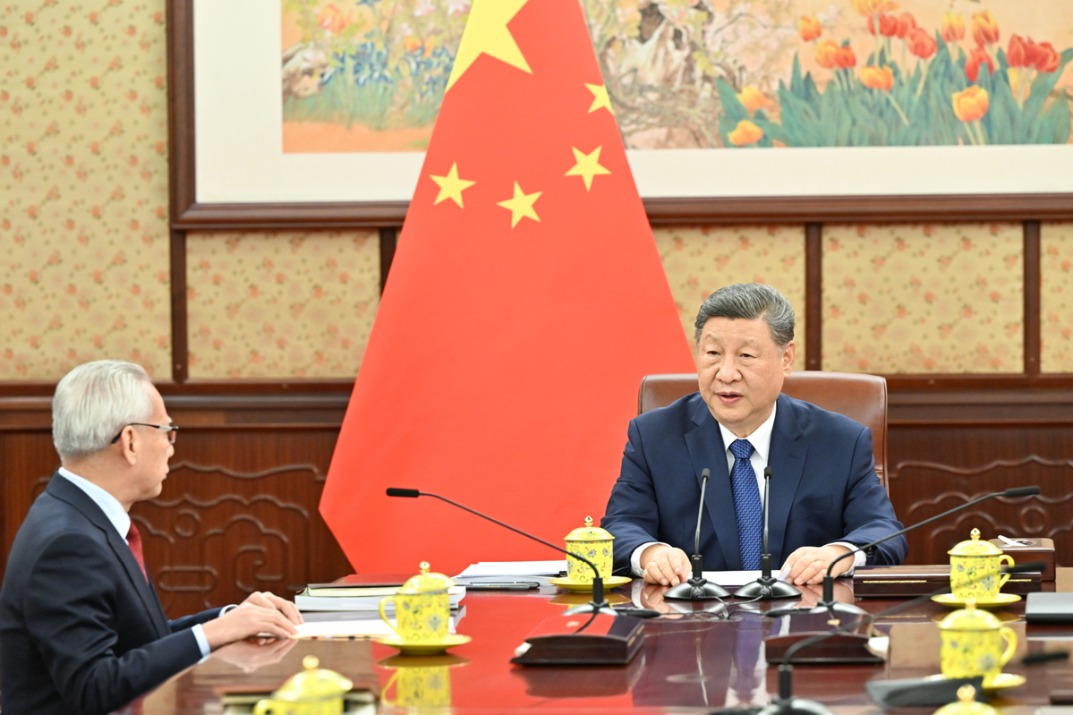
Nevertheless, with the US now waging what some call tech decoupling and others a tech war, and key figures in the Joe Biden administration such as US Commerce Secretary Gina Raimondo describing China as "the greatest threat the US has ever faced", with the US Congress preparing new anti-China legislation aiming to cripple Chinese modernization, President Xi Jinping has responded by asserting China's right to development, describing US policies as "technology blockades" necessitating "indigenous innovation", and above all expressing confidence that China will "prevail".There are many compelling reasons why his confidence is well-founded, but there's one above all others that's often overlooked when evaluating which side is winning.
But first, those keeping score share some consensus: the US is still winning in core technologies, semiconductors, quantum computers and cutting-edge military and space development. China has pulled ahead in 5G and 6G, smartphones and telecom network gear, electric vehicles, commercial drones, batteries, solar panels and other renewable energy products, smart cities and STEM education. By some accounts, competition is neck-and-neck in artificial intelligence, social media, mobile games, vaccines and R&D investment. In some fields, including finance, banking, digital currencies and online payments, for example, results are mixed, with China ahead in some areas and the US in others.
More important, perhaps, is that China is winning as an advanced technological society. In a paper I published last year in the Journal of Chinese Political Science, I argued that the primary contradiction China faced in the modern period, starting roughly in the 19th century, was a profound technology gap between it and the leading powers. This gap left China vulnerable to foreign aggression while revealing long-standing limits associated with China's feudal or semi-feudal society and relations of production.
I argued the technology gap should be understood in two ways: first, as we commonly understand it, in terms of advances in basic sciences, industrialization and innovation of tech products; and second as the development of a national "technological society", that is, one socially capable of mobilizing and solving technical challenges whatever their characteristics or origin.
With the respect to the first gap, as noted above, despite some important lags, China has drawn level with the US in many technologies and surpassed it in others. With respect to the second gap, establishing a technological society, China has taken the lead.
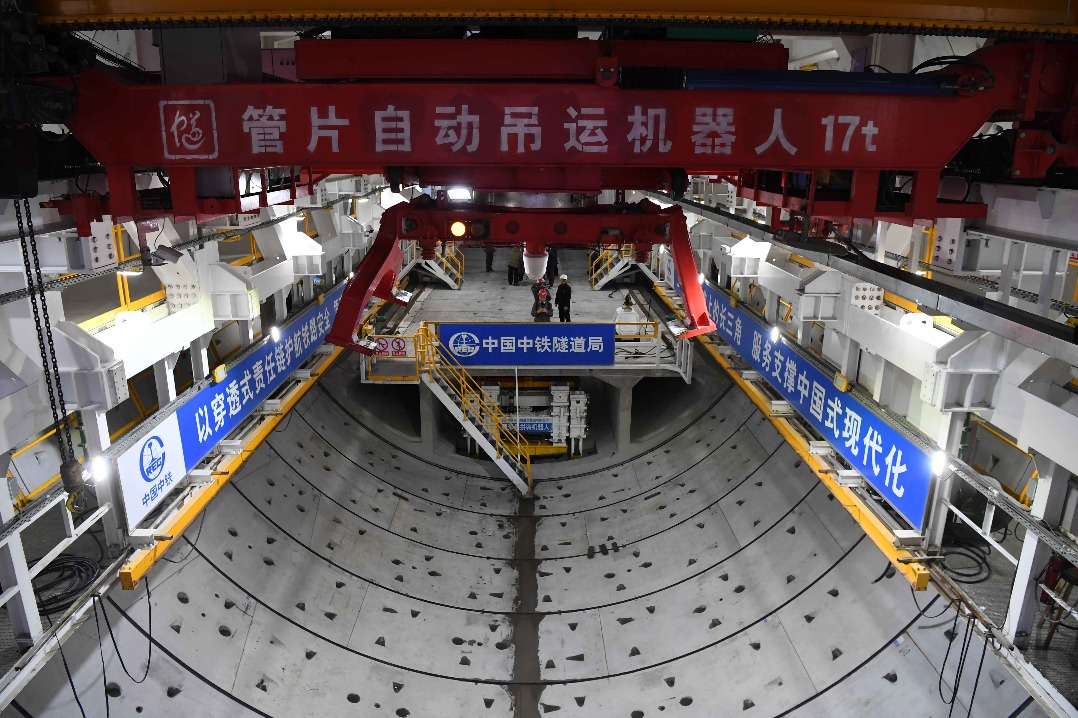
Evidence of that is found in China's world-leading national industrial system, world-class infrastructure, and its green innovation and development. It's also the case that it was through the progressive development of a China's technological society that other achievements have been possible, including lifting about 800 million people out of abject poverty, eliminating extreme poverty altogether, and establishing a middle-income population exceeding 400 million.
These achievements are rightfully credited to a political system described as "whole process people's democracy", which has advanced national rejuvenation through a high level of political, social, commercial and industrial coordination. This is what has propelled China's modernization and its emergence as a technology power, as a world leader in technology production but likewise the world's most advanced technological society.
While the US efforts to curtail China's access to advanced technology have certainly provoked significant concerns in Beijing, the US gravely underestimates China's rise as a technological society. On the one hand, an advanced technological society does not need the most advanced technologies in order to succeed: this was observed during the COVID-19 pandemic, for example, with the US developing more advanced, mRNA vaccines, while China used the older technologies. The newer vaccine methods may have been more effective, but they were also more costly and harder to distribute, and because they were not paired sufficiently with other public health measures requiring a high-functioning technological society, the US' response to the pandemic was catastrophic.
On the other hand, because advanced technological societies have advantages when it comes to solving national problems, and because China's advancement has also included closing the technology gap overall, it's likely that China will also innovate effective solutions to problems stemming from the US tech war, and likewise continue to develop solutions for other problems, including climate change. This is why President Xi's confidence that China will prevail is not misplaced.
The author is a professor of politics and international relations at East China Normal University and a senior research fellow with the Institute for the Development of Socialism with Chinese Characteristics at Southeast University and the Hainan CGE Peace Development Foundation. The author contributed this article to China Watch, a think tank powered by China Daily.
The views do not necessarily reflect those of China Daily.
Contact the editor at editor@chinawatch.cn