Researchers raise cloned rhesus monkey to adulthood









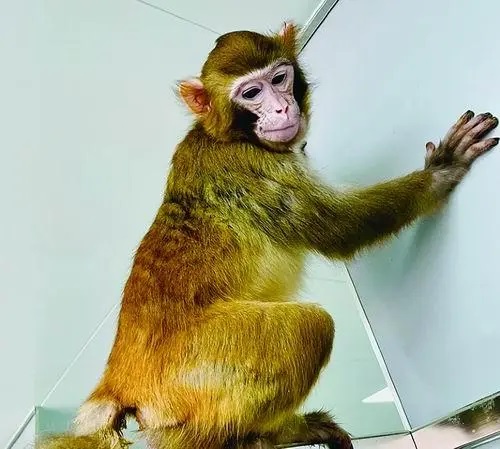
Chinese researchers have published a paper in the journal Nature Communications, reporting the successful cloning and survival to three years of a healthy rhesus monkey.
The monkey, named ReTro, is the world's first cloned rhesus monkey to reach adulthood. The study suggests that a promising cloning strategy for primates has been found through replacing a type of cell that helps provide nutrients to the embryo, enhancing the understanding of reproductive cloning mechanisms in primates and potentially improving its efficiency.
The research paper, published on Jan 16, mentions that in traditional cloning methods, most mammals have extremely low live birth rates, ranging from 1 percent to 3 percent, with high rates of embryo and newborn mortality.
Previous studies have indicated that cloned piglets and mice have shown abnormal placental structures compared to those derived from artificial insemination, and bovine and sheep embryos have experienced fetal losses due to placental defects.
The Chinese research team — including Sun Qiang and Liu Zhen from the Center for Excellence in Brain Science and Intelligence Technology of the Chinese Academy of Sciences, along with Lu Fulong from the Institute of Genetics and Developmental Biology of the Chinese Academy of Sciences — established a cell replacement method that allowed the successfully cloned rhesus monkey to survive for over two years.
Sun and his team have been dedicated to primate cloning technology research for the past 10 years and have achieved several significant breakthroughs, which have had a considerable impact in the international academic community.
About 20 years ago, Sun stayed in the mountains in Xishuangbanna Dai autonomous prefecture, Yunnan province, for four years. During this time, he spent every day with the monkeys on the mountain, observing and conducting research. Finally, on the day of the 2007 traditional Chinese solar term Beginning of Spring, his team successfully established China's first group of test-tube macaques.
This was the first representative achievement of Sun and his team, and a photo of the first test-tube monkey has been displayed on Sun's desk ever since.
"Surviving macaques obtained through assisted reproduction methods were reported in the United States as early as the 1980s. Whether it's creating transgenic and gene-edited monkeys or conducting monkey somatic cell cloning research, mastery of assisted reproductive technology in monkeys is a prerequisite," Sun said.
In 2017, the world's first cloned monkey was born in China. "Cloned monkeys" were listed as one of the top 10 popular science and technology terms by the National Language Resources Monitoring Center in China and were also selected by the Ministry of Science and Technology as one of China's top 10 scientific advances in 2018.
"This technology can potentially be used to construct non-human primate animal models with consistent genetic backgrounds and genotypes for applications in biomedical research," Sun said.
"Both Zhong Zhong and Hua Hua have now reached sexual maturity, are very healthy, live with other monkeys, and have produced offspring of their own," Sun said.
The Institute of Neuroscience of the Chinese Academy of Sciences' non-human primate platform is located on the remote Xishan Island in Suzhou, Jiangsu province.
At just 30 years old, Liu became the youngest team leader at the institute. When tackling the challenge of cloning monkeys in 2017, Liu spent nearly six months sitting in front of a microscope for up to six hours a day, manipulating mouse embryos and honing his skills to complete the removal of an egg cell nucleus in less than 10 seconds. The veterinary team also worked around the clock, observing the monkeys' menstrual cycles and births.
Newborn monkeys need to be fed every two to three hours, even at night. Without mental preparation, it's challenging to perform this job well. During the most difficult times at the platform, only seven people remained, but they persevered.
Sun said: "In past years, some masters came here to seek employment, applying for basic veterinary positions. I asked them to first become familiar with the monkeys. As a result, after a little over a month, they left because the living environment was not convenient enough or they couldn't accept starting monkey veterinary training from scratch."
The new breakthrough in primate cloning technology has sparked lively discussions internationally. However, Sun and his team have not stopped their efforts. Just this week he arrived at a monkey research base in Yunnan to embark on new research endeavors.
yandongjie@chinadaily.com.cn




- Eight missing after cargo ship collides with fishing vessel near Shandong
- Investing in people: a worthwhile investment
- Exhibition commemorating the epic relocation of universities opens in Fujian
- Twelve punished for scaffold collapse that killed 7 in Shandong
- Slovenian official visits whole-process people's democracy practice site of CPPCC committees
- China's commercial rocket maker puts two satellites into orbit