Xi Focus-Profile: Xi Jinping, man of culture










In 1982, Xi started working in Zhengding, a historical county in Hebei province, first as deputy Party chief and then as Party chief. After discovering two ancient locust trees in his workplace, he had them verified for age and fenced off for protection. He also initiated a comprehensive survey of cultural relics throughout the county, and holistic conservation efforts began.
Xi's profound passion for history and culture was so intense that, at one point, he considered pursuing archaeology; however, this interest extended beyond mere personal fascination.
He often shares an ancient Chinese proverb with officials and foreign friends, advocating the use of history as a compass for present and future endeavors. He believes that drawing lessons from tradition is instrumental in formulating policy decisions.
Situated in Zhejiang province, the archaeological ruins of Liangzhu, now a UNESCO World Heritage Site, were surrounded by mining fields in the early 2000s. The excessive industrial dust and noise pollution transformed the entire area into what Jiang Weidong, an official from the site's management committee, described as "something like a war zone."
Upon learning about this situation in July 2003, Xi, then Party chief of Zhejiang, promptly ordered the closure of the mines. His dedication toward Liangzhu endured throughout the subsequent decades. As archaeologists confirmed the significance of Liangzhu as a testament to 5,000 years of Chinese civilization, he gave meticulous instructions for its protection. In his congratulatory message to the inaugural Liangzhu Forum last year, Xi hailed the site as a treasure of world civilizations.
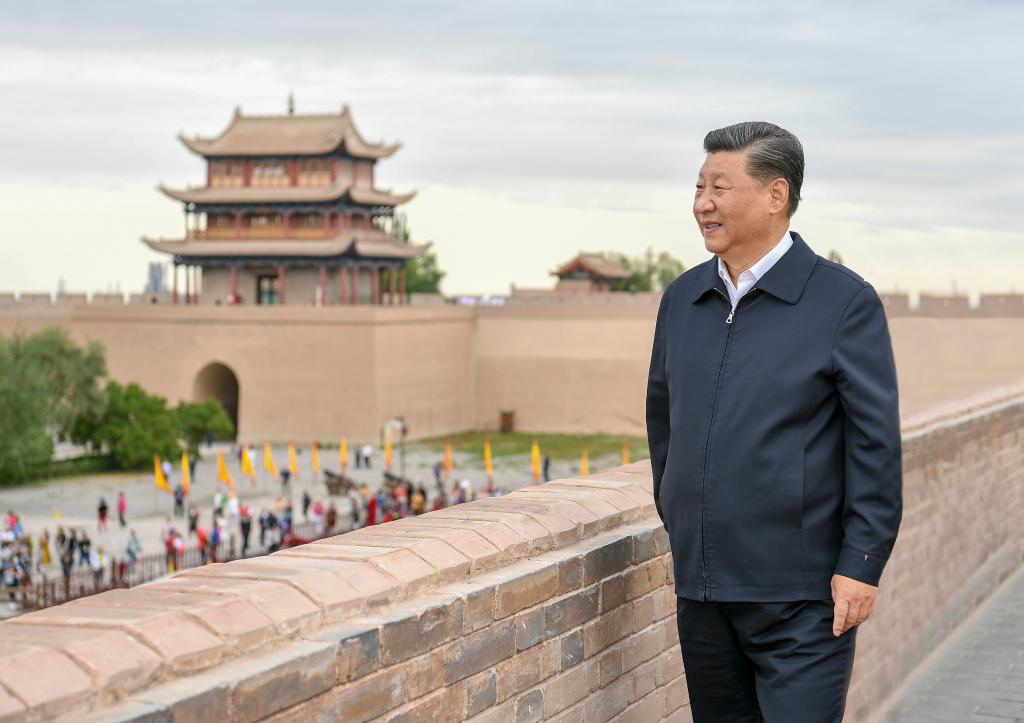
Since taking on the Party's leading role -- general secretary of the CPC Central Committee -- in 2012, Xi has issued over 170 significant instructions regarding cultural relics, archaeology, and intangible cultural heritage. He has also conducted over 100 on-site inspections of historical and cultural sites.
Xi also harbors a deep love for "Red Culture." Over the years, he has visited almost every significant historical site related to critical chapters of the revolutionary past. These locations include a lake in Zhejiang, where the first CPC National Congress was held in 1921, and Fragrant Hills in suburban Beijing, where elder Party leaders laid the foundation for the establishment of New China.
"While journeying toward success, remember where we came from," Xi said.
He is a fan of rich human cultures. Speaking about his extensive travels across the world, Xi said, "Delving into the diverse civilizations across the five continents brings me the utmost joy."
Since assuming the presidency, Xi has visited over 70 countries. In Greece, he discussed an ancient Chinese phrase about stopping wars and Athena's contemplation of war and peace. He drew parallels between Chinese tea and Belgian beer in Belgium, highlighting the value of appreciating different cultures. In Mexico, he showed keen interest in the similarities between elements of the Maya civilization and Chinese elements like the dragon. In the Luxor Temple in Egypt, he spoke about the origins and developments of ancient civilizations.
Xi also shared personal reflections on literature, such as his impressions of Ernest Hemingway's "The Old Man and the Sea" and his experiences visiting places associated with Hemingway in Cuba.
People familiar with Xi say that his cultural upbringing has profoundly influenced his strong sense of idealism and his pragmatic approach to work. He often refers to the philosophy of "Zhi Xing He Yi," or "unity of knowledge and action," advocated by the ancient Chinese philosopher Wang Yangming (1472-1529), and considers it an essence of traditional Chinese culture.