Paralyzed patient regains motor skills with implant









Brain-computer interface decodes neural signals, commands special glove to move
Chinese researchers recently announced that the first of two quadriplegic patients to be implanted with a domestic braincomputer interface has recovered some motor skills.
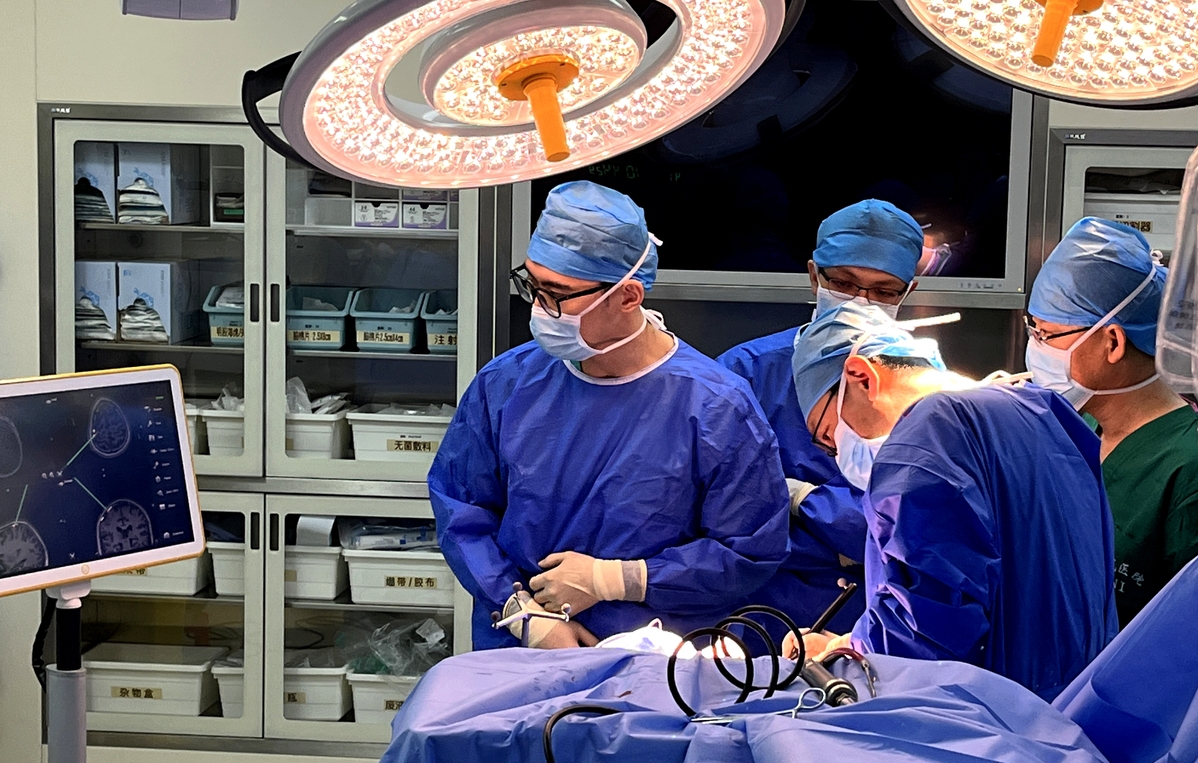
The first patient, a 54-year-old man who was paralyzed from the neck down after a car accident in 2010, received a homegrown implant linking brain signals to computers in a clinical trial performed at Xuanwu Hospital affiliated to Capital Medical University in Beijing on Oct 24.
The implant, called the Neural Electronic Opportunity, is about the size of a coin and is wireless and minimally invasive. Two of the implants were placed inside the patient's skull in a region that avoids damaging neural tissues.
The patient was released from the hospital 10 days later. After three months of rehabilitation and training at home, he is now able to grasp a bottle and drink water by wearing a special glove with a neurological link to the implant, said Tsinghua University, who jointly developed the system with Xuanwu Hospital.
In a statement released on Wednesday, the university said once a machine learning algorithm is in place, he will be able to feed himself. "With further development of the system, the patient will be able to restore multiple hand movements and functions," the statement said.
Zhao Guoguang, president of Xuanwu Hospital and leader of the surgical team, said during an interview with Beijing Radio and Television Network that by wearing the glove, the patient can grab a bottle with 90 percent accuracy.
"Damaged functions of the spinal cord are also showing signs of improvement, and the patient said he has begun feeling some temperature differences in his hands," he added.
The second patient, who had sustained a spinal cord injury, underwent the implant surgery at Beijing Tiantan Hospital on Dec 19. The system is functioning normally, and the patient is undergoing rehabilitation at home, the university said.
Both surgical trials passed ethical review before commencement and were registered domestically and internationally, researchers said.
A brain-computer interface system builds a communication pathway between the brain and an external device such as a computer by tracking and analyzing brain signals.
It has the potential to help patients with spinal cord injuries or diseases such as amyotrophic lateral sclerosis and epilepsy to regain movement, according to experts, who added that such technology could also help boost people's information processing capacity.
One of the most well-known institutions tapping into the field has been Neuralink, founded by United States billionaire Elon Musk.
Musk said on Jan 29 that the company's implant was implanted in a patient for the first time a day earlier, and initial results showed promising neuron spike detection.
Chinese researchers said the domestic brain-computer interface system has an edge over its foreign counterparts in that the implantation will not damage brain tissues, averting inflammation, scarring and other adverse conditions.
Another plus is the system does not require putting a battery inside the human body.
Tsinghua University said the next phase of the study is to advance rehabilitation protocols to accelerate neural growth at the site of damaged spinal cord segments.
Zhao, the hospital president, said more efforts will be made to build algorithms, expand treatment methods and formulate diagnoses and treatment protocols for brain-computer interface systems to widen the technology's application and benefit more patients.