


Diversity powers ancient Silk Road hub's modern development









URUMQI — At the northwestern edge of the Taklimakan Desert, China's largest desert, a modern oasis city has emerged over a period of two decades.
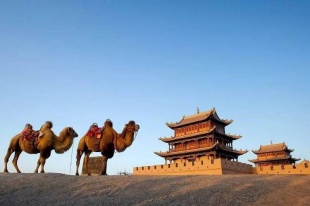
About 10 kilometers north of the downtown area, the ruins of an ancient city sit on a mountain, with beacon towers on the peak and shrines among the cliffs.
The 20-year-old city and the ancient ruins dating back some 2,000 years are both part of the city of Tumxuk in Northwest China's Xinjiang Uygur autonomous region. Envoys, merchants, farmers, Sinologists and archaeologists have all left their footprints in Tumxuk, and their contributions have powered the city's modern development.
Local residents call the ancient ruins Tangwangcheng (meaning "Tang King City"), as records show they found coins there dating back to the Tang Dynasty (618-907). Ramparts, columns and ancient river courses can be seen among the ruins, which cover more than 700,000 square meters.
According to Lin Meicun, a professor at the School of Archaeology and Museology of Peking University, the site bears witness to the ancient Silk Road. Having studied documents and relics found at the site, such as ancient chariot accessories unearthed in Tangwangcheng and its surroundings, Lin believes that the ruins are those of "Pantuo City", which is mentioned in official historical texts.
Envoys and merchants from the central part of China used the ancient Silk Road to transport silk and spread iron-smelting and well-digging technology westward, at the same time adopting the grapes and alfalfa of the country's western region, according to archaeologists.
However, Tangwangcheng may no longer have been habitable during the Song Dynasty (960-1279), says Li Zongqian, director of Xinjiang reclamation history museum in Tumxuk. "At that time, as natural conditions deteriorated, the river near Tangwangcheng stopped flowing, and people could no longer farm or live here," says Li.
In the late 19th and early 20th century, explorers from countries, including France, Britain and Germany, took relics away from China, but they also aroused the world's interest in the ancient culture of Xinjiang and the Silk Road civilization. Meanwhile, Chinese academics were also becoming interested, and generations of Chinese archaeologists have investigated relics in Xinjiang, including at Tangwangcheng, since then.
Tangwangcheng was placed under national-level protection in 2001. In the past two years, national and regional institutions have jointly conducted two phases of investigations and excavations of the site of Tangwangcheng.
In the first phase, archaeologists unearthed over 500 objects, such as bronze mirrors, monkey-shaped Buddha statues, pottery and coins from the Tang Dynasty, some 40 items of which are exhibited at the Xinjiang reclamation history museum.
"Tangwangcheng is a rare, comprehensive relics site. It provides important information for us to explore the social life, religious beliefs and cultural exchanges between the East and the West in Xinjiang," says Yang Rui, the archaeological excavation team leader for Tangwangcheng.
Yan Panning, a resident of Tumxuk, started working as a guide at the Xinjiang reclamation history museum last year. She says the job has deepened her understanding of Tumxuk's long history.
"The cultural relics, such as Gandhara sculptures and colorful murals, represent Tumxuk's importance. I hope to tell the story of Tangwangcheng to more people," she says.
The ancient Silk Road hub has ushered in a new chapter in modern development in recent decades. Since 1949, the central government has mobilized people to develop Xinjiang's desert regions, which nowadays includes Tumxuk and its surrounding area. People gradually reclaimed land, dug canals, built houses and roads, and planted crops and trees.
Around 50 percent of the city's land consists of urban green areas, while water is provided by six reservoirs with a designed total storage capacity of 830 million cubic meters in 2022. The population has grown from 110,000 when it was established in 2004 to over 300,000.
Xie Jiagui, dean of the Research Institute of Tangwangcheng History and Culture, says he could hardly have imagined the city's fast-track development when he witnessed the birth of Tumxuk 20 years ago, and he is still engaged in the research of Tangwangcheng and Tumxuk.
"Tracing the history of Tumxuk is important to understanding the people who once lived on this land and what happened here," the 62-year-old says. "I hope to seek experience from the past to serve Tumxuk's modern development."
Xinhua