Chinese scientists find clues about origin of cosmic rays









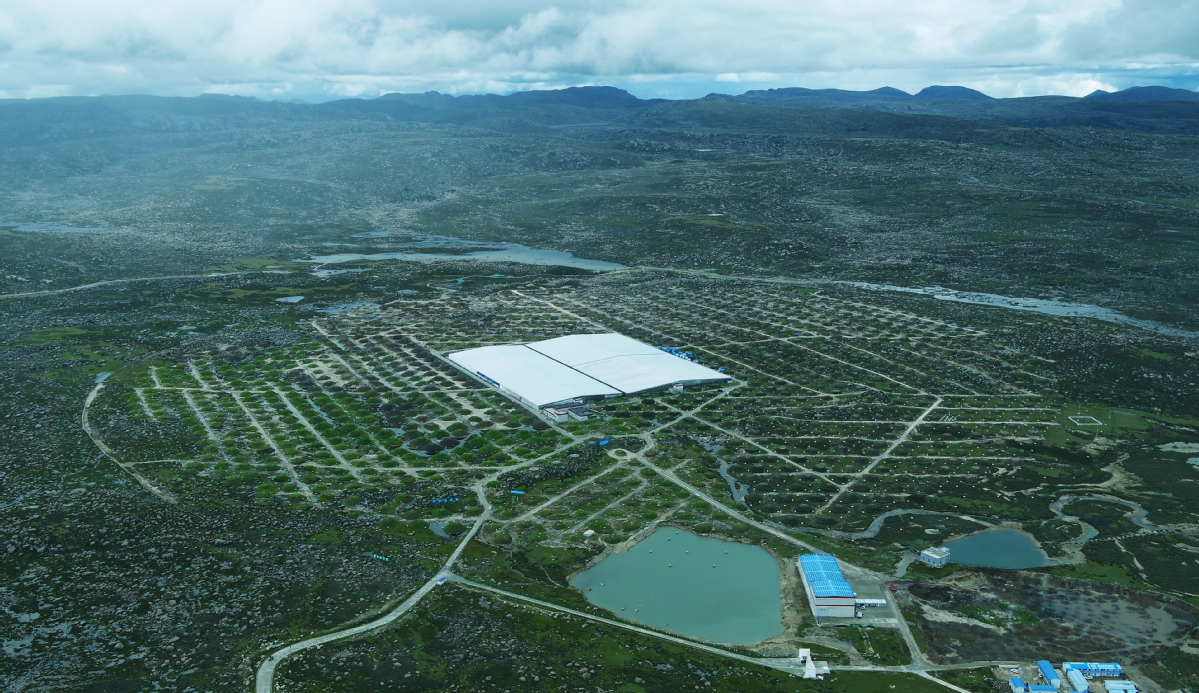
Scientists have discovered a giant bubble of ultra-high-energy gamma rays in the Cygnus constellation, offering the first clue to the origin of cosmic rays exceeding 10 peta-electron volts, according to a study published on Monday in Science Bulletin.
The Large High Altitude Air Shower Observatory in China made the groundbreaking discovery, revealing a "super cosmic ray accelerator" within the bubble. This accelerator continuously produces high-energy particles that collide with interstellar gas, generating the observed gamma rays.
Cosmic rays are charged particles from space, mainly protons, whose source and acceleration mechanisms remain a major mystery in astrophysics. Past observations revealed the cosmic ray energy spectrum is made up of several peta-electron volts, suggesting the Milky Way itself accelerates particles up to that limit.
However, the origin of higher-energy cosmic rays remained unknown. LHAASO's discovery fills this gap, pinpointing a massive star cluster known as Cygnus OB2 within the bubble as the likely accelerator. This cluster contains young, hot stars with powerful stellar winds, creating ideal conditions for particle acceleration.
"By monitoring gamma rays, we can infer their origins," explained study leader Cao Zhen from the Institute of High Energy Physics. "Gamma rays travel straight, unlike charged particles deflected by magnetic fields, allowing us to trace them back to their source."
The discovery also suggests the accelerator significantly increases cosmic ray density around it, potentially explaining previously detected diffuse gamma-ray emissions.
"This not only impacts our understanding of diffuse emission but also has implications for describing cosmic ray transport in the galaxy," said renowned astrophysicist Elena Amato of the Italian National Institute for Astrophysics.
Located at an altitude of 4,410 meters on Mount Haizi in Daocheng county, Sichuan province, LHAASO, the world's most sensitive ultra-high-energy gamma-ray detector, is a key national scientific facility in China.




- Tianmen grand bridge under construction in Guizhou
- International mayors attend ice and snow expo in Harbin
- Trumpet trees blanket district in Xiamen with purple blossoms
- International mayors gather in Harbin to explore ice and snow economy
- Understand China in the new era: What Chinese modernization means for the world
- In pics: skyline in morning glow in Beijing