


Tracing a golden legacy









A Beijing handicraft factory is carrying forward tradition and innovation, giving new mettle to old metal with designs that shine across time, Chen Nan reports.
Editor's note: Traditional arts and crafts are supreme samples of Chinese cultural heritage. China Daily is running this series to show how master artisans are using dedication and innovation to inject new life into these age-old heritages. In this installment, we examine how the ancient craft of cloisonne reflects our modern lives.
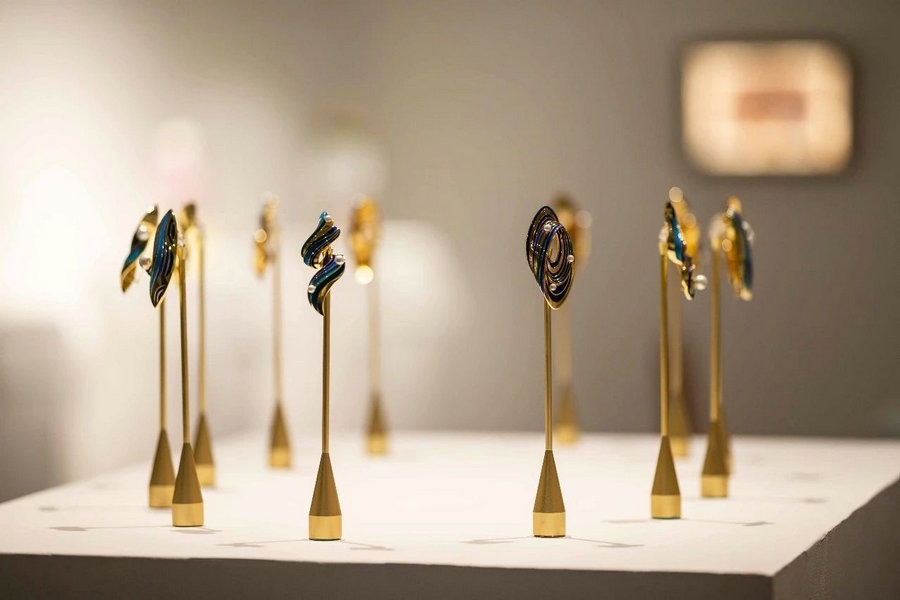
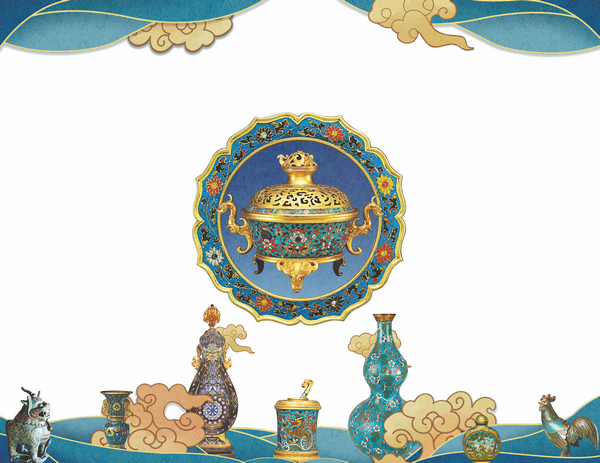
You'll see large cloisonne vases, striking plates and other colorful pieces in Beijing Gongmei Group's arts-and-crafts factory's studio near Yonghegong, or the Lama Temple, in the capital.
Gaze upon these long enough, and you will be stunned by the diversity of distinctive Chinese patterns traced by countless thin golden wires.
"It's said that there are 108 steps in the process of producing cloisonne goods," says the factory's director, 59-year-old Zhang Yongzhen, who has practiced the craft for four decades.
"I don't know the exact number. But I can tell you that the traditional handicraft is very sophisticated. No one can finish the whole process by himself or herself. It's a delicate art that takes dedication to every small step."
Cloisonne, or jingtailan in Chinese, is the technique of creating designs on metal with colored-glass paste, or enamel, that fills in spaces among copper or bronze wiring that's bent or hammered into patterns.
The fundamentals include shaping the object's body; bending and inlaying copper wires to render surface patterns; coloring in the shapes these wires form with metallic oxides; heating — since the enamel usually shrinks after firing, this process is repeated to fully fill in the designs — and, finally, polishing and gilding.
The technique was introduced to China in the late 13th century. It's believed that cloisonne reached its peak and was given its present Chinese name during the reign of Emperor Jingtai in the Ming Dynasty (1368-1644). Lan means blue in Chinese, and jingtailan goods were typically infused with a special dark blue enamel as the base color.
The craft was further developed in the Qing Dynasty (1644-1911), following innovations in copper-smelting techniques.