Cosmic ray discovery, AI weather forecasting among year's Top 10









Precise weather forecasting through the use of large-scale artificial intelligence models and the unveiling of the mechanism driving aging in the human genome were among the Top 10 Scientific Advances in China last year, according to the National Natural Science Foundation of China.
The scientific breakthroughs in the Top 10 list, which was released on Thursday, span fields including the life sciences, medicine, artificial intelligence, quantum physics and astronomy.
They include the discovery of the existence of a tangible biological clock in the brain and its rhythmic regulatory mechanism, the revelation of new mechanisms for initiating human cell DNA replication, and the discovery of a giant bubble of ultra-high-energy gamma rays in the Cygnus constellation that offers the first clue to the origin of high-energy cosmic rays.
A team of experts in cloud computing from Huawei used AI methods to construct the Pangu meteorological large-scale model, which improved on the forecast lead time of the European Centre for Medium-Range Weather Forecasts' integrated forecast system by more than 14 hours.
In the latter half of the last century, Chinese meteorologists established an equation system based on atmospheric dynamics and used supercomputers for numerical simulations to predict weather. However, those methods encountered bottlenecks over the past decade, with slow improvements in prediction accuracy and enormous consumption of computational power.
"The Pangu meteorological large-scale model surpassed traditional numerical methods in the accuracy of forecasting certain meteorological elements and increased reasoning efficiency by tens of thousands of times," said Mu Mu, an academician of the Chinese Academy of Sciences and distinguished professor of atmospheric and oceanic sciences at Fudan University.
The Pangu model achieved more accurate predictions of important weather elements such as temperature, air pressure, humidity and wind speed, and could also be used to forecast extreme weather events, he said.
Among the 88 named typhoons in 2018, the absolute error in 3-day and 5-day forecasts of typhoon eye positions by the Pangu model was reduced by over 25 percent compared to those of the European Centre for Medium-Range Weather Forecasts system. During the flood season last year, the Pangu model successfully predicted the paths of strong typhoons such as Mawar, Talim, Doksuri and Rumbia that affected China.
The foundation has released the Top 10 Scientific Advances in China every year since 2005.
The journal China Basic Sciences and other publications recommended over 600 scientific research achievements officially published between Dec 1, 2022, and Nov 30. Nearly 100 experts in relevant disciplines selected 30 of them, and more than 2,100 experts in basic research, including academicians of the CAS and the Chinese Academy of Engineering, selected the 10 best from the shortlist.
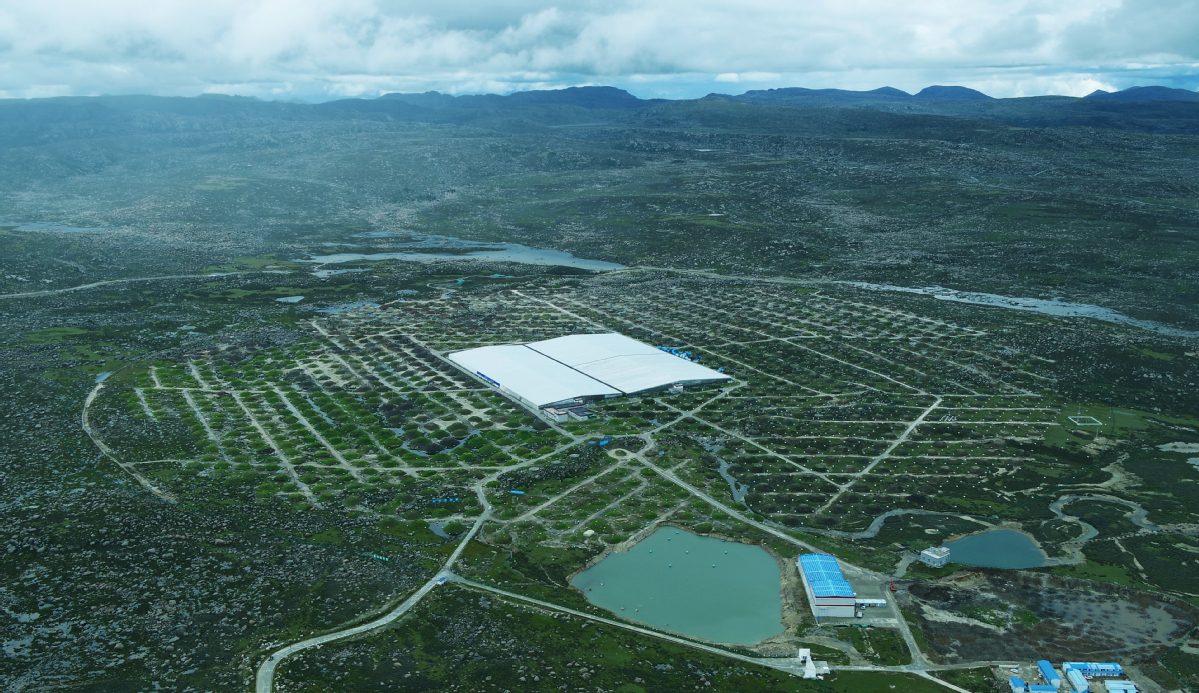
One groundbreaking discovery on the list was made by the Large High Altitude Air Shower Observatory, the world's most sensitive ultra-high-energy gamma ray detector.
A key national scientific facility in Sichuan province, it revealed a "super cosmic ray accelerator" in a giant bubble of ultra-high-energy gamma rays in the Cygnus constellation.
Cosmic rays are charged particles from space, mainly protons, whose source and acceleration mechanisms remain a major mystery in astrophysics. Past observations revealed the cosmic ray energy spectrum comprises several peta-electron volts, suggesting the Milky Way itself accelerates particles up to that limit.
However, the origin of higher-energy cosmic rays remained unknown. The observatory's discovery filled this gap, pinpointing a massive star cluster known as Cygnus OB2 within the bubble as the likely accelerator. The cluster contains young, hot stars with powerful stellar winds, creating ideal conditions for particle acceleration.
"By monitoring gamma rays, we can infer their origins," said study leader Cao Zhen from the Institute of High Energy Physics. "Gamma rays travel straight, unlike charged particles deflected by magnetic fields, allowing us to trace them back to their source."
The discovery also suggests the accelerator significantly increases cosmic ray density around it, potentially explaining previously detected diffuse gamma-ray emissions.






- Interest in Turkiye soars among Chinese tourists after introduction of visa-free entry
- Yunnan e-bike fire probe identifies raft of failings
- Investigation report released on e-bike fire that killed 8 in Southwest China
- Understanding Xi's vision of China and the world through New Year message
- 'Artificial sun' experiment finds way to break plasma density limit
- China reports 20% rise in inter-regional trips on first day of holiday