China's advancements in global innovation dynamics inspiring









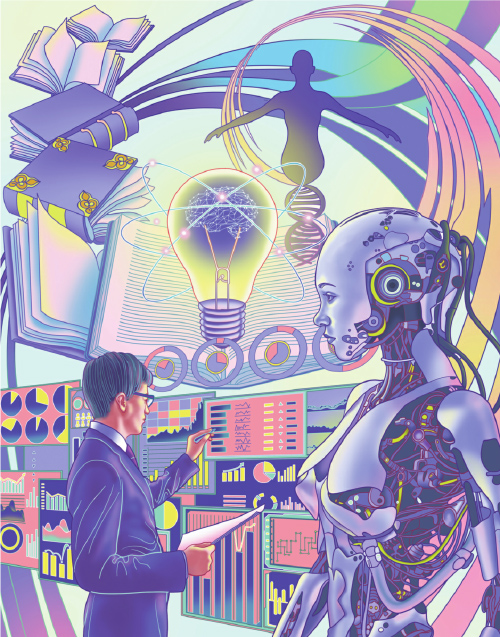
The launch of ChatGPT in November 2022 and the release of the first text-generated video model Sora last month symbolize key advancements in frontier technologies such as artificial intelligence, blockchain, cloud computing, big data, metaverse and Web 3.0. These advancements are catalyzing a new scientific and technological revolution, transforming every aspect of human life.
The World Intellectual Property Organization's Global Innovation Index 2022 identifies two primary innovation waves shaping the future: a "digital age wave" propelled by supercomputing, AI and automation; and a "deep science wave" driven by advances in biotechnology, nanotechnology, and new materials. The convergence of these waves promises to redefine innovation across industries.
According to the WIPO's World IP Report 2022, there has been 172 percent growth in digital innovations from 2016-20, with AI, big data and cloud computing leading this surge. Three critical trends underscore the evolving landscape of global innovation.
The first is the eastward shift of innovation hubs. Asia now accounts for 70 percent of global IP applications, up from 50 percent two decades ago, with East Asia being host to six of the top 10 science and technology clusters. This shift reflects the leading global position of Asia in the advancement of technology.
The second is collaborative exchange of innovation. The top science and technology clusters are deepening collaboration, particularly in patent applications and research publications, highlighting the importance of openness and cooperation in the innovation process.
The third trend is of enterprise-led innovation. Enterprises are spearheading the advancement in technologies, with companies like Mitsubishi Electric, Sony, BOE, Baidu, Xiaomi, Huawei, Oppo and ZTE leading the charge in their respective clusters, reflecting the pivotal role of enterprises in the innovation ecosystem.
Frontier technologies such as AI and the metaverse highlight the growing importance of and challenges facing IP in fostering growth and development. The challenges include safeguarding AI algorithms, establishing patent and copyrights criteria for AI innovations and AI-generated content, and integrating virtual and real-world assets' intellectual property rights (IPR). The evolving digital landscape calls for an adaptable IPR system that would promote innovation in a way that benefits all stakeholders, including small and medium-sized enterprises, women and youths.
The WIPO has been at the forefront of addressing these issues through its WIPO Conversation on IP and Frontier Technologies series. Since 2019, eight sessions have convened global experts from among stakeholders at all levels.
A particularly impactful session was the eighth, dedicated to generative AI and IP, attracting more than 5,000 participants from 162 countries to discuss the implications of AI on IP policy and regulation. The upcoming ninth session, themed "Training the Machines-Bytes, Rights, and the Copyright Conundrum", scheduled for March 13-14, will focus on the critical role of training data in AI development, addressing quality, bias and accessibility issues. The session aims to foster a deeper understanding of training data's influence on the IP ecosystem, inviting a wide range of participants to contribute to the future of AI and creative industries.
China's advancements in frontier technologies
China has made remarkable achievements in digital frontier technologies like AI, 5G and cloud computing, becoming a leader in innovation. China's information and communications technology (ICT) patents comprise 14 percent of the global total. By the end of 2023, the most rapidly growing sectors in China's domestic patent registrations were IT methods for management, computer technology and basic communication processes, with year-on-year increases of 59.4 percent, 39.3 percent and 30.8 percent respectively. This growth underscores China's robust innovations in digital technology, significantly contributing to the digital economy's high-quality development, which now exceeds 50 trillion yuan ($6.94 trillion) and accounts for more than 40 percent of its GDP.
Intellectual property has emerged as a crucial driver of innovation and creativity, playing a vital role in China's high-quality development strategy. To develop new quality productive forces, it is imperative that China strengthen intellectual property protection. In February, the WIPO Office in China highlighted the achievements of Chinese companies in frontier technologies, providing a platform for sharing best practices and exploring IP's role in innovation.
Tech giants such as Baidu, Alibaba, Tencent, Huawei, BOE, Douyin and Oppo are leading the way through technological innovation. In fact, Huawei invested more than 80 billion yuan in R&D in the first half of 2023 alone, securing numerous patents, trademarks and designs, and it is the largest user of WIPO's PCT system for international patent registration. Such IPR protection supports Huawei's growth but also helps advance the ICT industry.
Additionally, new energy companies such as BYD, GCL ET, and Goldwind are promoting innovation in blade battery technology (lithium battery), photovoltaic panels and wind turbines, enhancing the export potential of China's emerging industries. Small and medium-sized enterprises such as Xi'an KissFuture, Shanghai Westwell and Beijing IICT have become industry leaders by leveraging AI in digital cinema, green port logistics and urban traffic management. As a matter of fact, Xi'an KissFuture and Shanghai Westwell were awarded the 2nd WIPO Global Awards, distinguishing them from the rest of the 548 competitors from 58 countries.
Milestones in IP and innovation in 50 years
The 50th anniversary of the collaboration between the WIPO and China, celebrated in Beijing and Geneva, underscores China's tradition of innovation, which goes back 5000 years. WIPO Director General Daren Tang said the occasion was a testament to China's remarkable progress in IPR and its pivotal role in leveraging IP to foster socioeconomic development.
China's contribution to global IP filings is unparalleled, holding leading positions in the WIPO's PCT, Madrid, and Hague systems for international IP registrations. By the end of last year, China had set a new global benchmark with 4.99 million valid invention patents, including 4.01 million domestic patents — making it the first country to surpass 4 million valid domestic invention patents.
In the 2023 Global Innovation Index, China ranked 12th; it was the only middle-income country to break into the top 15. This achievement is further bolstered by its leadership in science and technology clusters, boasting 24 of the world's top clusters, including Shenzhen-Hong Kong-Guangzhou, Beijing and Shanghai-Suzhou, which are respectively ranked 2nd, 4th, and 5th globally.
The ascent of China's innovation-driven economy reflects comprehensive strength across all facets of the innovation ecosystem, marking a significant chapter in the country's enduring legacy of creativity and invention.
The WIPO envisions a bright future for innovation and creativity in China, and it remains dedicated to working alongside Chinese stakeholders to harness the opportunities and tackle the challenges presented by emerging technologies. The WIPO's goal is to cultivate a more open and inclusive global IP ecosystem, and using the IP system to promote innovation, sustainable development and economic growth.
Serving as the WIPO's arm in China, the WIPO Office in China will act as a crucial link, fostering connections between the market, stakeholders and the media. Embracing new technologies, new generations and new initiatives, the WIPO Office in China aims to highlight China's exemplary IP practices and accomplishments, and provide targeted, timely and tailored services in the country to promote new quality productive forces.
The views don't necessarily reflect those of China Daily.
The author is director of the WIPO Office in China.
If you have a specific expertise, or would like to share your thought about our stories, then send us your writings at opinion@chinadaily.com.cn, and comment@chinadaily.com.cn.