Waste medicine can enhance crude oil flow, scientists find









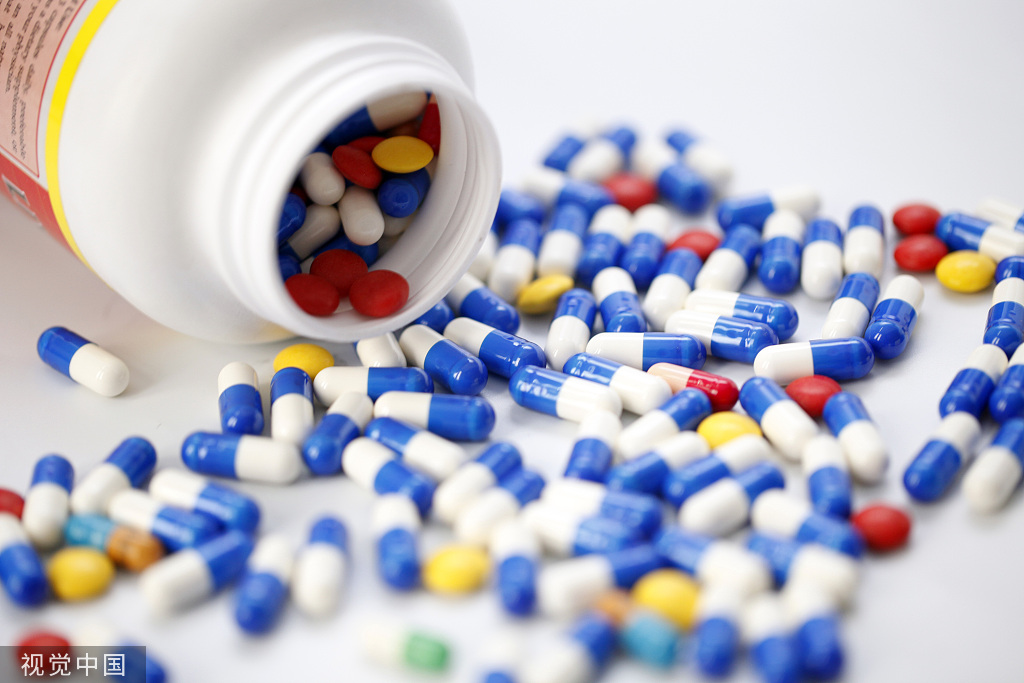
Chinese scientists have discovered that expired medicines can be turned into a chemical additive to enhance the flow of crude oil, offering new insights into the efficient recycling of waste medicine.
Researchers from Xi'an Shiyou University in Xi'an, the provincial capital of Shaanxi province, found that progesterone injections or capsules, often used to treat hot flashes, mood swings and other symptoms of menopause, can play a role in reducing the viscosity of crude oil and decreasing its "pour point" — the lowest temperature at which oil is capable of flowing naturally.
The study, published in the Journal of Environmental Management in January, explained the transformation by which progesterone injections disperse the featherlike, compact structure of wax crystal in crude oil.
Moreover, the study estimated that the use of flow improver made out of expired drugs would cost from $1,062 to $1,241 per metric ton, taking into account the expenses for the collection, transportation and processing of the medicine as well as final packaging. "It is economically feasible to use waste progesterone as a flow improver," it said.
Chen Gang, a professor at the university's College of Chemistry and Chemical Engineering and a leading author of the study, told China Daily that researchers saw the potential of progesterone because its chemical structure is similar to that of crude oil.
"Likewise, polypropylene in facial masks and some components in foam plastics and acrylic glass also make it possible to convert them into substances that can lower the viscosity and coagulation of crude oil," he said.
Recycling and reusing waste medicines and plastics carry great significance these days amid a global drive to accelerate the recycling of resources and reduce the carbon footprint.
In China, about 78.6 percent of families have a medicine cabinet at home, but 80 percent of them do not clean out expired drugs regularly, according to a report released in 2014 by a pharmaceutical company based in Guangdong province.
About 90 percent of survey participants said they had randomly thrown away expired medication, and about 15,000 tons of expired and unused drugs can be found in homes annually, it said.
Pharmaceutical waste generated at home is usually disposed of in trash bins or burned like other household waste. Each year, the incineration of expired or unused medicine increases carbon dioxide emissions by approximately 15,000 tons, according to Chen.
"As a result, the method proposed in the study will not only save waste disposal costs and save expenses on making flow improver, but is also environmentally friendly and can help realize the national dual carbon goals," he said.
China is committed to reaching peak carbon emissions before 2030 and realizing carbon neutrality before 2060.
While the research offers a new avenue for reusing waste medicine, Chen said that achieving mass deployment of the technique remains challenging.
"Due to the lack of a systematic classification system for waste medicine in China, it will be difficult to collect a large volume of unused drugs," he said.
Pharmaceutical household waste is classified as hazardous waste in China and must be burned or disposed of in a harmless way. As a result, it is necessary to gain approval from authorities before reusing waste medicine for other purposes, Chen said.
"Our research has pointed out a possibility, and it will take systematic efforts to scale up the innovation," he said.





- Interest in Turkiye soars among Chinese tourists after introduction of visa-free entry
- Yunnan e-bike fire probe identifies raft of failings
- Investigation report released on e-bike fire that killed 8 in Southwest China
- Understanding Xi's vision of China and the world through New Year message
- 'Artificial sun' experiment finds way to break plasma density limit
- China reports 20% rise in inter-regional trips on first day of holiday