Domestic brands make way into drivers' top 10
Foreign automakers face challenge as Chinese startups pile on pressure









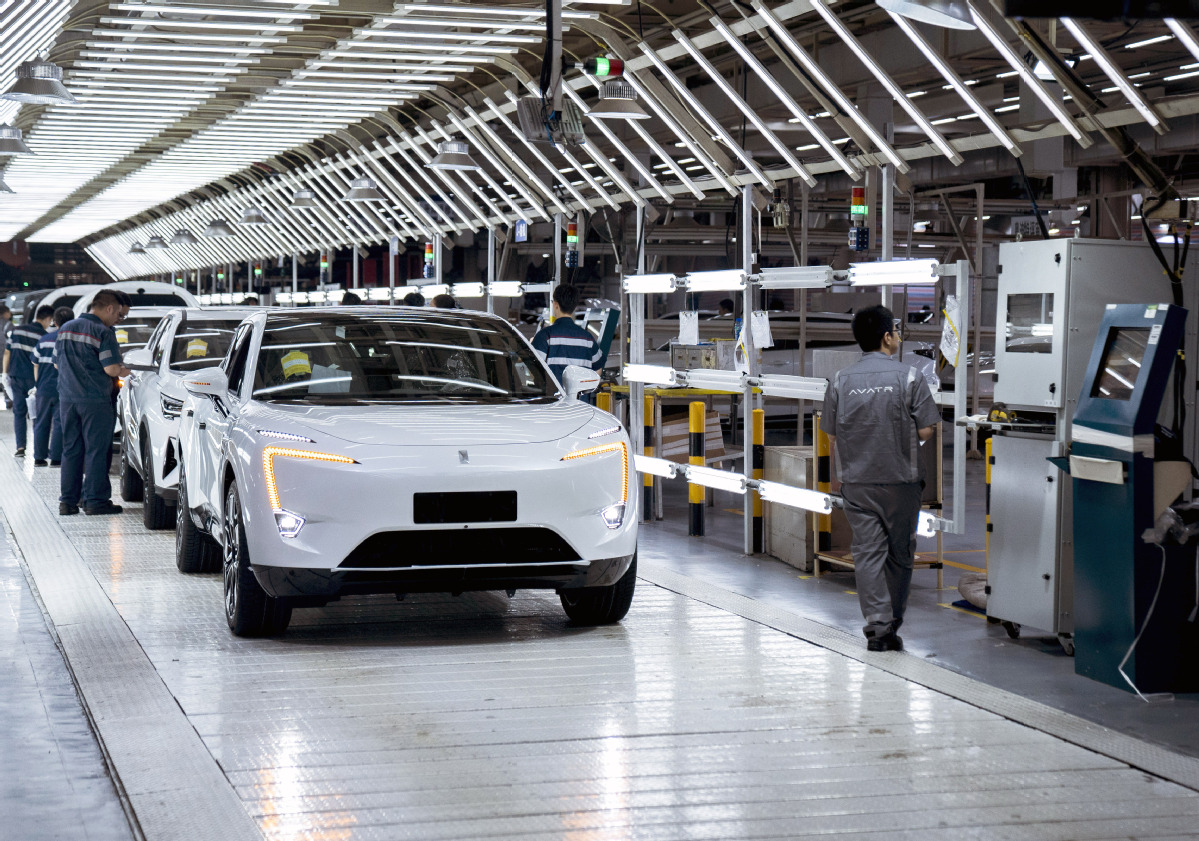
Chinese new energy vehicle marques, especially premium ones, are seeing their brand awareness among domestic car buyers surge and overtake international rivals, said a McKinsey report released last week.
In a survey of 2,449 respondents across 19 Chinese cities, seven out of the top 10 premium NEV brands were Chinese ones. The three remaining were German, ranking fourth, fifth and seventh.
The findings are not surprising. Many Chinese NEV brands including Nio and Li Auto have made their challenge to established international premium carmakers clear.
William Li, founder and CEO of Nio, said the company's goal is to change BBA — an acronym which consumers use to refer to BMW, Mercedes-Benz and Audi — into NBA, with the letter N being Nio, in the Chinese premium vehicle market.
Nio has achieved its goal in some wealthy cities, including Shanghai. Li expects Nio to account for 40 percent of the Chinese EV market segment with prices exceeding 300,000 yuan ($41,690) this year.
Li Auto, known for its range-extended vehicles, expects its sales this year to reach 800,000 units, the same ballpark of the German trio's sales in China. Li Auto sold 370,000 units in 2023, up 182.1 percent year-on-year.
Their meteoric rise seems unstoppable. The McKinsey report found that even owners of the German trio's cars have put five Chinese marques into their top 10 premium NEV marque list — and the top three are Chinese.
For those in the survey who purchased premium Chinese NEVs, the top reason was automated driving functions, followed by smart cabin features and attractive styling.
"Chinese brands have garnered some brand awareness, but their brand loyalty is not yet very strong," said Bill Peng, a McKinsey partner in its Hong Kong office.
The consulting firm's survey shows that 63 percent of Chinese premium NEV owners would consider traditional foreign brands if they came up with the same autonomous driving and smart cabin functions.
Such brands, especially the German ones, are working to catch up with startups, especially in the number of new models.
Audi is scheduled to unveil its first China-made model on the dedicated PPE platform codeveloped with Porsche this year.
BMW and Mercedes-Benz, both of which have several NEV models in the market, are revving up efforts in local autonomous driving research and development.
For those who chose NEVs from such brands, the top reasons were their reliable quality, good styling and the potential bankruptcy of startups, most of which are still losing money.
One silver lining for established marques was that when survey respondents were asked to compile their list of top 10 premium vehicle brands, regardless of their powertrain, none was Chinese.
"That means, Chinese marques have to do a better job in consumer relations and branding operations," said Peng. "They need to improve their loyalty and keep the technologically leading position. Otherwise, the consumers will leave you."
International brands have to double their efforts as well. Chinese car buyers are no longer willing to pay extra for a vehicle because it bears a foreign marque.
The survey found that 47 percent of gasoline car owners said no when asked if they would like to pay a premium for such a marque. The figure was even higher for NEV owners, at 52 percent, both of which were higher than the figures in the previous survey.
NEVs are fast growing to become part of everyday life. In 2023, their sales totaled 9.5 million units in China, accounting for 31.6 percent of total vehicle sales in the country.
"The NEV market is now a matured one, driven by demand, instead of favorable policies, such as free license plates," said Thomas Fang, a McKinsey partner in its Shanghai office.
Lower costs compared with gasoline vehicles ranked as the top reason for their purchase, followed by smart features like automated driving, in this year's survey.
License plates, which ranked fourth in the list of reasons in 2021, moved downward to seventh position this year.
However, for the first time, the proportion for battery EV owners who said they would not consider an EV as their next vehicle grew.
In the survey, 22 percent said they would like switch back to gasoline vehicles, a spike from 3 percent in 2023.
The increase was primarily because of poor charging experiences in smaller cities, where infrastructure has failed to expand with rising EV sales, said the McKinsey report.
Statistics from the China Electric Vehicle Charging Infrastructure Promotion Alliance show that there were 9.02 million charging pillars in the country by the end of February, up 63.7 percent year-on-year. But most of them are in first and second-tier cities.