China's rice technology nourishing Africa's needs
Perennial varieties reduce costs, provide higher yields, have potential to boost continent's food security










In China's vast rice breeding community, Hu Fengyi is in the minority.
Over the past two decades, the plant scientist at Yunnan University has maintained a sharp focus on mining the potential of a perennial rice variety originally from Africa, which can be harvested multiple times and reduces labor costs.
Unlike hybrid rice and other conventional high-yield varieties, perennial rice has received limited academic attention in the past.
"There are lots of researchers studying rice in China, and if your research is mainstream you are able to compare notes with your fellow researchers," he said.
However, perennial rice is such a little-researched field that it is impossible to work with others to fast-track progress. "You have to feel the way forward in the darkness," Hu said.
Through trial and error, Hu and his colleagues have combined the perennial variety with mainstream ones, and rolled out three hybrid varieties that can transcend rice's normal life cycle, and when grown in the right environment provide stable yields.
Compared with hundreds of new rice varieties approved for commercial production across the country each year, the three hybrid ones approved for commercial production after decades of research are a telltale sign of the solitary nature of rice scientists' work. "To make it, we had to sit on a cold bench," Hu said, using a Chinese saying that describes someone being left out. "We've learned to withstand solitude."
Two of Hu's hybrids were named after the college he works at — Yunda 107 and Yunda 25.Over a three-year trial period, Yunda 25 produced 5.5 to 6.5 metric tons annually per hectare and showed outstanding resistance to pests, which greatly reduced the need for pesticides.
"It is not unlike rolling out new car models," Hu said, referring to the enhanced traits of newer perennial varieties. "You can add functions to newer models and can improve existing ones."
Apart from reducing labor, Hu said perennial rice is also more ecologically friendly as farmers do not have to plant every year. "The soil conditions are less disturbed physically as well as chemically," he said.
Perennial rice's popularity has grown quickly in China and among its rice-producing neighbors. In 2020, less than 4,000 hectares of perennial varieties were planted, but a year later the number ballooned to more than 15,500 hectares.
The expansion of perennial rice is also representative of China's shift to a more tech-driven approach to improve agricultural productivity and ensure the security of staple food supplies.
Honoring promises
As part of its commitment to help Africa improve the continent's food security, China has started to share its perennial rice technology, a move which has been hailed by both agricultural experts and farmers.
The technology was incorporated into the agricultural technology advancement framework at the High-Level Ministerial Session of the fifth African Union Specialized Technical Committee on Agriculture, Rural Development, Water, and Environment held in November last year.
It has also been included in the African Union Seeds and Biotechnology Program 2024-2025, and has already been introduced in Uganda, Malawi, Madagascar and Burundi, through collaborations between Chinese and African agricultural experts.
Luo Tingyue, a Chinese technician for the FAO-China-Uganda South-South Cooperation (Phase 3) program who has been promoting rice-planting technologies in Uganda for five years, said he and his colleagues started to grow perennial rice in September.
The rice, which is planted at the China-Uganda Agricultural Cooperation Industrial Park in Lubenge wetland in Uganda's Luwero district, was harvested last month.
Noting that perennial rice can be harvested several times after planting, he said it saves a great deal in labor costs and farmers' time, making it a superior species for use in African countries.
In addition, perennial rice has also demonstrated higher yields compared with many conventionally grown species in Uganda, Luo said. It produced 1.5 to 2.5 metric tons per 4,050 square meters in trial production, compared with around 1 ton for conventional rice, he said.
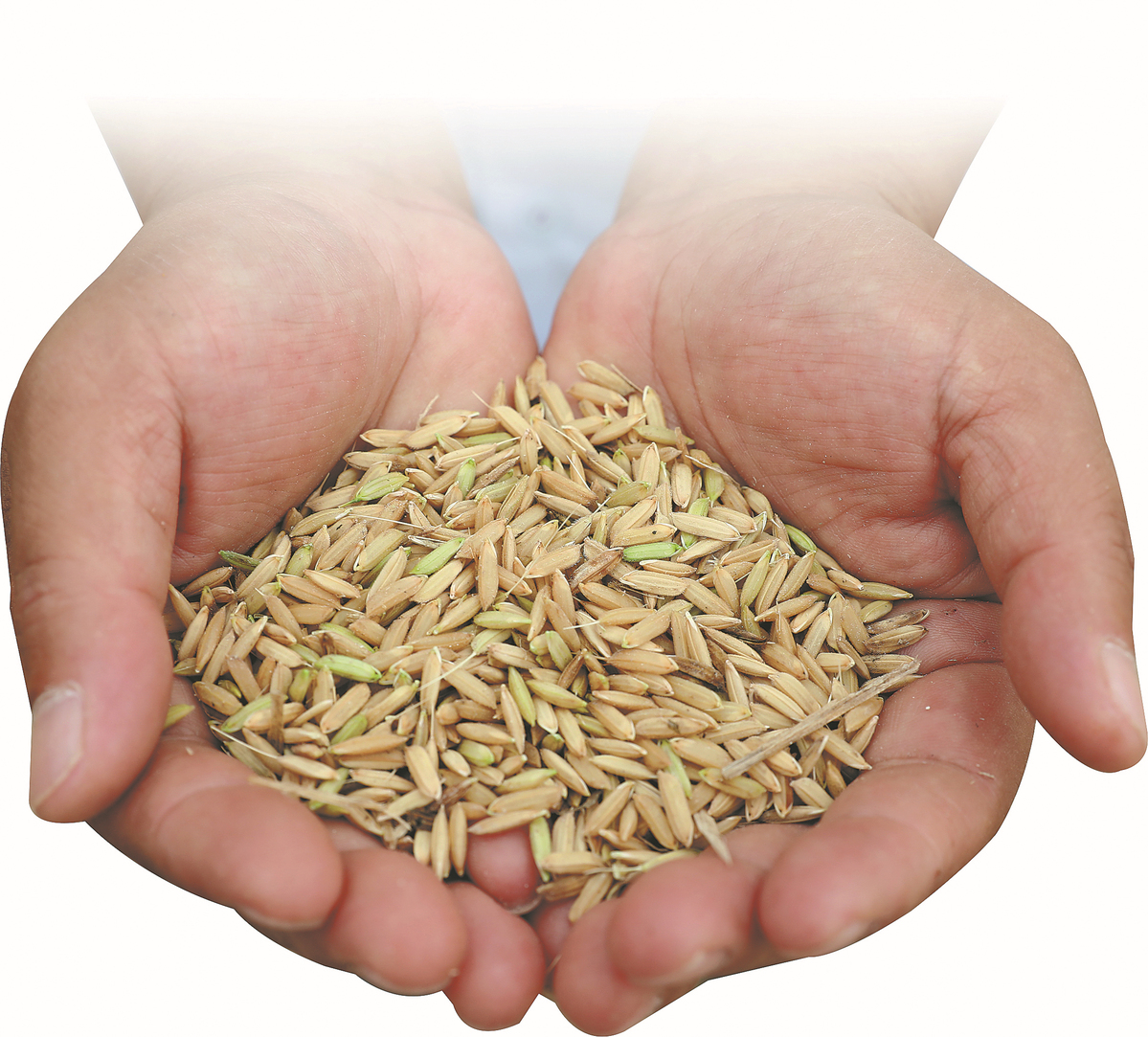
"The grain looks longer and bigger," Luo said, holding a handful of rice. "According to our measurements, every 1,000 grains of the rice weighs 29 grams, compared to between 23 and 26 grams for every 1,000 grains of locally planted rice species."