Exploring music's transformative power
Youth from diverse backgrounds discuss music's influence on culture and its role in fostering understanding and unity worldwide in the latest episode of Youth Power.









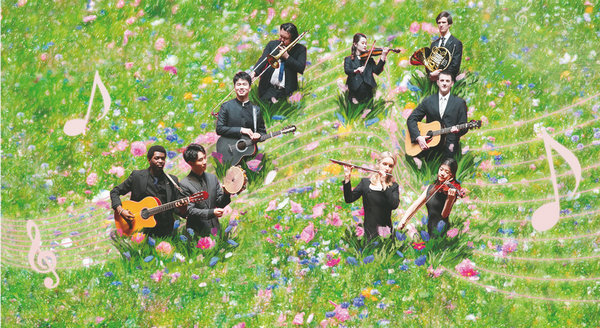
In the latest and final episode of this season's Youth Power by China Daily, which aired on March 30, eight music enthusiasts and musicians from five countries came together to share their stories about how they believe music shapes the world.
Lv Wei, a 31-year-old violinist, is the assistant principal of the Wuxi Symphony Orchestra in East China's Jiangsu province. Her musical journey began because her parents — as she put it — "forced" her into it.
"My parents believed that playing an instrument would help me focus better on my studies at school, so they introduced me to the piano first and later to the violin," Lv said. "After a few years of practice, I developed a fondness for the sound of the violin and wanted to share my music and ideas with different people on stage."
For Benjamin Essomba, a 26-year-old music producer from Cameroon, his love for music developed more naturally. Growing up attending church, he had early access to various instruments.
"I don't recall ever being forced to play music," said Essomba. "When you see people you know and love playing something that sounds really good, you'll think, 'Why can't I do it?'"
However, loving music and mastering it are two different endeavors. Ludoviko Maletti, a 25-year-old French horn player from Italy currently performing with the Wuxi Symphony Orchestra, believes that many talented musicians have been immersed in music from a very young age, often being the offspring of musicians themselves.
"Talent does exist, but it's a product of nurturing rather than nature," Maletti explained, adding that he personally doesn't believe he has inherent talent; rather, everything he has achieved is a result of dedicated cultivation.
Lv believes that 75 percent effort and 25 percent talent are the crucial ingredients for creating a great musician. "We need a lot of time and attention to practice the techniques, and then the 25 percent of talent can elevate you to a higher level as an artist," she said.
While becoming a recognized musician is challenging, some may argue that developing an appreciation for classical music, such as symphonies, can also be difficult and requires a refined taste. Maletti suggested that those interested in exploring classical music can begin with more accessible pieces, such as the rhythmic first movement of The Rite of Spring by Russian-born composer Igor Stravinsky (1882-1971).
"Back in high school, I added this piece to my friend's playlist, and he ended up enjoying it. He later expressed that he was up for more classical music," Maletti said.
Chen Shihua, a 19-year-old student from Peking University, pointed out the potential of movie soundtracks to foster an interest in classical music among the public.
"For example, Playing Love from The Legend of 1900 is one of my favorite pieces in movies. I can feel a mixture of regret, love, humanity, memories, and a myriad of complex emotions in it," said Chen.
As musicians grow and refine their skills, they often seek collaborations across different styles, genres, and countries. Melissa Baidak, a 24-year-old doctoral student from Russia at Beijing Foreign Studies University, shared her experience attending a concert featuring a fusion of Western and Chinese musical instruments, such as the violin and the pipa (a four-stringed Chinese lute).
"Music serves as a tool for intercultural communication, bringing people together and making the sound of different musical instruments more fascinating," said Baidak.
Wang Zongnan, a 24-year-old student from Tsinghua University, also witnessed a harmonious blend of performance styles across countries. Recalling an event hosted by China's Guangzhou Symphony Orchestra and the Spanish theater group La Fura, he described it as a "visual symphony".
"The orchestra played Beethoven's Pastoral Symphony in the center of the stage, while La Fura's actors performed a play at the front of the stage and among the audience. The play revolved around environmental protection. It was a magical combination of cultures," he said.
The host of this episode of Youth Power, 19-year-old Wang Licheng, a student at Peking University, emphasized that music itself is a universal language that transcends borders to unite different peoples and nurture mutual understanding.
Wang Zongnan agreed, underlining the practical aspect of self-expression. He shared how his exchange experience in Sweden led him to write a song whimsically reflecting on the evolution of his own cultural identity, as he explored both the similarities and differences among various cultures.
Dylan Walker, 27, a music enthusiast from the United States, also resonates with Wang Licheng's belief in the power of music to foster understanding. Having studied and lived in China for years, Walker has formed friendships not only with Chinese locals but also with people from diverse backgrounds worldwide.
"Singing together in Chinese is one thing, but singing a song in their native language with them creates a deep emotional connection. It really brings you closer together and helps you understand their culture. It also sparks an interest in understanding each other and a sense of mutual respect," said Walker.
Joseph Chen, 26, a trombone player in the Wuxi Symphony Orchestra, sees music as more than just a means of self-expression and building friendships. He believes it's a core aspect of human existence.
Chen referenced Maslow's hierarchy of needs, which suggests that as humans, our most inherent necessities start from food and shelter, with art being a higher-level need. However, he observes that the actual progression of human development is quite the opposite: before we had shelter and a stable source of food, we had cave paintings and bone flutes, which were art and music.
"Creating art is more fundamental to being human than having enough to eat. So, what we musicians do here is profoundly essential to the human experience. It's something that's very ingrained in what it means to be human," Chen said.