Chang'e 6 to carry foreign science payloads
Moon: Robotic probe set to land in basin on far side









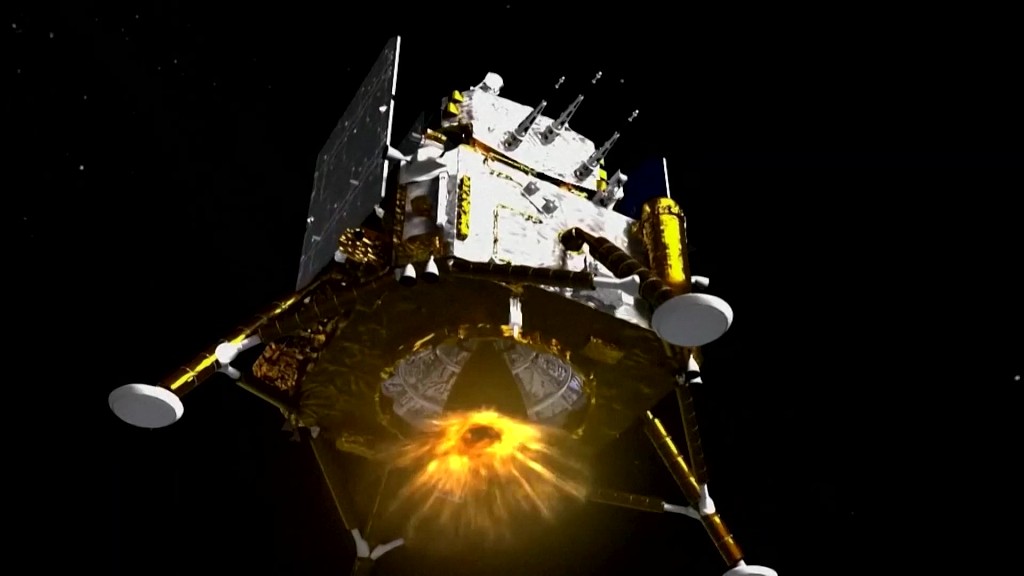
China's upcoming lunar mission has garnered global attention for more reasons than one. The Chang'e 6 robotic probe will not only make an ambitious and unprecedented attempt to collect samples from the lunar far side, it will also carry three European science payloads to the site.
The mission holds great significance because the new samples will enable scientists to study and better understand the history and the physics of the moon.
According to the China National Space Administration, the three foreign science payloads include a radon measuring instrument from France's national space agency that will help study the movement of lunar dust and some volatile chemicals between the lunar regolith, a layer of unconsolidated rocky material, and the lunar exosphere.
The second foreign science payload is a passive laser retroreflector from Italy's National Institute for Nuclear Physics that will be used as a laser range-finder for the Chang'e 6 lander.
The third payload, developed by the Swedish Institute of Space Physics with support from the European Space Agency, will be the first-ever dedicated negative ion instrument flown beyond Earth. It will seek to detect negative ions emitted from the lunar surface as a result of interaction with solar wind.
More than 20 proposals from foreign space agencies and research organizations contested for the golden opportunity to join the Chang'e 6 mission and touch down on the moon's little-known far side, which has so far been the subject of scientific speculation and wild imagination. The three from France, Italy and Sweden emerged as winners.
Yang Yuguang, a senior space industry observer and vice-chair of the International Astronautical Federation's Space Transportation Committee, said that opening a nation's spacecraft to other nations' science payloads has become a common practice among space powers because international cooperation can maximize a mission's scientific value.
"An opportunity to put your science devices on a spacecraft, especially a historic one like the Chang'e 6, is always enthusiastically sought by scientists around the world," he said.
China and Europe have engaged in space industry cooperation for many years, and such collaborative projects have brought benefits to both sides, Yang said, citing the successful cooperation in data relay during China's Tianwen 1 Mars mission.
Wang Yanan, chief editor of Aerospace Knowledge magazine, said the Chang'e 6 mission will offer European scientists the first chance to deploy their instruments on the lunar far side, which will be a landmark moment for the planetary research community in Europe.
"Through this move, China has shown its sincerity and capability to bolster international space cooperation, and it will also definitely advance the collaboration in lunar exploration and development between China and Europe," Wang said.
A Long March 5 heavy-lift rocket, carrying the Chang'e 6 robotic probe, is scheduled to blast off from the Wenchang Space Launch Center on the east coast of Hainan province in the coming weeks.
If everything goes according to plan, the spacecraft will make a series of flight maneuvers and finally land in the South Pole-Aitken Basin.
Like Chang'e 5, its predecessor, the Chang'e 6 spacecraft is a product of the China Academy of Space Technology in Beijing and also consists of four components — an orbiter, a lander, an ascender and a reentry module.
After collecting dust and rocks on the moon, the ascender will transport the samples to the lunar orbit for transfer into the reentry module, which will carry them to Earth.
Meanwhile, scientific instruments on the lander will continue to perform their operations as long as they have sufficient power.
The United States, the former Soviet Union and China have brought lunar samples to Earth, but none has ever obtained soil from the far side of the moon.
Although the far side had been previously photographed by spacecraft, no probe had ever touched down on it until China's Chang'e 4 mission, which landed in the South Pole-Aitken Basin in January 2019.






- Interest in Turkiye soars among Chinese tourists after introduction of visa-free entry
- Yunnan e-bike fire probe identifies raft of failings
- Investigation report released on e-bike fire that killed 8 in Southwest China
- Understanding Xi's vision of China and the world through New Year message
- 'Artificial sun' experiment finds way to break plasma density limit
- China reports 20% rise in inter-regional trips on first day of holiday