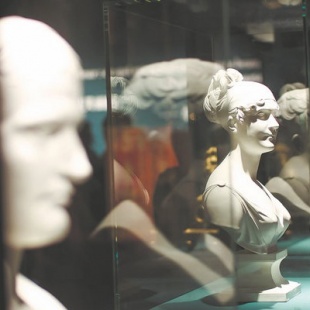



Displaying the classical chic of 'Le Petit Caporal'










Ancient influence
The Tuileries, Saint-Cloud and Meudon were appropriated by Napoleon following his crowning as emperor in 1804, and were used as places of governance and family retreats.
He turned the palaces into showcases of his individual aesthetics and the grand new style that emerged after the collapse of the French monarchy. In doing so, he delivered the message that France had entered a new age, and social order would be restored following revolutionary chaos.
Architects, artists, designers and representatives of prestigious manufacturers were summoned to aid with renovations, the results of which included the Arc de Triomphe and the luxurious interiors of the three palaces, with their neoclassical "Empire style" that later flourished outside France.
The style is exemplified by its integration of elements of ancient Egypt and Rome, both of which Napoleon greatly admired.
During the three years he ruled Egypt, scientists and scholars accompanied his armies to carry out surveys.
In Paris, artists and craftsmen re-imagined the mystic, majestic atmosphere of ancient Egypt in their work: modeling the legs and arms of furniture to resemble the Sphinx, for example.
Napoleon's admiration of ancient Rome is also presented at the exhibition, through iconic motifs and symbolic totems including Victoria, the goddess of victory, scepters, and ornaments adorned with bees and eagles.
He even gave his only heir, Napoleon Francois Charles Joseph (1811-32), the title of Roi de Rome (King of Rome).
The emperor's keen interest in decorative arts was motivated by a desire to rebuild commerce and industry after the revolution, so that France could compete with European counterparts empowered by the First Industrial Revolution.
Several of the tapestries on show are the work of prestigious producers, among which Gobelins stands out as a noted supplier to the royal house, and one painting depicts Napoleon inspecting the Gobelins Manufactory in 1810.
Already an arbiter of fashion under the monarchy, the royal porcelain factory at Sevres also benefited from Napoleon's policies. Its artisans continued to produce exquisite items that furnished his palaces and the homes of European nobility.
The exhibition contains re-creations of the rooms Napoleon and his first wife Josephine lived in, showing the empress' artistic tendencies.
"Josephine placed orders at the royal furniture works, and her preferences also influenced people. Unlike her husband, she favored a more refined and delicate style. Similar examples were found at the Chateau de Malmaison, which she purchased to live in," Lemoine says.
Su Xu, former director of the China Cultural Center in Paris, studied and worked in France for nearly three decades. He told the forum that he was happy that Chinese audiences were able to see ornaments from these once glorious buildings.
Having seen many objects from the Napoleonic era at French exhibitions, he says he is impressed by the exhibition, which makes him feel he was in Paris again.
Lemoine expresses hopes that the Mobilier National will bring more French arts and crafts to China, such as silk textiles and Sevres porcelain, two crafts that have connected China and France for centuries, but which have evolved differently in their respective locales.
Wang Chunchen, director of the Meet You Museum, and an art history professor at the Central Academy of Fine Arts, says the exhibition enables people to see the commonalities and the differences between the two cultures, which is "what makes exchanges meaningful".