


Relics tumble out of wall at Longmen Grottoes
Caves: Relics shed light on Tang Dynasty Buddhist art









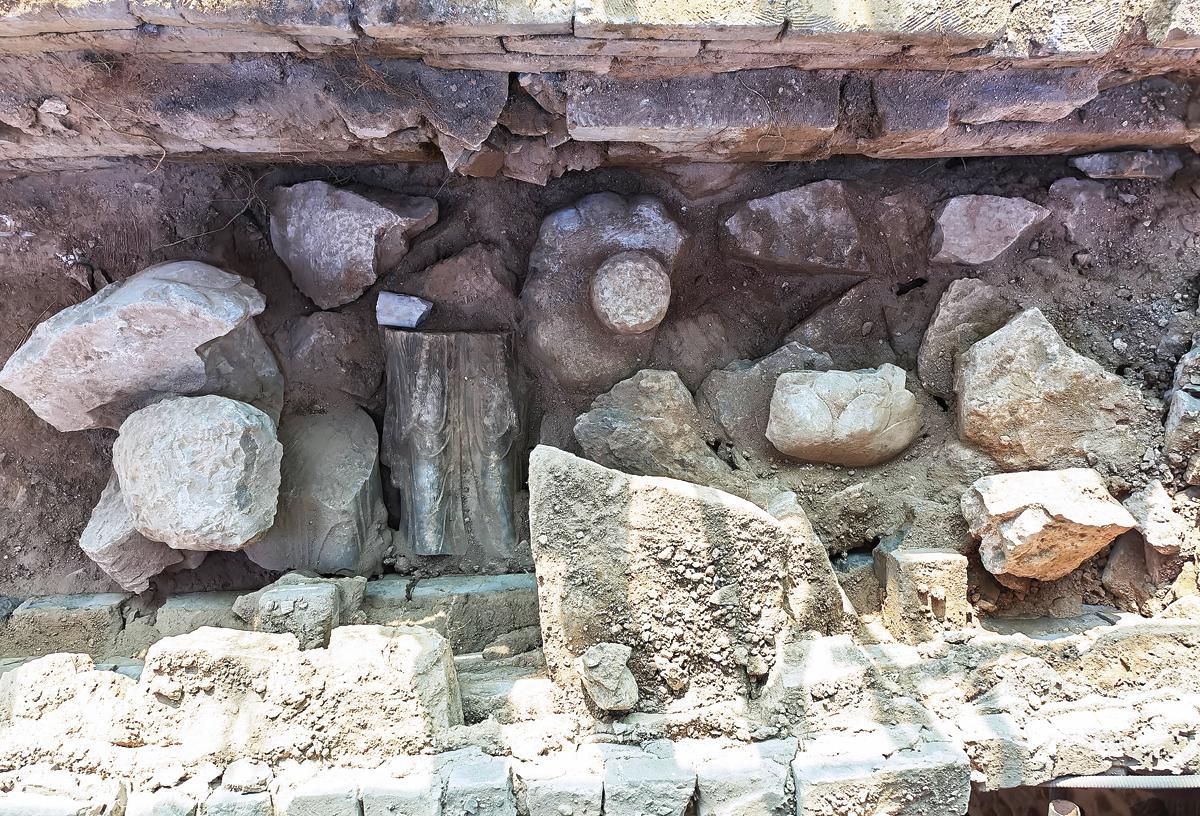
Some of the relics are large in size and feature exquisite carvings, while several of them show traces of colorful paint, Lu said.
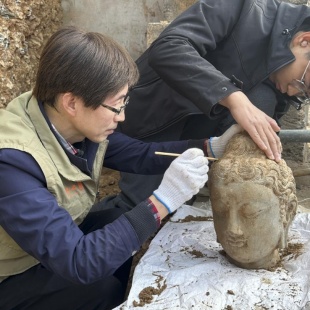
A well-preserved stone Buddha head, 38 centimeters in height and 22 centimeters in width, is among the stunning finds.
"The face is round, plump and has a particularly serene expression. The hair is like tidal waves. The head sculpture is exquisitely carved," Lu said.
"Judging from the overall appearance, it has a distinctive artistic style associated with the zenith of the Tang Dynasty, which indicates that it belongs to a period between the late 7th century and the early 8th century," he said.
The relics were stacked up and embedded in the wall, which is not originally from the Tang Dynasty. Judging from its appearance and use of materials, the wall was built much later during renovation work, Lu said, adding that the bricks used to build the wall were from the Ming Dynasty (1368-1644).
Combining historical records about a powerful earthquake in Henan during the reign of Emperor Jiajing (1522-1566) of the Ming Dynasty, the epicenter of which was not far from Luoyang, archaeologists preliminarily infer the wall was rebuilt after the temblor.
Lu said the relics found inside the wall were probably part of cave debris after the quake. When masons rebuilt the wall, they used these as infill for better foundational strength, and also to save some bricks.
The discovery has shed light on Buddhist statue art during the Tang Dynasty, the development of the Leigutai area, ancient socioeconomic development and religious practices, he said.
Luoyang was the national capital during Empress Wu's reign. Many members of the royal family and aristocracy built caves, which they believed would bring them good fortune, gradually forming the large-scale Longmen Grottoes.
During the Northern Song period (960-1127), Emperor Zhenzong (968-1022) paid a visit to the grottoes and ordered a major renovation at the site, repairing more than 15,000 statues.
"We haven't found records about major renovation of the grottoes in Ming Dynasty documentation, but the large number of Ming bricks used there indicates that those people did have a role to play in the renovation," Lu said.
The grottoes regained popularity under the Qing Dynasty (1644-1911) after a visit made by Emperor Qianlong (1711-99), he added.
In November 2000, the Longmen Grottoes were included on the UNESCO World Heritage list, the first such honor for an archaeological site in Henan. They form the 25th world cultural heritage site in China.