Relay satellite ready for lunar mission service
Queqiao 2 to provide communication support for operations on moon's far side









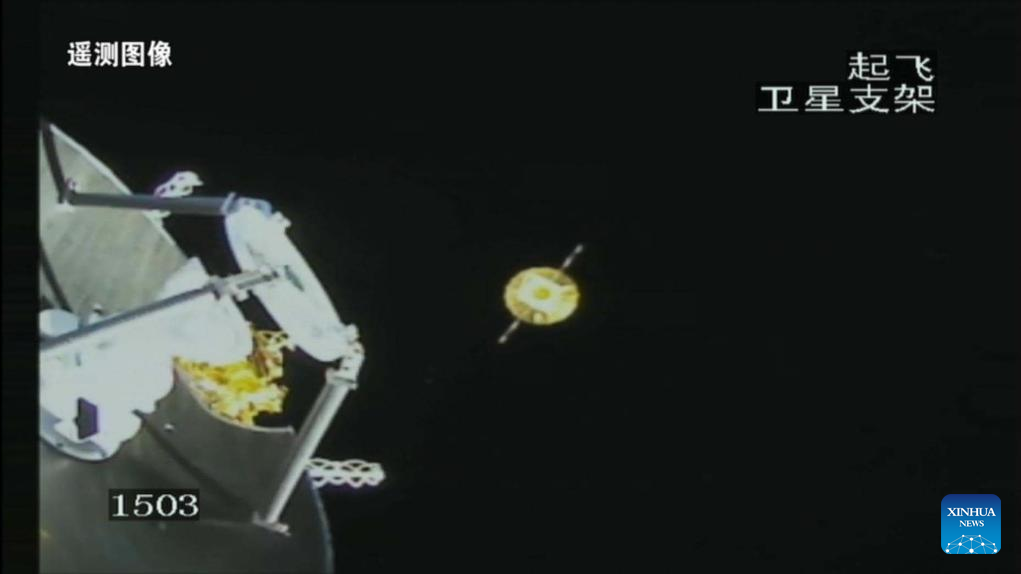
China's relay satellite Queqiao 2, or Magpie Bridge 2, is ready to provide communication service to missions operating on the moon's far side, according to the China National Space Administration.
The administration said in a news release on Friday morning that the spacecraft has finished in-orbit communication tests. Ground controllers assessed the results and determined that the satellite's framework and mission payloads had been running normally. Its capability and performance have proved to be good enough for signal relay tasks for Chinese and foreign lunar expeditions, the release said.
Queqiao 2 was lifted atop a Long March 8 carrier rocket from a coastal launchpad at the Wenchang Space Launch Center in the southernmost island province of Hainan.
The spacecraft carried out a series of maneuvers, such as a midcourse trajectory correction and a braking operation, before it entered a frozen elliptical orbit on April 2 to become the world's second relay satellite above the moon.
After arriving in its predetermined orbital position, Queqiao 2 conducted two-way communication tests with the Chang'e 4 probe, which is on the lunar far side, and Chang'e 6, which is waiting to be launched at the Wenchang center, to examine its performance. All of the tests were completed before Wednesday, according to the administration.
Currently, the satellite revolves around the moon about every 24 hours and will soon start relaying signals for Chang'e 4 and the coming Chang'e 6, it noted.
The Chang'e 4 probe, which landed in the South Pole-Aitken Basin in January 2019, is the world's first spacecraft to land on the moon's far side, which never faces Earth. Its signals have been transmitted through Queqiao 1, which was launched in May 2018.
Chang'e 6, if everything goes according to plan, will embark on its journey in the coming weeks and touch down in the South Pole-Aitken Basin. It is tasked with collecting dust and rock samples and sending them back to Earth. That will be a groundbreaking endeavor that is challenging, sophisticated and has never been done before.
Communication services between the Chang'e 4 and 6 probes and Earth require relay satellites due to their special locations.
Pang Zhihao, an expert on space exploration technology and a renowned writer on spaceflight, said the successful deployment of Queqiao 2 has paved the way for Chang'e 6's arrival on the lunar far side.
"If Queqiao 2 failed to reach its preset position, considering the fact that Queqiao 1 is not far from its retirement, it would be impossible to send probes to the far side because there would be no relay service," he explained.
The expert said that compared with Queqiao 1, the world's first lunar relay satellite, Queqiao 2 incorporates new technologies, more functions and stronger transmission capacity.
Developed by the China Academy of Space Technology, Queqiao 2 weighs about 1.2 metric tons and has two major payloads — a 4.2-meter parabolic antenna for communications with lunar probes and a 0.6-meter parabolic antenna to transmit data to ground control.
Beyond Chang'e 4 and 6, the satellite will also serve the Chang'e 7 and 8 missions in the near future, which will be the basis for an ambitious multinational plan initiated by China and known as the International Lunar Research Station, which is expected to be built in the 2030s.
In another development, the two experimental satellites launched with Queqiao 2, the Tiandu 1 and 2, have begun to verify new communication and navigation technologies in lunar orbit, according to the space administration.
zhaolei@chinadaily.com.cn






- Ex-Gansu vice-governor convicted of bribery, insider trading
- Shenzhen's innovative companies display their latest tech and products to a global audience
- Beijing slams Tokyo's security documents revision plan
- China's central bank signals flexible policy tools to guide financial growth
- New minerals discovered in the world's largest rare earth deposit
- Employers encouraged to enrich workers' cultural, sports, entertainment activities