


Events start in honor of Peking Opera key stars
Father and son, the discipline's most famous actors, are remembered with performances across the country in poignant tribute, Chen Nan reports.










Forums by Peking Opera experts and artists will celebrate the art of Mei Lanfang and Mei Baojiu, and focus on issues on the training of young Peking Opera performers.
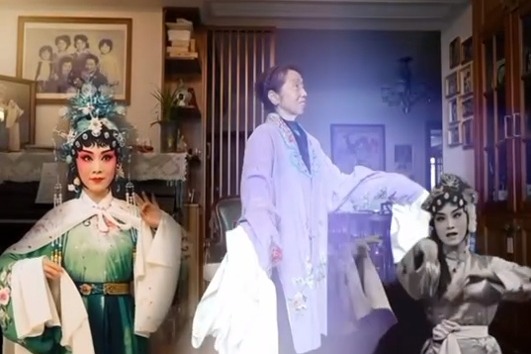
Mei Lanfang was born in Beijing into a Peking Opera family. He began studying Peking Opera at the age of 8, and made his stage debut at 11. He specialized in performing nandan roles, in which men play female characters — a practice forged in feudal times, when women were forbidden to take the stage. At 13, Mei Lanfang joined Xiliancheng, then the biggest Peking Opera troupe in Beijing, and with performances not only in Beijing, but also in Shanghai, Mei Lanfang soon gained a national reputation.
He toured Japan in 1919, 1924 and 1956.In 1930, he toured the United States for about two months, giving shows in New York, Washington and San Francisco, among others. In 1935, he performed in the former Soviet Union and, in the same year, he toured Europe.
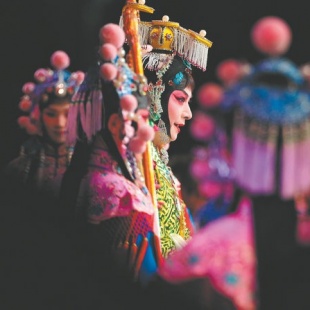
The heyday of nandan performance was in the first half of the 20th century, when Mei Lanfang, Shang Xiaoyun (1900-76), Cheng Yanqiu (1904-58) and Xun Huisheng (1900-68) established the four different performing styles of Mei, Shang, Cheng and Xun. Each style has been preserved, learned and is still performed by their students today.
Mei Baojiu, the ninth son of Mei Lanfang, started learning Peking Opera at 10 years old and, like his father, Mei Baojiu was also known for playing nandan roles. When he was 13, Mei Baojiu made his stage debut in Shanghai, before starting to tour with his father Mei Lanfang's Peking Opera troupe when he was 16. Mei Baojiu became head of the troupe after his father died in 1961.
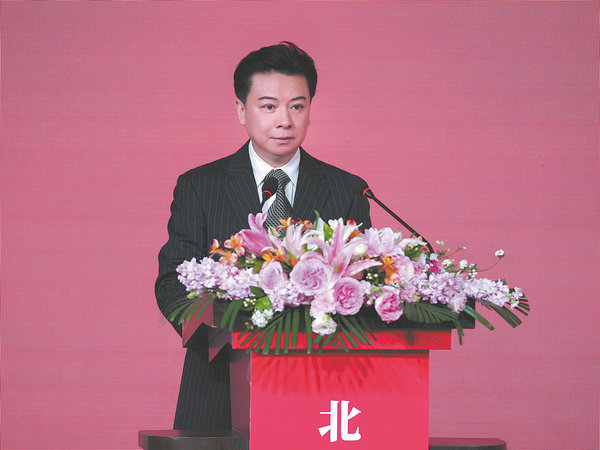
"Back in 2014, when we commemorated the 120th anniversary of Mei Lanfang's birth, my master (Mei Baojiu) led us to visit his father's ancestral home in Taizhou, Jiangsu province, and places where he once performed, such as Tianjin, Shanghai, Hong Kong, Tokyo and New York. We performed Farewell My Concubine and Mu Guiying Taking Command. All those memories are still vivid. Ten years later, my master left us, and now we commemorate him and his father," says Hu Wenge, the only nandan apprentice of Mei Baojiu, who now performs with the Jingju Theater Company of Beijing.
Hu adds that, back in 2014, when they performed in New York, a fan of Mei Lanfang came to their shows and gave Mei Baojiu a piece of paper — a music score of Mei Lanfang's when he toured the US in 1930.
"It was a very touching moment when I saw the old music score had been so well looked after. It also proves that the art of Mei Lanfang is timeless and shared by people from around the world," Hu says.
According to Feng Gang, deputy director of Shanghai Jingju Theater Company, Mei Lanfang made his debut in Shanghai when he was 19 years old and, in 1932, he moved to Shanghai from Beijing due to the War of Resistance Against Japanese Aggression (1931-45).
The Peking Opera master withdrew from the theater for years from 1941 to 1945, growing a beard because he refused to perform for the Japanese army. In October 1945, he resumed his acting career with shows in Shanghai.
"His comeback performances in Shanghai were a sensation. We not only want to celebrate the great art of Mei Lanfang, but also his patriotism," Feng says, adding that the Peking Opera master also learned Kunqu Opera and infused the art of the 600-year-old traditional Chinese opera form into Peking Opera.
On May 31, 1961, Mei Lanfang performed Mu Guiying Taking Command in Beijing, which proved to be his last stage appearance, concluding a legendary career spanning over 60 years.