


Digging up the Buddhist past
Archaeologists unearth intriguing clues hinting at a legacy of architectural achievement, Wang Ru reports.









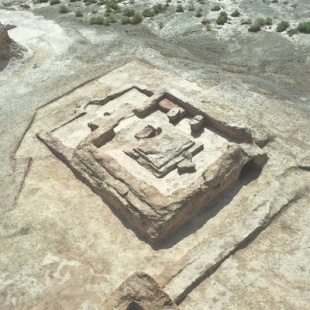
"When I imagine the story of Mo'er Temple, I think it was a gradually developing process. Early buildings continued to be restored and used. As a result, it had a strong sense of history in its appearance. At its peak during the Tang Dynasty, the complex reached the scale we see today," he says.
Since most of the buildings were located on the edge of the steep cliff, they presented a spectacular sight. The buildings would have been painted with white lime and when people viewed them from afar, it would have been impressive, he adds.
The temple can be regarded as testimony to the important era when Buddhism spread to Xinjiang, which is often believed to have been during the 1st century BC.
Xiao says that Kashgar was the gateway from China to Central, South and West Asia and an important station on the ancient Silk Road.
"Combining historical records, scholars believe that when Buddhism spread to Xinjiang, the earliest stations were Khotan (today's Hotan) and Shule. … No later than the early period of the 2nd century, Buddhism from the Gandhara area (in modern-day Pakistan) spread to Kashgar," Xiao says.
From Xinjiang, Buddhism continued to spread to China's central areas, and developed as it came into contact with local cultural traditions, gradually becoming Chinese Buddhism.
As a result, the Mo'er Temple, which was begun in the 3rd century, was one of the earliest Buddhist temples built in Shule.
In his famous book Datang Xiyu Ji (Great Tang Records on the Western Regions), Tang Buddhist monk Xuanzang records his journey to India on a mission to obtain Buddhist sutras, and mentions that when he returned, he passed by what is now Kashgar and saw "several hundred Buddhist temples and more than 10,000 monks".
"This means he possibly visited Mo'er Temple, and saw it at its most prosperous," Xiao says.