Joint lab helps Kenya reap rich harvest
Collaboration aims to improve Africa's food security with superior crop varieties









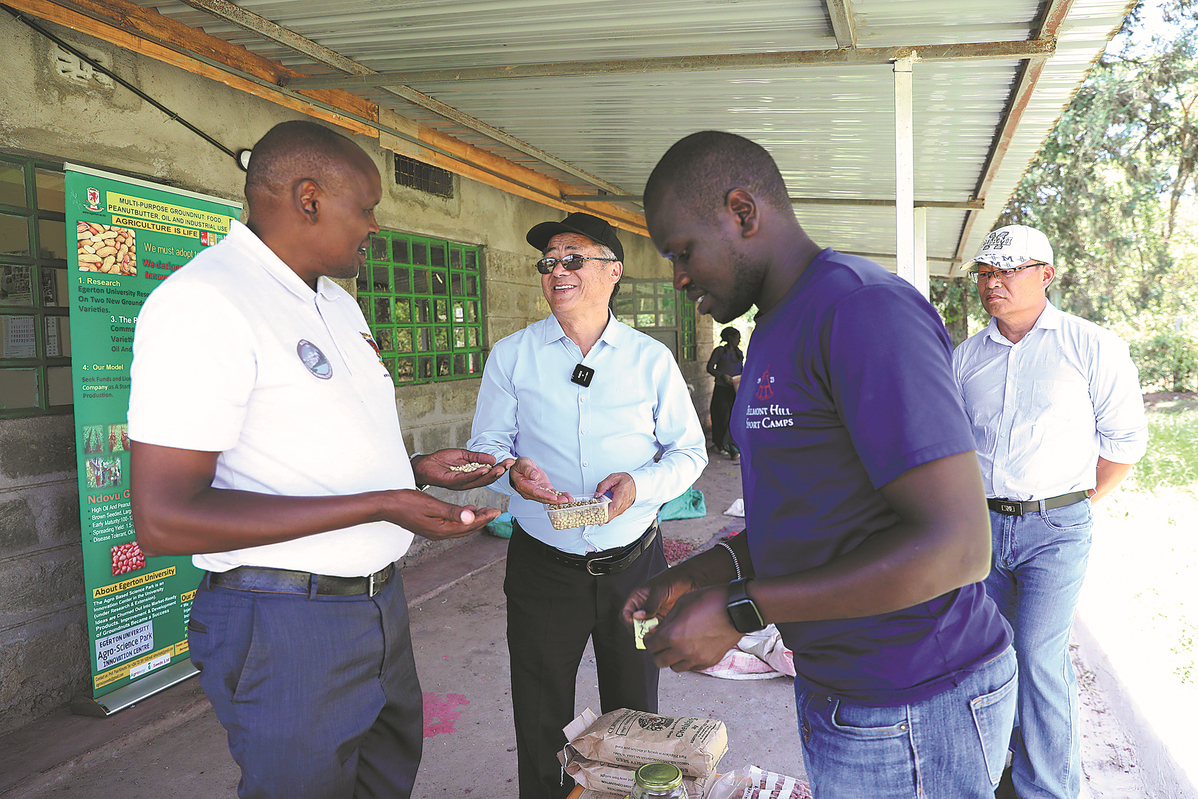
A China-Kenya joint agricultural lab in Kenya has bred more than two dozens of superior crop varieties over the past five years, effectively improving food security for farmers across the country.
Established in 2019, the Kenya-China Joint Laboratory for Crop Molecular Biology at Egerton University in Nakuru County has developed 25 crop varieties through molecular breeding, of which 18 have been commercialized. The crops are suitable in different ecological conditions, disease resistant and high yielding compared with traditional ones.
Once the seeds are developed, they are taken to the Agro-Science Park at the university, where seed bulking and commercialization take place.
Among the improved seeds are five bean varieties, three of which have been released in the market and have attracted much attention from farmers because of their advantages.
The most popular one is the Chelalang beans that were released in the market in 2016. In the Kalenjin community, the name loosely translates to mean a warm, beautiful girl who can fetch the highest bride price.
Paul Kimurto, director of Agro-Science Park, said Chelalang can yield up to 25 bags, or 2,250 kilograms, per hectare.
"It's a very adaptive variety. If you grow when there is enough rain, it prolongs the growth and puts in more yield. When the rainfall is short, it quickly accelerates, so it has early maturity characteristic. Hence, farmers don't lose yields," he said.
Anna Wanjiku, a farmer from Matangi Tisa village in Nakuru, was amazed by a bean variety last year. As the August rains arrived, she sowed Chelalang and Tatton beans, another variety under the bulking process and nearing commercialization.
The rain vanished for a month after the crops germinated, then returned. While Wanjiku's other beans succumbed to the drought, the Chelalang and Tatton beans persevered.
Wanjiku reaped a remarkable harvest. From 20 kg of Tatton beans, she collected a bountiful 120 kg. Her investment in 5 kg of Chelalang beans yielded 40 kg.
"In the upcoming rainy season, I will plant each of the variety in a 0.8-hectare land. I'm looking forward to a bumper harvest and consequently, increased income," she said.
Hillary Chelal, a research assistant at Egerton University, highlighted the characteristics of Tatton beans, including their superior yield, prolific pods, self-stripping leaves for effortless harvest, adaptability to diverse altitudes and preference by canneries.
In partnership with agricultural development nonprofit Kilimo Trust, Chelal said they are also promoting water-efficient upland rice and five such varieties have been tested.
Kenya imports about 80 percent of rice, but Chelal said the country has the potential to produce enough rice for its population.
Rising production
Joseph Orende, program assistant officer at Kilimo Trust, said that through partnering with Egerton University and training farmers on sustainable rice production techniques, they have increased production from 2 metric tons to 3.5 tons per hectare within two years.
With proper management, the rice varieties have the potential to produce 7 to 11 tons per hectare, he said.
"Looking at what we have been able to achieve in the two years, if it is sustained, this collaboration can be able to achieve food security initiative in Africa if replicated to many areas and several food chains," he said.
Liu Gaoqiong, a horticulture professor at Egerton University, said the collaboration between China and Kenya through the lab aims to improve food security in Africa, with its rapidly expanding population and unpredictable weather patterns.
"We are trying to develop different varieties with good yields, good quality and climate-smart. We also plan to bring more agricultural equipment from China to Kenya," he said.
Kimurto said the laboratory is mitigating climate change through the development of resistant crop varieties that are able to grow in areas with low rainfall.
"We have developed four varieties of finger millet that are early maturing (and) resistant to low soil fertility and diseases. We have also developed sorghum varieties that are good for breweries," he said.
Plans are underway to establish the Egerton Agro-Industrial Park with the help of the Nakuru government to accelerate commercialization of improved crop varieties, he said.