



NEVs give the lie to 'overcapacity'
China's lead, infrastructure, price advantage leave competitors lagging









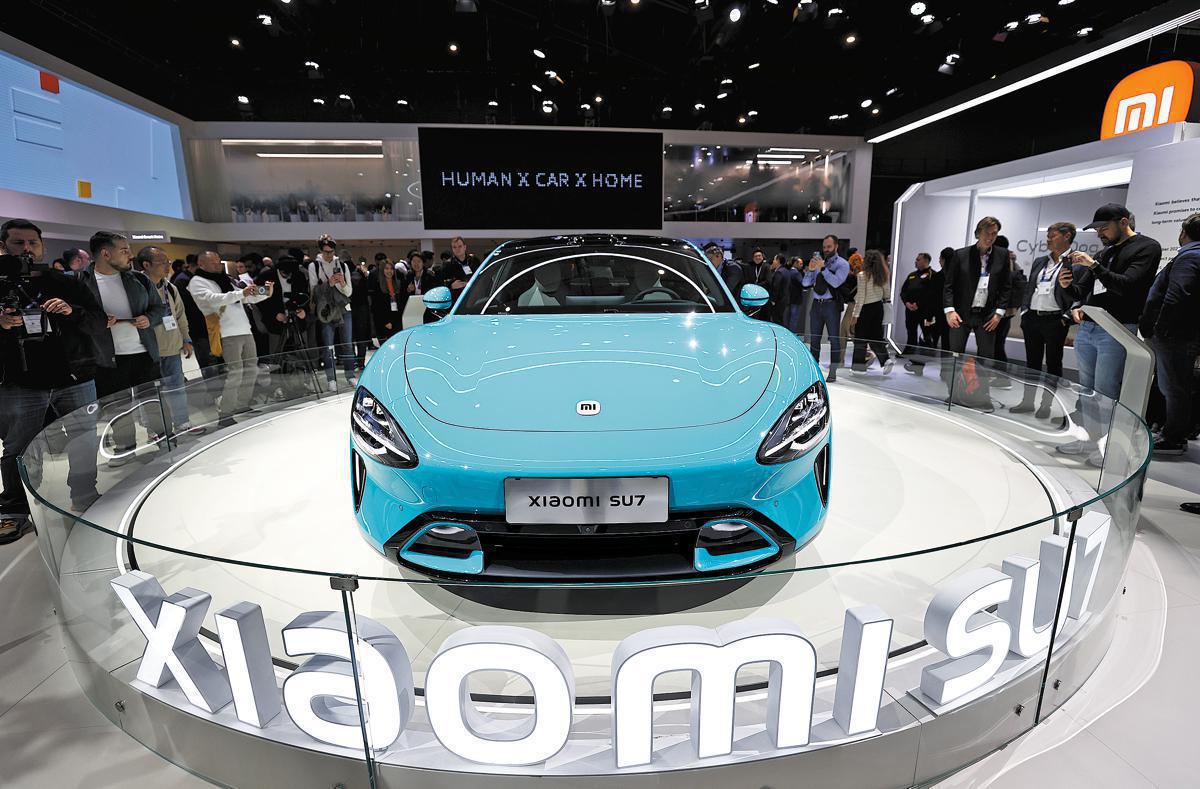
The last time Tan Siyuan, 24, a freelance business manager who also assists in his family business of industrial equipment in Shanghai, found himself lining up for hours was to lay his hands on the then latest iPhone X model.
That was several years back. After that, it's the recent launch of Xiaomi Corp's SU7 electric car that saw him lining up again, this time for over an hour.
In Tan's view, the dekko at the latest sensation in the automobile market was well worth the time spent. He already owns a Mercedes-Benz E-Class. Yet, he wasted no time in placing an order for the SU7 after a test drive, fully aware its delivery might take months.
"The SU7's trendy style and performance made me feel it's worth every penny of its price, which, by the way, is very competitive," he said. Xiaomi's first car, he said, has already become a fashion icon, just like the iPhone X model was among his friends years ago.
At a time when some countries, including the United States, blame China for so-called overcapacity in the new energy sector, what makes Chinese new energy vehicles or NEVs such as the SU7 irresistible to young, well-off consumers such as Tan is the "perfect balance of affordability, style and performance".
Zhang Xiang, an auto sector researcher at the North China University of Technology, said: "No doubt there has been significant and increasing demand for NEVs from both home and abroad. The release of production capacity in China's NEV sector is a result of innovation, and research and development of local companies.
"Many of these Chinese NEVs offer better experiences than traditional fuel vehicles, boasting higher levels of intelligence, large screens and rich software options. Many models are now cheaper than traditional fuel vehicles."
In overseas markets, many traditional carmakers such as Toyota and Volkswagen are sticking to their core technology in fuel vehicles and appear unwilling to transition quickly to the era of EVs, thus lagging in the field, Zhang said.
"However, consumers abroad do hope to drive highly intelligent and energy-efficient vehicles like Chinese car owners are already doing."
The allure of Chinese EVs has also captivated a new generation of consumers, especially female drivers who have not traditionally been considered car enthusiasts.
Marcy Lu, 28, who works in the internet sector, said she would buy a purple SU7 for its regal allure and the sun-shielding capability of its windshield. "Though they are not core functions of a car, they satisfy my need for a comfortable experience as a female driver. As I see it, other automakers don't consider such aspects to make them a reality."
Wang Xin, associate professor of China Studies and director of Asian Studies at Baylor University in the US, said in an interview to South China Morning Post that China should not be blamed for offering cost-effective new energy technologies and products to the world.
"In conflating overcapacity and the broader issues of the EV market, Washington's narrative is way off the mark. It is the US market's high prices, not Chinese overcapacity, that hinder widespread EV adoption, given that Chinese EVs are completely excluded from the US currently," Wang said in the SCMP interview.
Wang also said that last year, EVs accounted for around 8 percent of the total US vehicle sales, and while US consumers have limited choices in NEVs with prices averaging around $50,000, China's largest EV maker, BYD, offers a subcompact, the Seagull, for less than $10,000.
"In contrast, the US is lagging in realizing even its EV infrastructure ambitions. China has nothing to do with this slow rollout. Unlike the protectionist stance adopted by the US, China's approach prioritizes industrywide growth rather than narrow corporate and political interests," Xin told SCMP.
From an international trade perspective, Zhang emphasized that cars are "international products and should flow freely".
He said: "This not only helps Chinese enterprises internationalize but also enables foreign consumers to buy cheaper car products, thereby promoting the progress of the entire industry. This is beneficial to both domestic and foreign companies."
chengyu@chinadaily.com.cn



















