
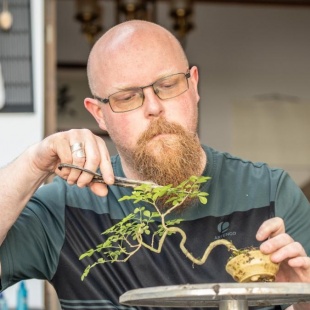



Canadian bonsai artist's enduring passion for Chinese bonsai heritage









CHENGDU -- Inside the White Bear Bonsai Garden, located in Chongzhou city in Southwest China's Sichuan province, Chad Sinclair, 46, is fully engrossed in tending to dozens of bonsai trees in the serene surroundings.
These bonsai trees, crafted from golden bamboo, moss, grasses and unique stones, are frequently adorned with custom-made ceramic figurines portraying ancient Chinese poets, monks and musicians. These figurines may be seated, reclining, gazing upward, or engaged in musical performances, creating a scene of serene harmony.
The art of bonsai is also known as "Penjing" in Chinese. As spring blossoms, Sinclair carefully moves the bonsai trees to bask in the sunlight, meticulously pruning the tangled bamboo branches.
"People in Sichuan create bamboo bonsai resembling bamboo forests, which fascinates me. Compared to trees, I prefer bamboo," Sinclair said, explaining the profound bond he sees between bonsai and bamboo.
Hailing from Vancouver in Canada, he has lived in China for over 20 years and describes himself as a "Chengdu old-timer." His fascination with Chinese bonsai traces back to his childhood visit to the 1986 World Exposition on Transportation and Communication with his grandmother who was an ardent admirer of Chinese culture.
During the fair held in Vancouver, they stopped by the Chinese Pavilion, where Sinclair was entranced by the ancient and majestic Chinese culture, including Tai Chi, porcelain and bonsai.
"My grandmother and mother saw my interest in bonsai and wanted me to learn it, but there was no one teaching Chinese bonsai in Canada, only Japanese bonsai courses. So, I had to start with Japanese bonsai," Sinclair said.
Through years of study and guidance from bonsai masters in Canada, Sinclair gradually discerned the differences between Japanese bonsai and Chinese Penjing, fostering a greater admiration for the authentic essence of Chinese bonsai. "The master told me that to truly learn the art of bonsai, I must go to China," he recalled.
"So, in my early twenties, I packed my bags, bid farewell to all my family and friends in Canada, and told them I was going to distant China." Initially, Sinclair planned to study bonsai in China for a few years, then go to Japan for another couple of years to study bonsai, and finally return to Canada.
However, upon arriving in Chengdu, his plans changed. "In Chengdu, I immediately fell in love with this city. There are parks filled with all kinds of bonsai everywhere, and the people here are very friendly. I knew I wanted to stay here," he said.
As one of the four major traditional bonsai schools in China, Sichuan bonsai, known for its twisted tree trunks and majestic rocks, has gained widespread recognition. In 2011, Sichuan bonsai techniques were included in China's national intangible cultural heritage list.
"Sichuan bonsai is the most unique bonsai style for me. Many trees have twists and turns, and many tree shapes resemble dragons. It's like our lives, full of ups and downs, like riding a roller coaster, full of fun," Sinclair said.
To delve deeper into the art of bonsai, Sinclair and his wife rented a small traditional courtyard in Chongzhou, one of the birthplaces of traditional Sichuan bonsai, and named it "White Bear Bonsai Garden."
While creating bonsai in the garden, the couple also learned fine brushwork painting, calligraphy, as well as traditional Chinese musical instruments.
After years of research, he has gradually developed his own Penjing style. His works integrate the simplicity of the West with the artistic essence of China, emphasizing the overall landscape effect, and meticulous material selection and layout.
Today, Sinclair is a well-known bonsai artist in Chengdu. So far, he has completed over 500 bonsai pieces. Every time he completes a satisfying bonsai, he and his wife take photos and videos and share them with netizens worldwide on social media platforms. When friends from various countries come to visit their courtyard, he also gifts them his beloved bonsai.
The ongoing International Horticultural Exhibition 2024 Chengdu has also offered him an excellent platform to introduce Sichuan bonsai to the world. Through endorsements, Sinclair was appointed as one of the 12 promotion ambassadors for the horticultural exhibition.
In the future, Sinclair plans to establish larger studios in Sichuan and Canada to introduce Chinese bonsai to more people and use bonsai culture as a bridge for communication between China and his hometown.




















