


The hidden histories of the 'far country'










Reflecting on self
"It feels very jarring to me when people say that I am the model minority," Huynh says, reflecting on his understanding of Asian immigrants and the show. "When my parents worked, (they) sacrificed so much to get where we are now. This play is a very honest look at the Asian community. Despite what people may say about being Asian in America, despite what the preconceived notions are, this is a community. This is a group of people that have had to struggle and fight to get to where they are now.
"We're supposed to exemplify the American Dream, but this play reminds me that the American Dream is one thing, but the American reality is a completely different thing," he says. "The history is kind of complex."
"Many of us here with immigrant parents can definitely reflect on that in the same way," says Feng Hao, who is cast as Moon Gyet, one of the main characters, who is incarcerated in the Angel Island Detention Center for 17 months.
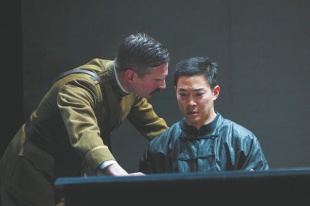
Like Gyet, many immigrants waited for an answer, an approval or a denial, as interrogations took a long time to complete, and the play includes a scene in which an immigrant is asked how many steps their house has.
"This is actually based on real interviews conducted at Angel Island," the director says. "One of the questions the immigration officials asked them was 'how many steps', because they were trying to catch them in a lie."
The questions were repeated again and again in an effort to trip the immigrants up. Not only were they asked things like the number of steps their houses had, but also the direction a particular window faced, or the name of their neighbor's dogs, questions with answers small enough to either be unknown, or else misremembered.
"The more detailed, and the more exacting the questions they asked, the better they were at tripping the person into admitting that they were lying," he says. "The officials were not expecting a real answer. It was just a way to trick people, so they could find an inconsistency."
But despite the endless waiting and questions, there was still a light for the immigrants. Decades after the closure of Angel Island, a park ranger found hundreds of poems carved into the wooden walls of the detention barracks, expressing their feelings.
"A lot of art comes from the self, the soul," says Joyce Meimei Zheng, who plays Yuen, explaining her perspective on the poetry.
"I think for a lot of artists, and I think for people in general, expressing art, expressing poetry is a natural human instinct," she says. "It just pours out of you. And when you're suffering so much, you literally have nothing else."
She says that given their backgrounds, some of the immigrants were writing poetry on the walls to express themselves, but also as a form of entertainment. "Confined in these rooms for the whole day, they had a little bit of time outside, and then they were back inside, and were just there waiting, and they had no idea when they would be, or if they were going to be, released."
"The poems are one of the few written artifacts of these people's experiences," Feng adds. "They wanted to mark that they were there. They were messages to the future."