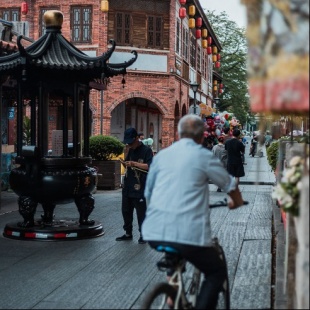



Local inhabitants key to preserving heritage










Experts emphasized the importance of local inhabitants in preserving the living heritage of historical neighborhoods and cultural cities, and putting protection ahead of tourism development.
"While we can restore old houses, it is challenging to encourage residents to return once they have moved elsewhere," Zhao Yanjing, a professor of architecture from Xiamen University, said at a forum focusing on protection of cultural heritage and safeguarding living heritage on Friday in Shenzhen, Guangdong province. It is a sub-forum of the Forum on Building up China's Cultural Strength 2024.
According to the Ministry of Housing and Urban-Rural Development, there were 142 State-listed historical and cultural cities as of last year.
Zhao said that some historical neighborhoods in China lack a human touch.
Local residents are often relocated elsewhere, leaving behind empty houses and shops that cater solely to tourists, a phenomenon happening in many places, he said.
"The reason we protect cultural heritage is that we protect the memories of history. And people living in them are key to secure these memories. The memories have been passed down, forming the continuity of Chinese civilization," Zhao said.
Zhao's words were inspired by a story shared by He Xiaojun, Party secretary of Chaozhou in Guangdong province, a cultural city with a history of about 1,600 years.
He mentioned that in Chaozhou, there are approximately 2,000 traditional residences dating back to the Ming (1368-1644) and Qing (1644-1911) dynasties. Many of these old houses are still inhabited by the original families who have lived there for generations. One such family, whose forefather was a high-ranking officer, has been residing in their house for 400 years.
Since 1993, new constructions have not been permitted in the ancient city of Chaozhou, and existing buildings are not allowed to be dismantled. Residents repair and protect their own houses, preserving many traditional customs.
"These families have strong connections to their houses. They take good care of them, and traditional customs are passed down through the generations," said He, adding that wedding and dining traditions are still maintained in the same way as their forefathers did.
Zhao explained that the protection of historical cities and neighborhoods is like undergoing cosmetic procedures: the goal is to delay aging, not to seek immortality. For places like cultural relics and archaeological sites, protection is the top priority. But how to balance tourism and the protection of cultural heritage is still a challenge.
Fan Jinshi, honorary director of the Dunhuang Academy and an archaeologist who has spent her life protecting the Mogao Caves, stressed at the forum that protection should come ahead of tourism.
"When it comes to culture, everyone invariably thinks of tourism. However, culture and cultural relics are the core content of tourism. Only by first ensuring the protection of culture can tourism be possible," she said.
Fan has stayed in Dunhuang for 61 years to engage in protection and research work. She said it took several generations of people like her to protect the caves, and thus tourists can appreciate the glamour and charm of these precious artworks now.
"The foremost task is to ensure their proper protection, then the research work and finally the tourists can see them and learn about the stories behind them," added Fan.